Primary Care Centre Versus Arthritis, School of Medicine, Keele University, Keele, UK.
Keele Clinical Trials Unit, Keele University, Keele, UK.
BMJ. 2022 Apr 6;377:e068446. doi: 10.1136/bmj-2021-068446.
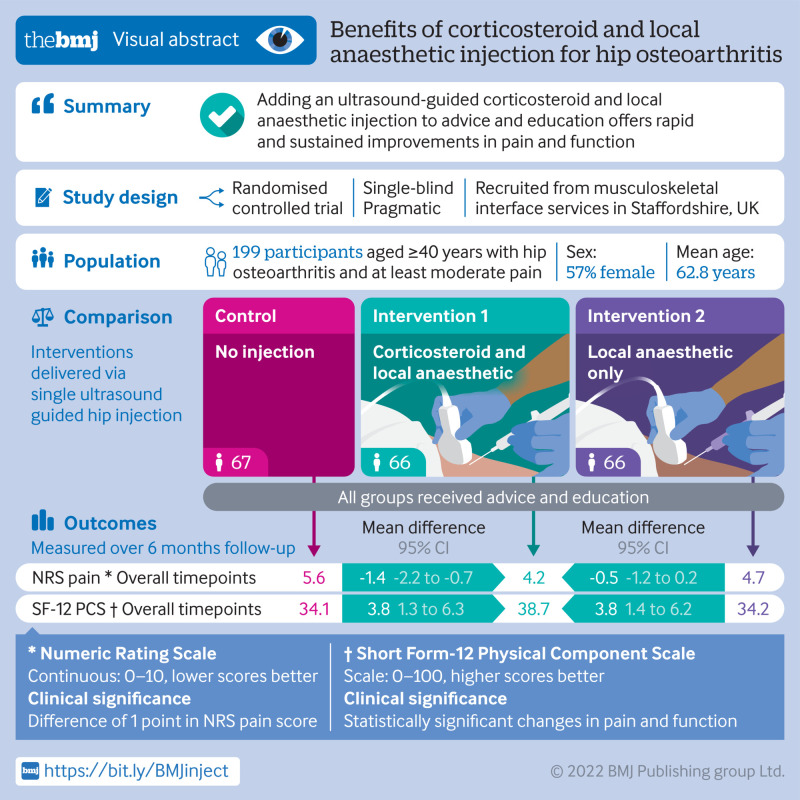
To compare the clinical effectiveness of adding a single ultrasound guided intra-articular hip injection of corticosteroid and local anaesthetic to advice and education in adults with hip osteoarthritis.
Pragmatic, three arm, parallel group, single blind, randomised controlled trial.
Two community musculoskeletal services in England.
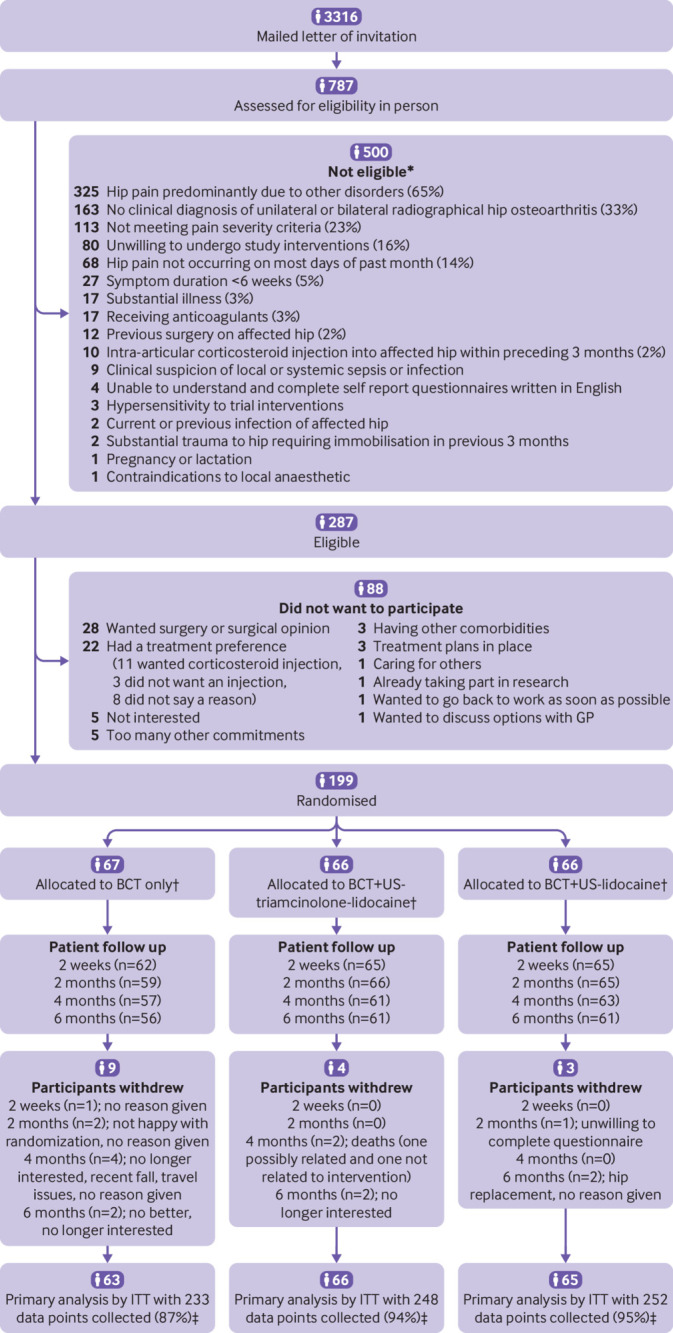
199 adults aged ≥40 years with hip osteoarthritis and at least moderate pain: 67 were randomly assigned to receive advice and education (best current treatment (BCT)), 66 to BCT plus ultrasound guided injection of triamcinolone and lidocaine, and 66 to BCT plus ultrasound guided injection of lidocaine.
BCT alone, BCT plus ultrasound guided intra-articular hip injection of 40 mg triamcinolone acetonide and 4 mL 1% lidocaine hydrochloride, or BCT plus ultrasound guided intra-articular hip injection of 5 mL 1% lidocaine. Participants in the ultrasound guided arms were masked to the injection they received.
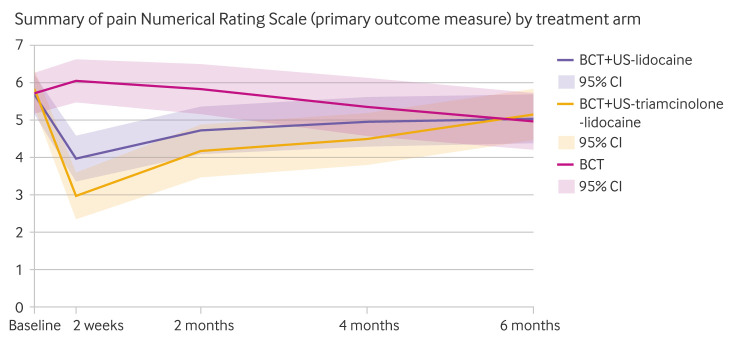
The primary outcome was self-reported current intensity of hip pain (0-10 Numerical Rating Scale) over six months. Outcomes were self-reported at two weeks and at two, four, and six months.
Mean age of the study sample was 62.8 years (standard deviation 10.0) and 113 (57%) were women. Average weighted follow-up rate across time points was 93%. Greater mean improvement in hip pain intensity over six months was reported with BCT plus ultrasound-triamcinolone-lidocaine compared with BCT: mean difference -1.43 (95% confidence interval -2.15 to -0.72), P<0.001; standardised mean difference -0.55 (-0.82 to -0.27). No difference in hip pain intensity over six months was reported between BCT plus ultrasound-triamcinolone-lidocaine compared with BCT plus ultrasound-lidocaine (-0.52 (-1.21 to 0.18)). The presence of ultrasound confirmed synovitis or effusion was associated with a significant interaction effect favouring BCT plus ultrasound-triamcinolone-lidocaine (-1.70 (-3.10 to -0.30)). One participant in the BCT plus ultrasound-triamcinolone-lidocaine group with a bioprosthetic aortic valve died from subacute bacterial endocarditis four months after the intervention, deemed possibly related to the trial treatment.
Ultrasound guided intra-articular hip injection of triamcinolone is a treatment option to add to BCT for people with hip osteoarthritis.
EudraCT 2014-003412-37; ISRCTN50550256.
比较在髋关节骨关节炎成人中,在建议和教育基础上添加单次关节内超声引导的皮质类固醇和局部麻醉剂与单纯建议和教育的临床效果。
务实的、三臂、平行组、单盲、随机对照试验。
英格兰的两个社区肌肉骨骼服务机构。
199 名年龄≥40 岁的髋关节骨关节炎且疼痛至少为中度的成年人:67 名被随机分配接受建议和教育(最佳当前治疗(BCT)),66 名接受 BCT 加超声引导的曲安奈德和利多卡因关节内注射,66 名接受 BCT 加超声引导的利多卡因关节内注射。
BCT 单独、BCT 加超声引导的髋关节腔内注射 40mg 曲安奈德和 4ml1%盐酸利多卡因,或 BCT 加超声引导的髋关节腔内注射 5ml1%盐酸利多卡因。接受超声引导的手臂的参与者对他们接受的注射情况不知情。
主要结局是六个月内自我报告的髋关节疼痛当前强度(0-10 数字评分量表)。在两周和两个月、四个月和六个月时进行自我报告。
研究样本的平均年龄为 62.8 岁(标准差 10.0),113 名(57%)为女性。各时间点的平均加权随访率为 93%。与 BCT 相比,BCT 加超声-曲安奈德-利多卡因在六个月内髋关节疼痛强度的平均改善更大:平均差异-1.43(95%置信区间-2.15 至-0.72),P<0.001;标准化平均差异-0.55(-0.82 至-0.27)。与 BCT 加超声-曲安奈德-利多卡因相比,BCT 加超声-曲安奈德-利多卡因在六个月内髋关节疼痛强度无差异(-0.52(-1.21 至 0.18))。存在超声证实的滑膜炎或渗出与 BCT 加超声-曲安奈德-利多卡因显著交互作用有关(有利-1.70(-3.10 至-0.30))。在 BCT 加超声-曲安奈德-利多卡因组的一名接受生物假体主动脉瓣的参与者在干预后四个月死于亚急性细菌性心内膜炎,据认为可能与试验治疗有关。
髋关节骨关节炎患者,在建议和教育基础上添加关节内超声引导的曲安奈德注射是一种治疗选择。
EudraCT 2014-003412-37;ISRCTN50550256。