CNRS, Univ. Bordeaux, Bordeaux INP, Talence, France.
ITACA, Universitat Politècnica de València, Valencia, Spain.
Hum Brain Mapp. 2022 Jul;43(10):3270-3282. doi: 10.1002/hbm.25850. Epub 2022 Apr 7.
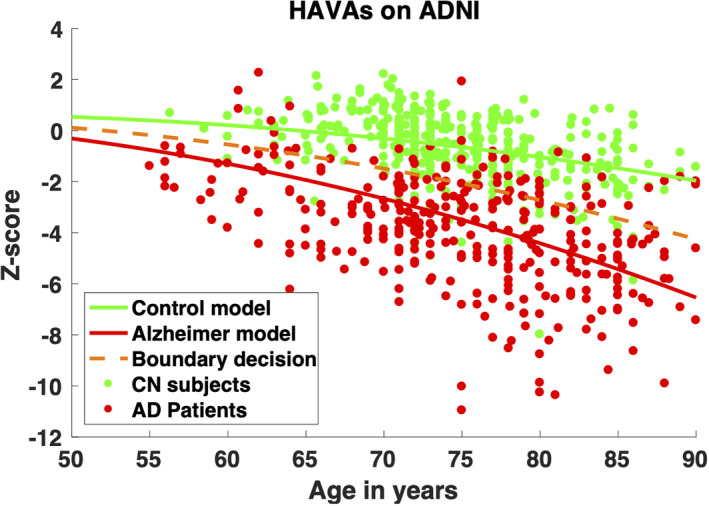
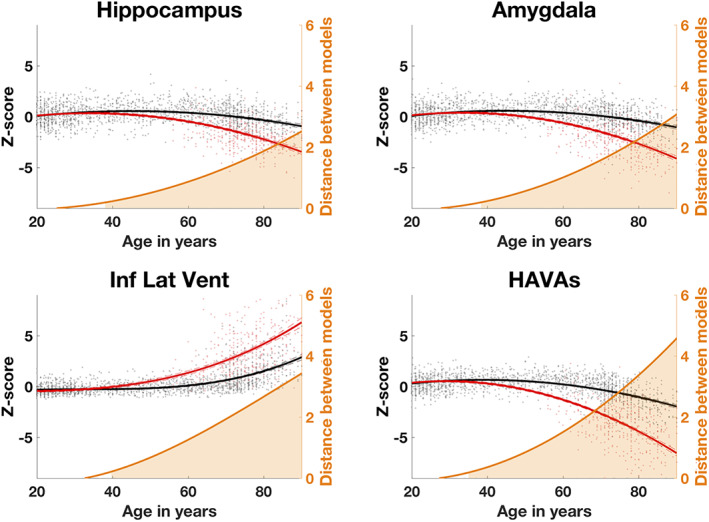
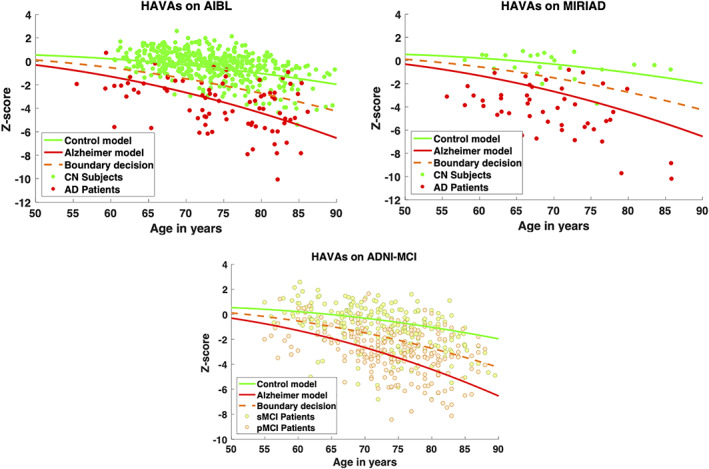
In this article, we present an innovative MRI-based method for Alzheimer disease (AD) detection and mild cognitive impairment (MCI) prognostic, using lifespan trajectories of brain structures. After a full screening of the most discriminant structures between AD and normal aging based on MRI volumetric analysis of 3,032 subjects, we propose a novel Hippocampal-Amygdalo-Ventricular Atrophy score (HAVAs) based on normative lifespan models and AD lifespan models. During a validation on three external datasets on 1,039 subjects, our approach showed very accurate detection (AUC ≥ 94%) of patients with AD compared to control subjects and accurate discrimination (AUC = 78%) between progressive MCI and stable MCI (during a 3-year follow-up). Compared to normative modeling, classical machine learning methods and recent state-of-the-art deep learning methods, our method demonstrated better classification performance. Moreover, HAVAs simplicity makes it fully understandable and thus well-suited for clinical practice or future pharmaceutical trials.
在本文中,我们提出了一种基于 MRI 的阿尔茨海默病(AD)检测和轻度认知障碍(MCI)预后的新方法,该方法使用脑结构的寿命轨迹。在对基于 3032 名受试者的 MRI 容积分析的 AD 和正常衰老之间最具判别力的结构进行全面筛选后,我们提出了一种基于规范寿命模型和 AD 寿命模型的新型海马-杏仁核-脑室萎缩评分(HAVAs)。在对 1039 名受试者的三个外部数据集进行验证期间,与对照受试者相比,我们的方法对 AD 患者的检测非常准确(AUC≥94%),并且对进行 3 年随访期间进展性 MCI 和稳定 MCI 之间的区分也非常准确(AUC=78%)。与规范建模、经典机器学习方法和最近的最先进的深度学习方法相比,我们的方法表现出更好的分类性能。此外,HAVAs 的简单性使其完全易于理解,因此非常适合临床实践或未来的药物试验。