Kaur Navpreet, Bhanot Kunal, Ferreira Germaine
Physical Therapy, University of St. Augustine for Health Sciences, Austin, TX.
Physical Therapy, Carlow University, Pittsburgh, PA.
Int J Sports Phys Ther. 2022 Apr 2;17(3):483-492. doi: 10.26603/001c.32593. eCollection 2022.
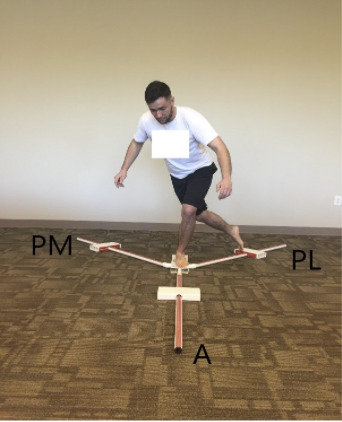
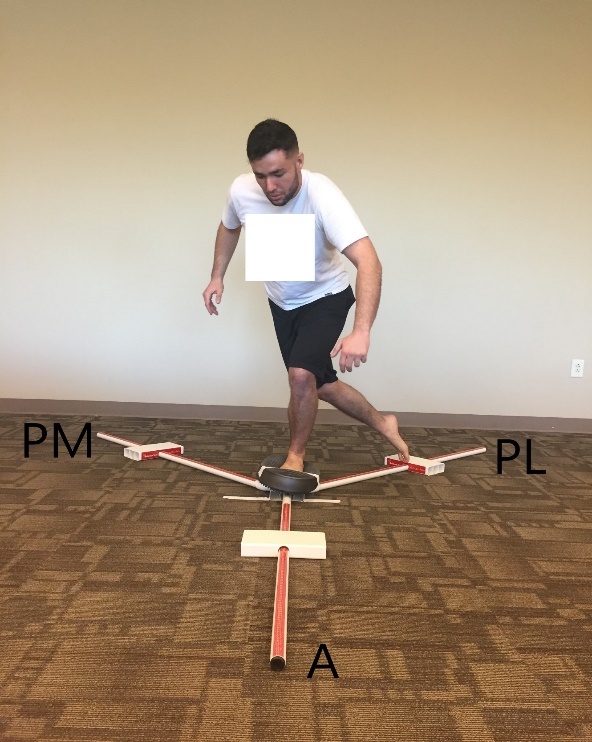
The Star Excursion Balance Test (SEBT) has been used as a rehabilitation exercise. To improve its efficacy, efficiency, and method variations, the Y-Balance Test (YBT) with anterior (A), posterolateral (PL), and posteromedial (PM) directions of the SEBT has been recommended. Electromyographic activity has been reported to change when the same task is performed on various surfaces.
HYPOTHESIS/PURPOSE: To compare the EMG activity of trunk and LE muscles during the performance of the YBT on stable and unstable surfaces.
Cross-Sectional study.
Healthy adults with no history of chronic ankle instability were recruited for the study. Surface electromyography was collected for bilateral (ipsilateral [i] and contralateral [c]) rectus abdominis (RA), external oblique (EOB), erector spinae (ES). While, gluteus maximus (GMAX), gluteus medius (GMED), medial hamstrings (MH), biceps femoris (BF), vastus medialis (VM), rectus femoris (RF), vastus lateralis (VL), anterior tibialis (AT), and medial gastrocnemius (MG) on the stance leg (ipsilateral side), during the performance of the YBT. The unstable surface was introduced using a Thera-Band stability trainer. Differences in electromyography were examined for each reach direction and muscle between the stable and unstable surfaces (p≤ 0.05).
Twenty (10 male, 10 female) subjects participated (age: 27.5 ± 4.0 years, height:167 ± 1.0 cm, weight: 66.5 ± 13.0 kg, body fat: 14.1 ± 6.2%). Significantly higher muscle activity for the unstable surface (p<0.05) with moderate to large effect sizes were observed for the following muscles in the A direction: GMED, GMAX, VM, RF, and MG; PL direction: iEOB, iES, cES, GMED, BF, VM, RF, and MG; and PM direction iEOB, iES, GMED, BF, VM, and RF. Significantly higher muscle activity for the stable surface (p = 0.007) was observed in MH muscle in the A direction. No significant differences (p>0.05) between the stable and unstable surfaces were observed in iRA, cRA, cEOB, VL, and AT for any of the directions of the YBT.
An increase in muscle activity was observed during YBT on unstable versus stable surfaces for some muscles.
2B.
星标偏移平衡测试(SEBT)已被用作一种康复训练。为提高其效果、效率及方法的多样性,有人推荐采用包含SEBT前向(A)、后外侧(PL)和后内侧(PM)方向的Y平衡测试(YBT)。据报道,在不同表面执行相同任务时,肌电图活动会发生变化。
假设/目的:比较在稳定和不稳定表面进行YBT时躯干和下肢肌肉的肌电图活动。
横断面研究。
招募无慢性踝关节不稳病史的健康成年人参与本研究。在进行YBT时,采集双侧(同侧[i]和对侧[c])腹直肌(RA)、腹外斜肌(EOB)、竖脊肌(ES),以及站立侧下肢(同侧)的臀大肌(GMAX)、臀中肌(GMED)、半腱肌(MH)、股二头肌(BF)股内侧肌(VM)、股直肌(RF)、股外侧肌(VL)、胫骨前肌(AT)和腓肠肌内侧头(MG)的表面肌电图。使用弹力带稳定训练器模拟不稳定表面。比较稳定和不稳定表面上每个伸展方向和肌肉的肌电图差异(p≤0.05)。
20名受试者(10名男性,10名女性)参与研究(年龄:27.5±4.0岁,身高:±1.0cm,体重:66.5±13.0kg,体脂:14.1±)。在A方向上,以下肌肉在不稳定表面的肌肉活动显著更高(p<0.05),效应量为中到大:GMED、GMAX、VM、RF和MG;PL方向:同侧EOB、同侧ES、对侧ES、GMED、BF、VM、RF和MG;PM方向:同侧EOB、同侧ES、GMEDBF、VM和RF。在A方向的MH肌肉中,观察到稳定表面的肌肉活动显著更高(p=0.007)。在YBT的任何方向上,同侧RA、对侧RA对侧EOB、VL和AT在稳定和不稳定表面之间均未观察到显著差异(p>0.05)。
在不稳定表面进行YBT时,部分肌肉的肌肉活动相较于稳定表面有所增加。
2B。