Poschmann Gereon, Bahr Jasmin, Schrader Jürgen, Stejerean-Todoran Ioana, Bogeski Ivan, Stühler Kai
Institute for Molecular Medicine, Proteome Research, University Hospital and Medical Faculty, Heinrich-Heine-University Düsseldorf, Düsseldorf, Germany.
Department of Molecular Cardiology, University Hospital and Medical Faculty, Heinrich-Heine-University Düsseldorf, Düsseldorf, Germany.
Front Cell Dev Biol. 2022 Mar 22;10:878027. doi: 10.3389/fcell.2022.878027. eCollection 2022.
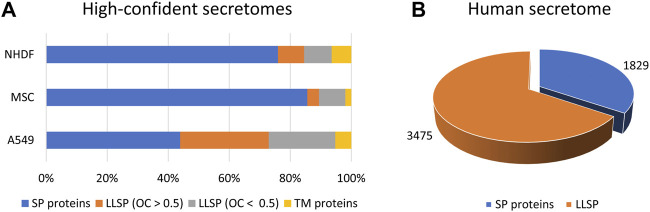
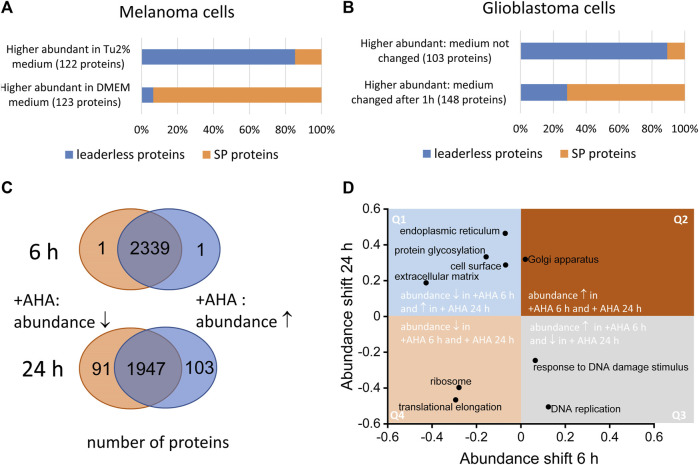
For a long time, leaderless secreted proteins (LLSP) were neglected as artifacts derived from dying cells. It is now generally accepted that secretion of LLSP-as a part of the collective term unconventional protein secretion (UPS) - is an evolutionarily conserved process and that these LLSP are actively and selectively secreted from living cells bypassing the classical endoplasmic reticulum-Golgi pathway. However, the mechanism of UPS pathways, as well as the number of LLSP and which part of a protein is involved in the selection of LLSPs for secretion, are still enigmatic and await clarification. Secretomics-a proteomics-based approach to identify and quantify all proteins secreted by a cell-is inherently unbiased toward a particular secretion pathway and offers the opportunity to shed light on the UPS. Here, we will evaluate and present recent results of proteomic workflows allowing to obtain high-confident secretome data. Additionally, we address that cell culture conditions largely affect the composition of the secretome. This has to be kept in mind to control cell culture induced artifacts and adaptation stress in serum free conditions. Evaluation of click chemistry for secretome analysis of cells under serum-containing conditions showed a significant change in the cellular proteome with longer incubation time upon treatment with non-canonical amino acid azidohomoalanine. Finally, we showed that the number of LLSP far exceeds the number of secreted proteins annotated in Uniprot and ProteinAtlas. Thus, secretomics in combination with sophisticated microbioanalytical and sample preparation methods is well suited to provide a comprehensive picture of UPS.
长期以来,无 leader 分泌蛋白(LLSP)一直被视为源自死亡细胞的假象而被忽视。现在人们普遍认为,LLSP 的分泌——作为非传统蛋白质分泌(UPS)这一统称的一部分——是一个进化上保守的过程,并且这些 LLSP 是从活细胞中主动且选择性地分泌出来的,绕过了经典的内质网 - 高尔基体途径。然而,UPS 途径的机制,以及 LLSP 的数量和蛋白质的哪一部分参与 LLSP 分泌的选择,仍然是个谜,有待阐明。分泌蛋白质组学——一种基于蛋白质组学的方法,用于识别和量化细胞分泌的所有蛋白质——本质上对特定的分泌途径没有偏见,并为揭示 UPS 提供了机会。在这里,我们将评估并展示蛋白质组学工作流程的最新结果,这些结果能够获得高度可靠的分泌蛋白质组数据。此外,我们指出细胞培养条件在很大程度上会影响分泌蛋白质组的组成。在无血清条件下控制细胞培养诱导的假象和适应性应激时,必须牢记这一点。对点击化学用于含血清条件下细胞分泌蛋白质组分析的评估表明,在用非经典氨基酸叠氮高丙氨酸处理后,随着孵育时间延长,细胞蛋白质组发生了显著变化。最后,我们表明 LLSP 的数量远远超过了 Uniprot 和 ProteinAtlas 中注释的分泌蛋白数量。因此,分泌蛋白质组学与复杂的微生物分析和样品制备方法相结合,非常适合全面描绘 UPS 的情况。