Department of Nutritional Medicine/Prevention, University of Hohenheim, Fruwirthstrasse 12, 70599, Stuttgart, Germany.
Department of Medical and Surgical Science (DIMEC), University of Bologna, Via Massarenti 9, 40138, Bologna, Italy.
Dig Dis Sci. 2022 Sep;67(9):4422-4433. doi: 10.1007/s10620-022-07462-3. Epub 2022 Apr 8.
Cereals are known to trigger for wheat allergy, celiac disease and non-celiac wheat sensitivity (NCWS). Inflammatory processes and intestinal barrier impairment are suspected to be involved in NCWS, although the molecular triggers are unclear.
We were interested if different bread types influence inflammatory processes and intestinal barrier function in a mouse model of inflammatory bowel disease.
Epithelial caspase-8 gene knockout (Casp8) and control (Casp8) mice were randomized to eight groups, respectively. The groups received different diets for 28 days (gluten-free diet, gluten-rich diet 5 g%, or different types of bread at 50 g%). Breads varied regarding grain, milling and fermentation. All diets were isocaloric.
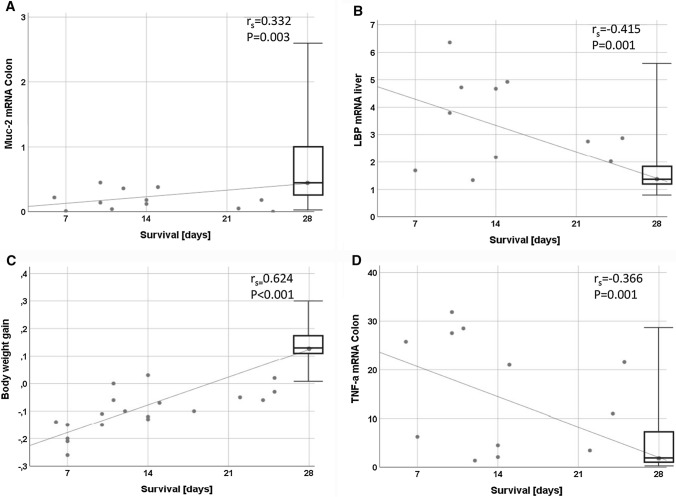
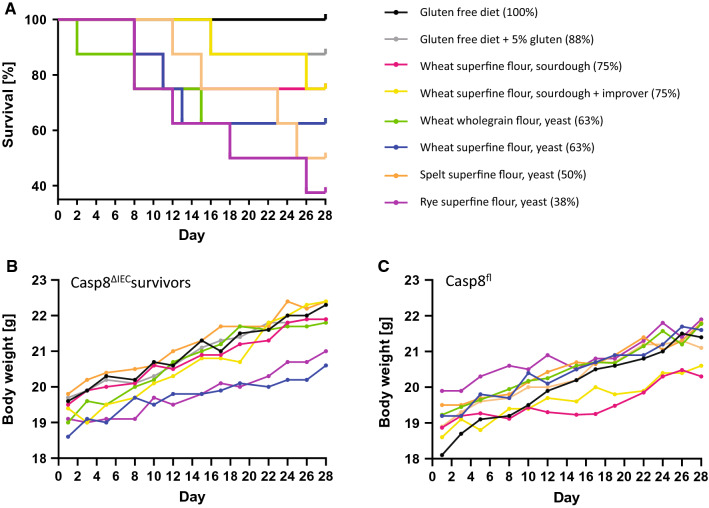
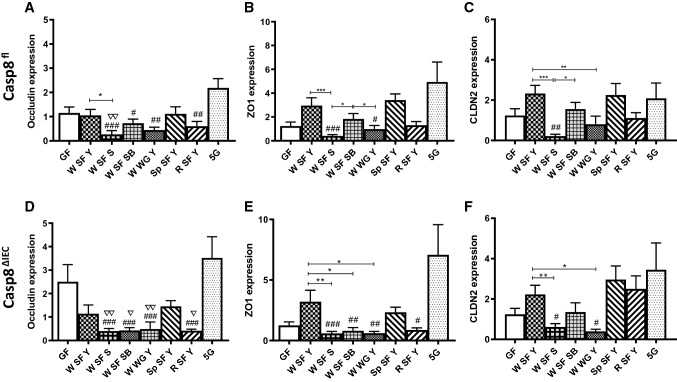
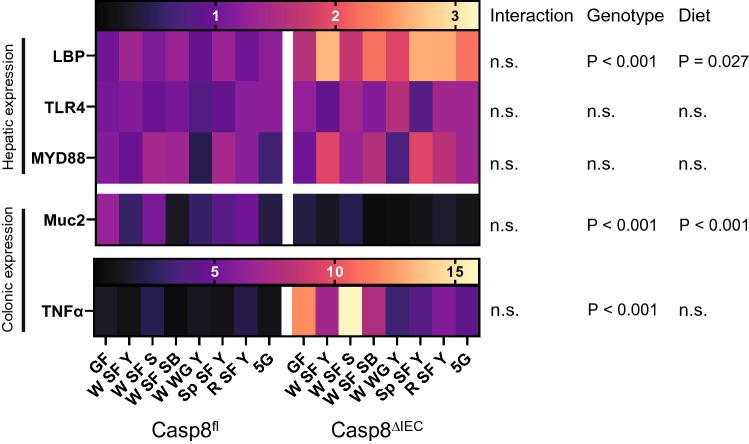
Regardless of the diet, Casp8 mice showed pronounced inflammation in colon compared to ileum, whereas Casp8 mice were hardly inflamed. Casp8 mice could tolerate all bread types. Especially yeast fermented rye and wheat bread from superfine flour but not pure gluten challenge increased colitis and mortality in Casp8 mice. Hepatic expression of lipopolysaccharide-binding protein and colonic expression of tumor necrosis factor-α genes were inversely related to survival. The bread diets, but not the gluten-rich diet, also decreased colonic tight junction expression to variable degrees, without clear association to survival and inflammation.
Bread components, especially those from yeast-fermented breads from wheat and rye, increase colitis and mortality in Casp8 mice highly susceptible to intestinal inflammation, whereas control mice can tolerate all types of bread without inflammation. Yet unidentified bread components other than gluten seem to play the major role.
谷物已知可引发小麦过敏、乳糜泻和非乳糜泻小麦敏感(NCWS)。炎症过程和肠屏障损伤被怀疑与 NCWS 有关,尽管分子触发因素尚不清楚。
我们感兴趣的是不同类型的面包是否会影响炎症性肠病小鼠模型中的炎症过程和肠屏障功能。
上皮半胱氨酸蛋白酶 8 基因敲除(Casp8)和对照(Casp8)小鼠分别随机分为 8 组。这些组分别接受不同的饮食 28 天(无麸质饮食、5%麸质丰富饮食或不同类型的面包 50g)。面包在谷物、碾磨和发酵方面存在差异。所有饮食都是等热量的。
无论饮食如何,Casp8 小鼠的结肠炎症明显比回肠严重,而 Casp8 小鼠几乎没有炎症。Casp8 小鼠可以耐受所有类型的面包。特别是酵母发酵的黑麦和小麦面包来自超精细面粉,但不是纯面筋,这增加了 Casp8 小鼠的结肠炎和死亡率。肝脂多糖结合蛋白的表达和结肠肿瘤坏死因子-α基因的表达呈负相关与存活率。面包饮食,而不是富含麸质的饮食,也不同程度地降低了结肠紧密连接的表达,但与存活率和炎症没有明显关联。
面包成分,特别是来自酵母发酵的小麦和黑麦面包,会增加 Casp8 小鼠的结肠炎和死亡率,这些小鼠对肠道炎症高度敏感,而对照小鼠可以耐受所有类型的面包而不会引起炎症。然而,除了面筋之外,其他尚未确定的面包成分似乎起着主要作用。