Nagy Anna, Csonka Nikolett, Takács Mária, Mezei Eszter, Barabás Éva
National Reference Laboratory for Viral Zoonoses, Division of Microbiological Reference Laboratories, National Public Health Center, Budapest, Hungary.
Institute of Medical Microbiology, Semmelweis University, Budapest, Hungary.
PLoS One. 2022 Apr 8;17(4):e0266840. doi: 10.1371/journal.pone.0266840. eCollection 2022.
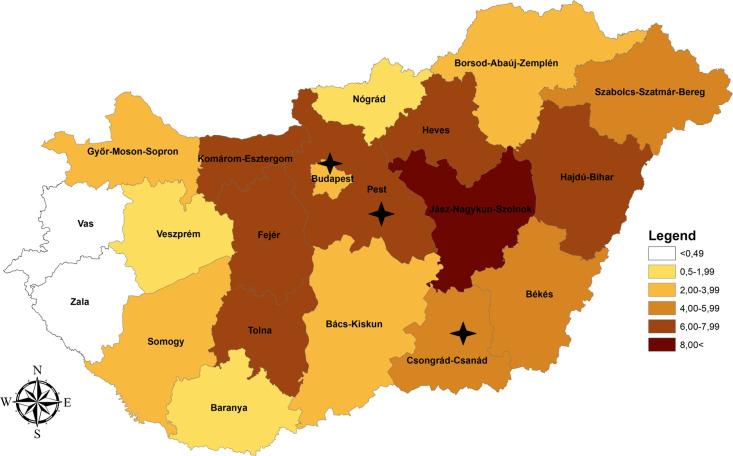
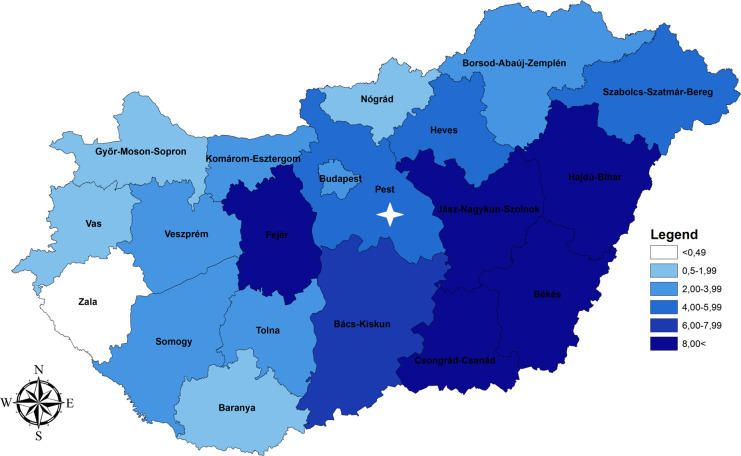
In Hungary, West Nile virus (WNV) has been responsible for 459 laboratory confirmed human cases between 2004 and 2019, while the first human Usutu virus (USUV) infection was confirmed only in 2018. A comprehensive serosurvey was conducted among blood donors to assess the WNV and USUV seroprevalence in 2019, one year after the largest European WNV epidemic. Altogether, 3005 plasma samples were collected and screened for WNV and USUV specific Immunoglobulin G (IgG) antibodies by Enzyme-Linked Immunosorbent Assay (ELISA). All reactive samples were further tested for tick-borne encephalitis virus IgG antibodies by ELISA. Indirect immunofluorescence test and microneutralization assay were used as confirmatory methods. Overall, the WNV seroprevalence was 4.32%, and in five blood donors USUV seropositivity was confirmed. The highest seroprevalence was measured in Central, Eastern and Southern Hungary, while the Western part of the country proved to be less affected. There was a statistically strong association between the WNV seroprevalence of 2019 and the cumulative incidence in the period of 2004 and 2019 calculated for every NUTS 3 region. The last WNV serological screening was performed in 2016 and the prevalence of anti-WNV IgG proved to be 2.19%. One year after the 2018 WNV outbreak, a significant increase in seroprevalence was observed in the Hungarian population and evidence for USUV seropositivity was also obtained. The spatial pattern of seroprevalence can support the identification of high-risk areas raising awareness of the need for increased surveillance, such as screening vector, equine, and avian populations. The communication with general practitioners and other professionals in primary health care services can support the early identification of acute human cases. Education and awareness-raising on the importance of protection against mosquito vectors amongst residents are also important parts of preventive measures.
在匈牙利,2004年至2019年间西尼罗河病毒(WNV)导致了459例实验室确诊的人类病例,而首例人类乌苏图病毒(USUV)感染直到2018年才得到确认。在欧洲最大规模的西尼罗河病毒疫情爆发一年后的2019年,对献血者进行了一项全面的血清学调查,以评估西尼罗河病毒和乌苏图病毒的血清阳性率。总共采集了3005份血浆样本,并通过酶联免疫吸附测定(ELISA)筛选西尼罗河病毒和乌苏图病毒特异性免疫球蛋白G(IgG)抗体。所有反应性样本均通过ELISA进一步检测蜱传脑炎病毒IgG抗体。间接免疫荧光试验和微量中和试验用作确证方法。总体而言,西尼罗河病毒血清阳性率为4.32%,并确认了5名献血者乌苏图病毒血清阳性。匈牙利中部、东部和南部的血清阳性率最高,而该国西部受影响较小。2019年的西尼罗河病毒血清阳性率与为每个NUTS 3地区计算的2004年至2019年期间的累计发病率之间存在统计学上的强关联。上一次西尼罗河病毒血清学筛查于2016年进行,抗西尼罗河病毒IgG的患病率为2.19%。在2018年西尼罗河病毒疫情爆发一年后,匈牙利人群的血清阳性率显著上升,同时也获得了乌苏图病毒血清阳性的证据。血清阳性率的空间模式有助于识别高风险地区,提高对加强监测必要性的认识,如筛查病媒、马匹和鸟类种群。与全科医生和初级卫生保健服务中的其他专业人员沟通有助于早期识别急性人类病例。对居民进行关于防蚊媒重要性的教育和提高认识也是预防措施的重要组成部分。