Perry Julie, Osman Selma, Wright James, Richard-Greenblatt Melissa, Buchan Sarah A, Sadarangani Manish, Bolotin Shelly
Public Health Ontario, Toronto, Ontario, Canada.
Faculty of Dentistry, University of Toronto, Toronto, Ontario, Canada.
PLoS One. 2022 Apr 8;17(4):e0266852. doi: 10.1371/journal.pone.0266852. eCollection 2022.
A correlate of protection (CoP) is an immunological marker associated with protection against infection. Despite an urgent need, a CoP for SARS-CoV-2 is currently undefined.
Our objective was to review the evidence for a humoral correlate of protection for SARS-CoV-2, including variants of concern.
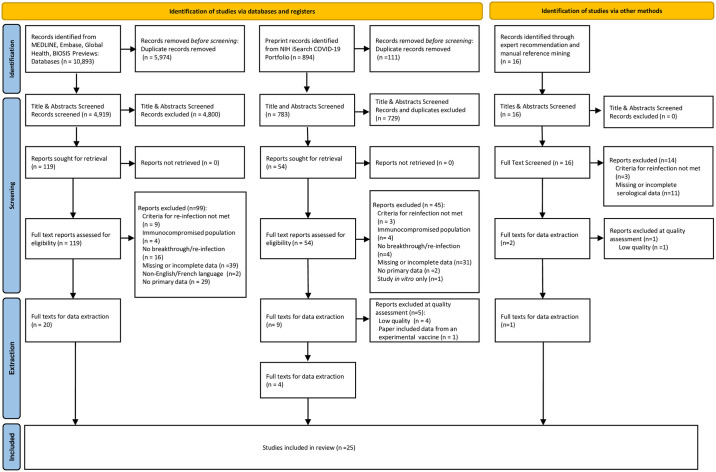
We searched OVID MEDLINE, EMBASE, Global Health, Biosis Previews and Scopus to January 4, 2022 and pre-prints (using NIH iSearch COVID-19 portfolio) to December 31, 2021, for studies describing SARS-CoV-2 re-infection or breakthrough infection with associated antibody measures. Two reviewers independently extracted study data and performed quality assessment.
Twenty-five studies were included in our systematic review. Two studies examined the correlation of antibody levels to VE, and reported values from 48.5% to 94.2%. Similarly, several studies found an inverse relationship between antibody levels and infection incidence, risk, or viral load, suggesting that both humoral immunity and other immune components contribute to protection. However, individual level data suggest infection can still occur in the presence of high levels of antibodies. Two studies estimated a quantitative CoP: for Ancestral SARS-CoV-2, these included 154 (95% confidence interval (CI) 42, 559) anti-S binding antibody units/mL (BAU/mL), and 28.6% (95% CI 19.2, 29.2%) of the mean convalescent antibody level following infection. One study reported a CoP for the Alpha (B.1.1.7) variant of concern of 171 (95% CI 57, 519) BAU/mL. No studies have yet reported an Omicron-specific CoP.
Our review suggests that a SARS-CoV-2 CoP is likely relative, where higher antibody levels decrease the risk of infection, but do not eliminate it completely. More work is urgently needed in this area to establish a SARS-CoV-2 CoP and guide policy as the pandemic continues.
保护关联指标(CoP)是一种与预防感染相关的免疫标志物。尽管迫切需要,但目前SARS-CoV-2的保护关联指标尚未明确。
我们的目的是综述SARS-CoV-2(包括关注的变异株)体液保护关联指标的证据。
我们检索了截至2022年1月4日的OVID MEDLINE、EMBASE、Global Health、Biosis Previews和Scopus数据库,以及截至2021年12月31日的预印本(使用美国国立卫生研究院iSearch COVID-19组合),以查找描述SARS-CoV-2再感染或突破性感染及相关抗体检测的研究。两名评审员独立提取研究数据并进行质量评估。
我们的系统评价纳入了25项研究。两项研究检测了抗体水平与疫苗效力(VE)的相关性,报告的值在48.5%至94.2%之间。同样,多项研究发现抗体水平与感染发生率、风险或病毒载量之间存在负相关,这表明体液免疫和其他免疫成分都有助于预防感染。然而,个体水平的数据表明,即使存在高水平抗体,感染仍可能发生。两项研究估计了定量的保护关联指标:对于原始SARS-CoV-2,这些指标包括154(95%置信区间(CI)42,559)抗S结合抗体单位/毫升(BAU/mL),以及感染后恢复期平均抗体水平的28.6%(95%CI 19.2,29.2%)。一项研究报告了关注的Alpha(B.1.1.7)变异株的保护关联指标为171(95%CI 57,519)BAU/mL。尚无研究报告奥密克戎特异性的保护关联指标。
我们的综述表明,SARS-CoV-2的保护关联指标可能是相对的,即较高的抗体水平可降低感染风险,但不能完全消除感染风险。随着疫情的持续,该领域迫切需要开展更多工作来确定SARS-CoV-2的保护关联指标并指导政策制定。