Ziefuß Anna R, Hupfeld Tim, Meckelmann Sven W, Meyer Martin, Schmitz Oliver J, Kaziur-Cegla Wiebke, Tintrop Lucie K, Schmidt Torsten C, Gökce Bilal, Barcikowski Stephan
Technical Chemistry I and Center for Nanointegration Duisburg-Essen (CENIDE), University of Duisburg-Essen, Universitaetsstrasse 7, 45141, Essen, Germany.
Applied Analytical Chemistry, University of Duisburg-Essen, Universitaetsstrasse 5, 45141, Essen, Germany.
NPJ Sci Food. 2022 Apr 8;6(1):19. doi: 10.1038/s41538-022-00134-6.
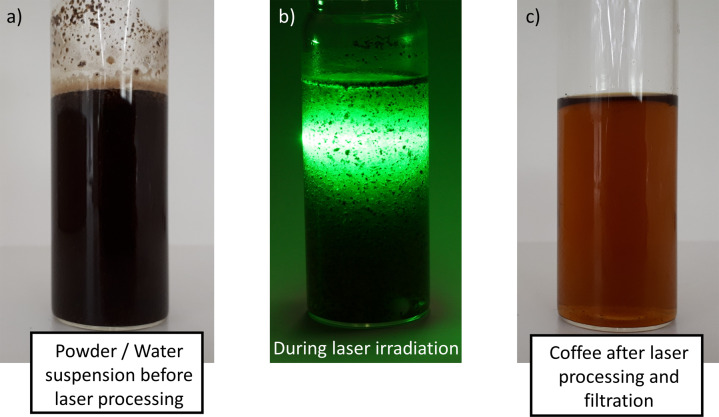
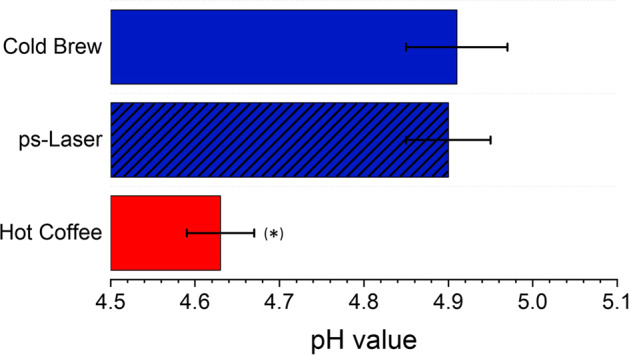
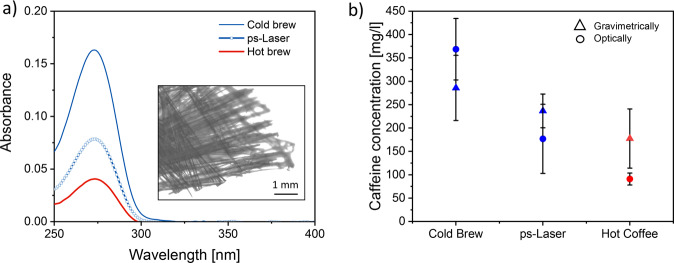
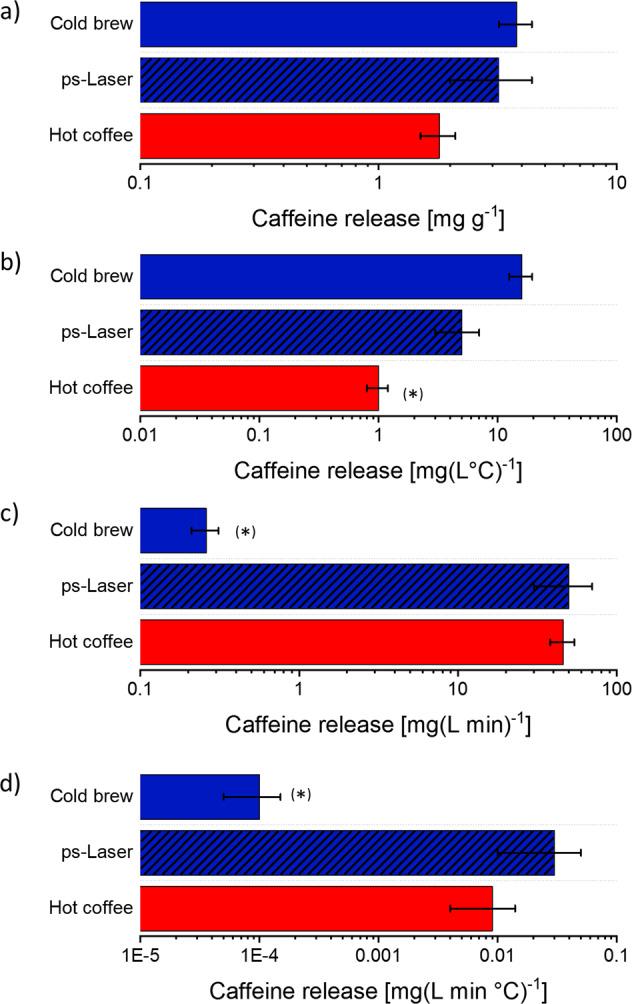
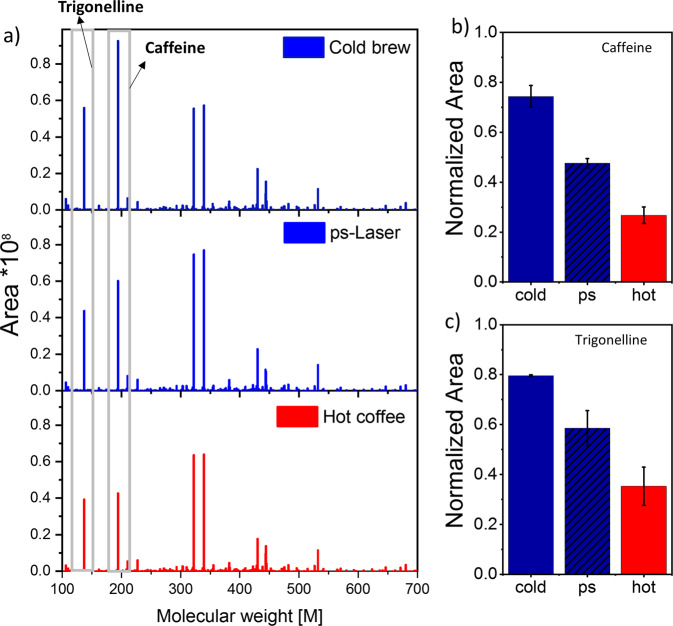
Coffee is typically brewed by extracting roasted and milled beans with hot water, but alternative methods such as cold brewing became increasingly popular over the past years. Cold-brewed coffee is attributed to health benefits, fewer acids, and bitter substances. But the preparation of cold brew typically needs several hours or even days. To create a cold-brew coffee within a few minutes, we present an approach in which an ultrashort-pulsed laser system is applied at the brewing entity without heating the powder suspension in water, efficiently extracting caffeine and aromatic substances from the powder. Already 3 min irradiation at room temperature leads to a caffeine concentration of 25 mg caffeine per 100 ml, comparable to the concentrations achieved by traditional hot brewing methods but comes without heating the suspension. Furthermore, the liquid phase's alkaloid content, analyzed by reversed-phase liquid chromatography coupled to high-resolution mass spectrometry, is dominated by caffeine and trigonelline and is comparable to traditional cold-brewed coffee rather than hot-brewed coffee. Furthermore, analyzing the head-space of the prepared coffee variants, using in-tube extraction dynamic head-space followed by gas chromatography coupled to mass spectrometry, gives evidence that the lack of heating leads to the preservation of more (semi-)volatile substances like pyridine, which provide cold-brew coffee its unique taste. This pioneering study may give the impetus to investigate further the possibility of cold-brewing coffee, accelerated by more than one order of magnitude, using ultrafast laser systems.
咖啡通常是通过用热水萃取烘焙和研磨后的咖啡豆来冲泡的,但在过去几年里,冷萃等替代方法越来越受欢迎。冷萃咖啡被认为有益健康,所含酸类和苦味物质较少。但冷萃咖啡的制作通常需要几个小时甚至几天时间。为了在几分钟内制作出冷萃咖啡,我们提出了一种方法,即在冲泡过程中对冲泡物施加超短脉冲激光系统,而不加热水中的粉末悬浮液,从而有效地从粉末中提取咖啡因和芳香物质。在室温下照射3分钟,就能使每100毫升咖啡中的咖啡因浓度达到25毫克,这与传统热冲泡方法所达到的浓度相当,但无需加热悬浮液。此外,通过反相液相色谱与高分辨率质谱联用分析液相中的生物碱含量,发现其主要成分是咖啡因和胡芦巴碱,与传统冷萃咖啡相当,而非热萃咖啡。此外,对制备好的咖啡变体的顶空进行分析,采用管内萃取动态顶空结合气相色谱-质谱联用技术,结果表明不加热能使更多像吡啶这样的(半)挥发性物质得以保留,正是这些物质赋予了冷萃咖啡独特的风味。这项开创性的研究可能会推动人们进一步研究使用超快激光系统将冷萃咖啡的制作速度加快一个多数量级的可能性。