Department of Psychology, University of Michigan, Ann Arbor, Michigan, USA.
Department of Psychology, Harvard University, Cambridge, Massachusetts, USA.
Dev Sci. 2022 Sep;25(5):e13266. doi: 10.1111/desc.13266. Epub 2022 May 10.
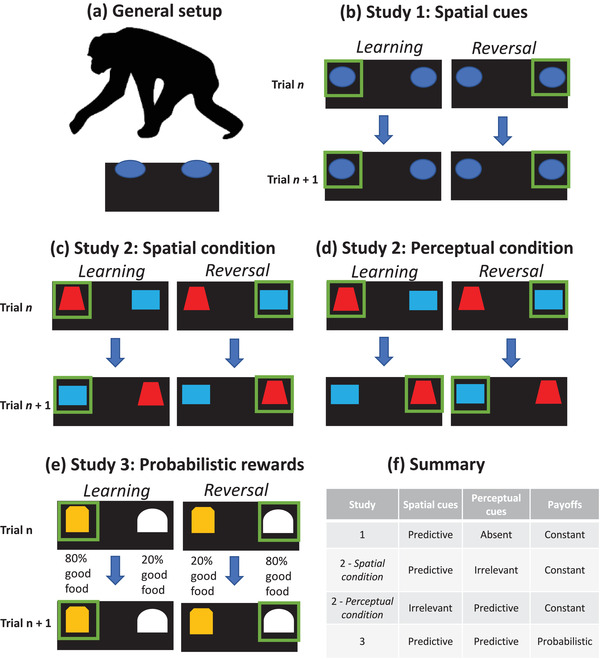
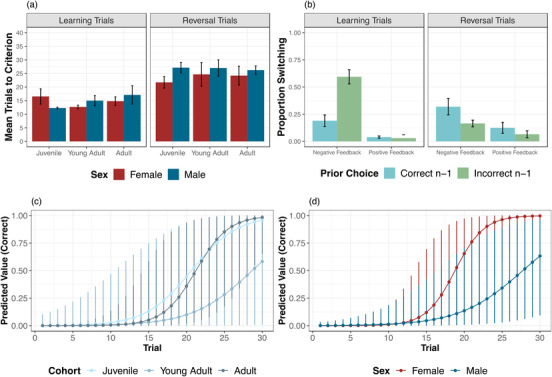
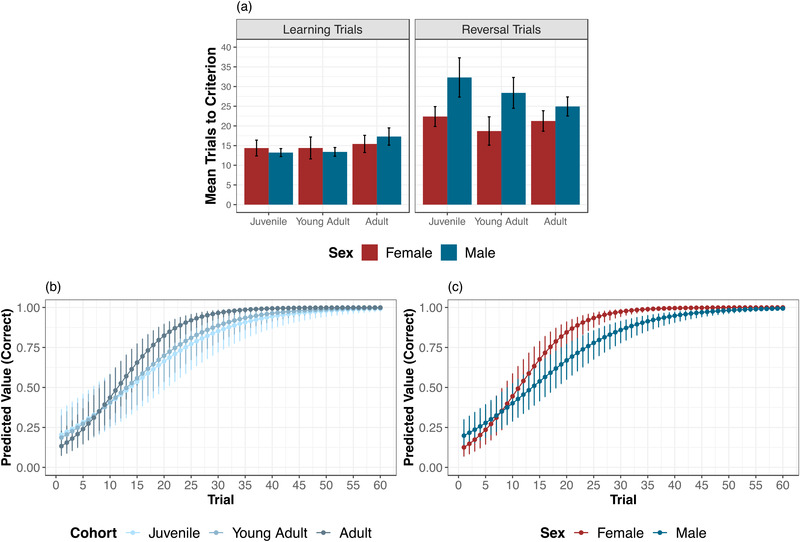
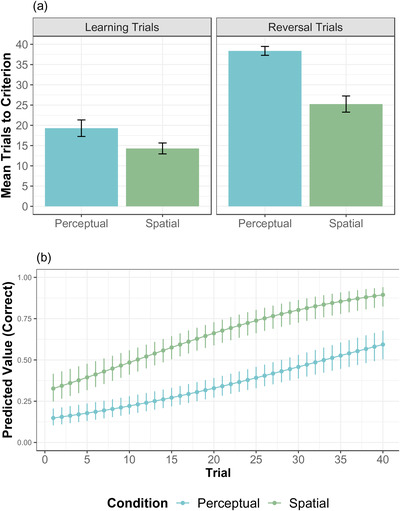
Cognitive flexibility is a core component of executive function, a suite of cognitive capacities that enables individuals to update their behavior in dynamic environments. Human executive functions are proposed to be enhanced compared to other species, but this inference is based primarily on neuroanatomical studies. To address this, we examined the nature and origins of cognitive flexibility in chimpanzees, our closest living relatives. Across three studies, we examined different components of cognitive flexibility using reversal learning tasks where individuals first learned one contingency and then had to shift responses when contingencies flipped. In Study 1, we tested n = 82 chimpanzees ranging from juvenility to adulthood on a spatial reversal task, to characterize the development of basic shifting skills. In Study 2, we tested how n = 24 chimpanzees use spatial versus arbitrary perceptual information to shift, a proposed difference between human and nonhuman cognition. In Study 3, we tested n = 40 chimpanzees on a probabilistic reversal task. We found an extended developmental trajectory for basic shifting and shifting in response to probabilistic feedback-chimpanzees did not reach mature performance until late in ontogeny. Additionally, females were faster to shift than males were. We also found that chimpanzees were much more successful when using spatial versus perceptual cues, and highly perseverative when faced with probabilistic versus consistent outcomes. These results identify both core features of chimpanzee cognitive flexibility that are shared with humans, as well as constraints on chimpanzee cognitive flexibility that may represent evolutionary changes in human cognitive development.
认知灵活性是执行功能的核心组成部分,执行功能是一系列认知能力,使个体能够在动态环境中更新行为。人类的执行功能被认为比其他物种更强大,但这种推断主要基于神经解剖学研究。为了解决这个问题,我们研究了黑猩猩(我们最亲近的物种)的认知灵活性的本质和起源。在三项研究中,我们使用反转学习任务来检验认知灵活性的不同组成部分,个体首先学习一个关联,然后当关联发生变化时,必须改变反应。在研究 1 中,我们测试了 n=82 只从幼年到成年的黑猩猩,进行空间反转任务,以描述基本转移技能的发展。在研究 2 中,我们测试了 24 只黑猩猩如何利用空间和任意感知信息进行转移,这是人类和非人类认知之间的一个假设差异。在研究 3 中,我们测试了 40 只黑猩猩进行概率反转任务。我们发现基本转移和对概率反馈的转移都有一个扩展的发展轨迹——黑猩猩直到生命后期才达到成熟表现。此外,雌性比雄性转移速度更快。我们还发现,当使用空间而非感知线索时,黑猩猩的成功率更高,而当面对概率性而非一致性结果时,它们的坚持性更高。这些结果不仅确定了与人类共享的黑猩猩认知灵活性的核心特征,还确定了可能代表人类认知发展进化变化的黑猩猩认知灵活性的限制。