Sadowski Janusz, Kaleta Anna, Kryvyi Serhii, Janaszko Dorota, Kurowska Bogusława, Bilska Marta, Wojciechowski Tomasz, Domagala Jarosław Z, Sanchez Ana M, Kret Sławomir
Institute of Physics Polish Academy of Sciences, Aleja Lotnikow 32/46, 02668, Warsaw, Poland.
Department of Physics and Electrical Engineering, Linnaeus University, 39182, Kalmar, Sweden.
Sci Rep. 2022 Apr 9;12(1):6007. doi: 10.1038/s41598-022-09847-w.
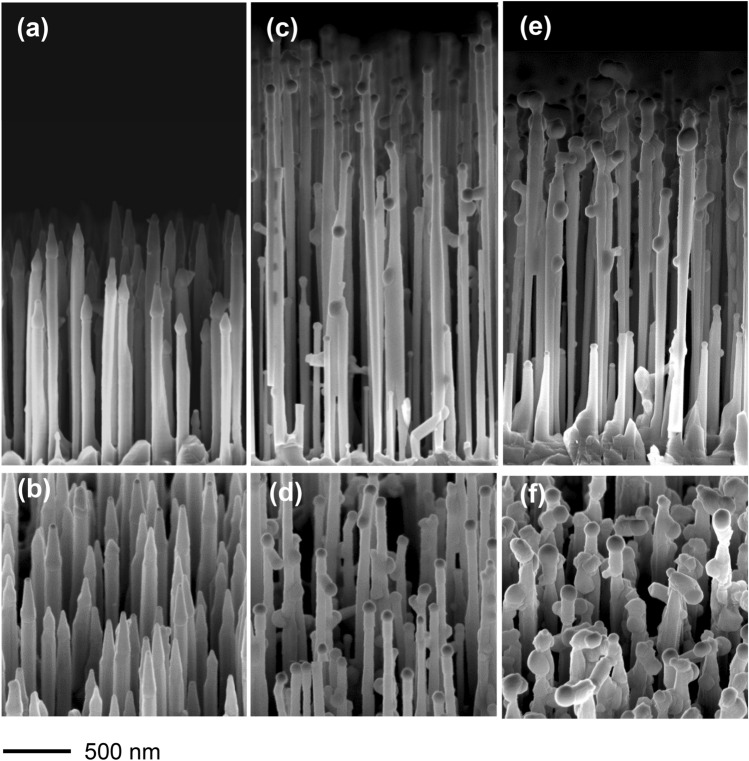
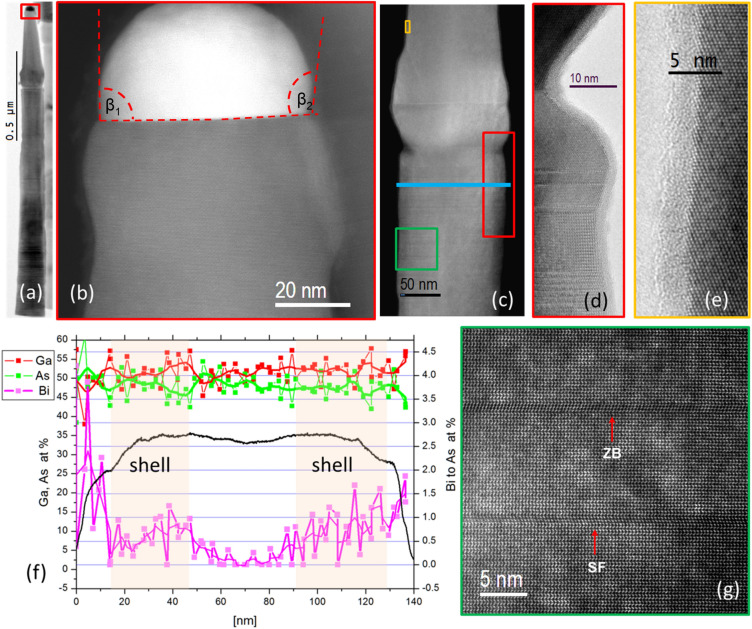
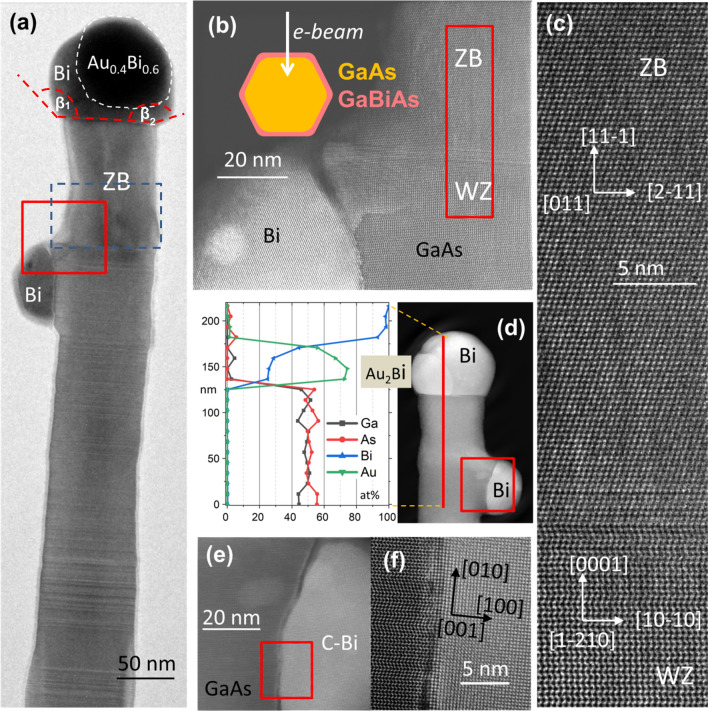
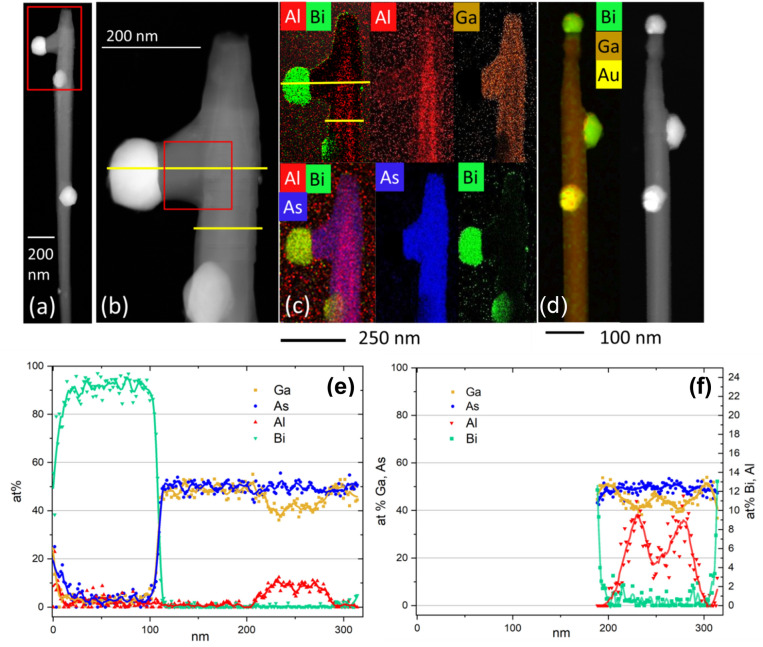
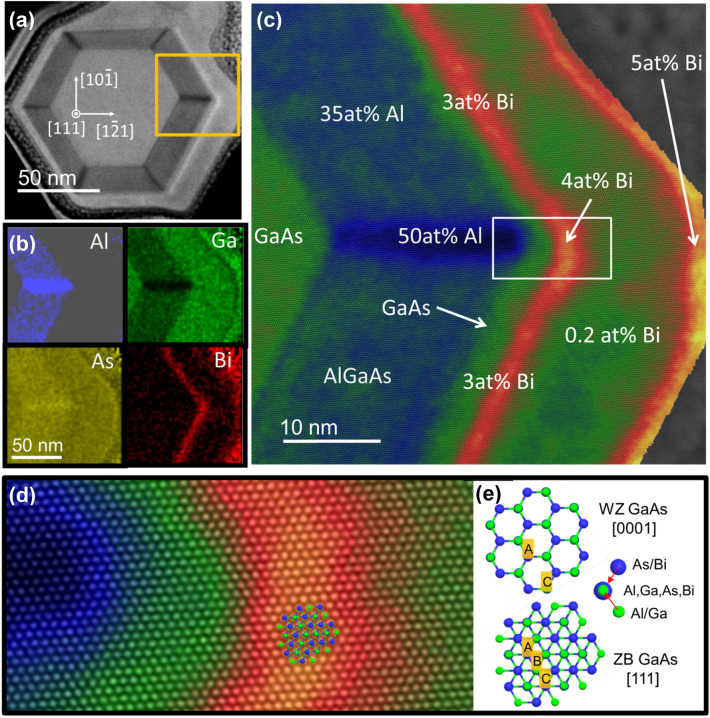
Incorporation of Bi into GaAs-(Ga,Al)As-Ga(As,Bi) core-shell nanowires grown by molecular beam epitaxy is studied with transmission electron microscopy. Nanowires are grown on GaAs(111)B substrates with Au-droplet assisted mode. Bi-doped shells are grown at low temperature (300 °C) with a close to stoichiometric Ga/As flux ratio. At low Bi fluxes, the Ga(As,Bi) shells are smooth, with Bi completely incorporated into the shells. Higher Bi fluxes (Bi/As flux ratio ~ 4%) led to partial segregation of Bi as droplets on the nanowires sidewalls, preferentially located at the nanowire segments with wurtzite structure. We demonstrate that such Bi droplets on the sidewalls act as catalysts for the growth of branches perpendicular to the GaAs trunks. Due to the tunability between zinc-blende and wurtzite polytypes by changing the nanowire growth conditions, this effect enables fabrication of branched nanowire architectures with branches generated from selected (wurtzite) nanowire segments.
利用透射电子显微镜研究了通过分子束外延生长的Bi掺入GaAs-(Ga,Al)As-Ga(As,Bi)核壳纳米线的情况。纳米线在具有金液滴辅助模式的GaAs(111)B衬底上生长。Bi掺杂壳层在低温(300°C)下以接近化学计量比的Ga/As通量比生长。在低Bi通量下,Ga(As,Bi)壳层是光滑的,Bi完全掺入壳层中。较高的Bi通量(Bi/As通量比约为4%)导致Bi以液滴形式在纳米线侧壁上部分偏析,优先位于具有纤锌矿结构的纳米线段上。我们证明,侧壁上的这种Bi液滴充当垂直于GaAs主干生长分支的催化剂。由于通过改变纳米线生长条件可以在闪锌矿和纤锌矿多型之间进行调节,这种效应使得能够制造出具有从选定(纤锌矿)纳米线段产生分支的分支纳米线结构。