Department of Human Development, Teachers College, Columbia University, New York, NY, USA.
Department of Psychology, Colorado State University, Fort Collins, CO, USA.
Brain Lang. 2022 Jun;229:105112. doi: 10.1016/j.bandl.2022.105112. Epub 2022 Apr 7.
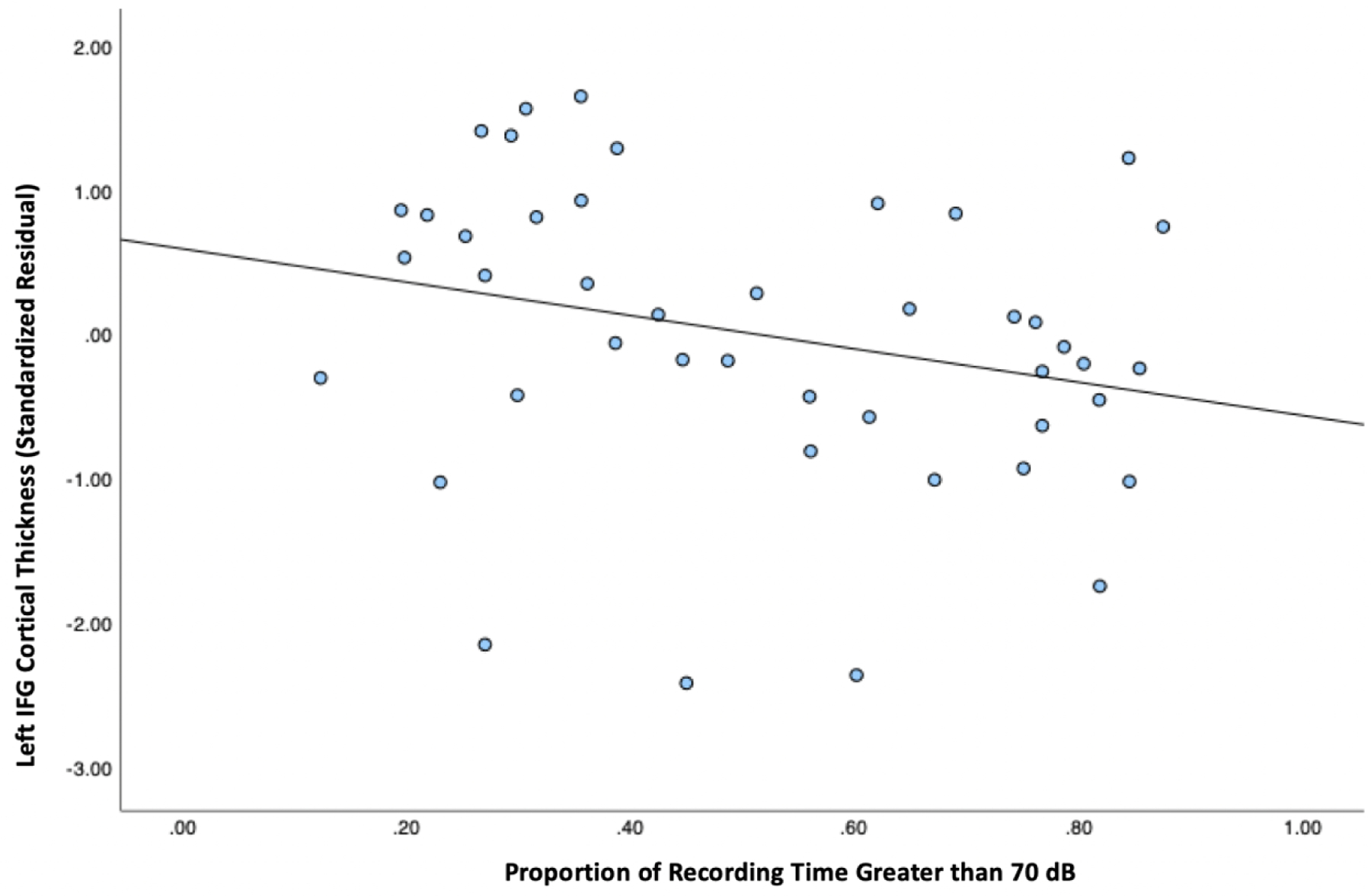
While excessive noise exposure in childhood has been associated with reduced language ability, few studies have examined potential underlying neurobiological mechanisms that may account for noise-related differences in language skills. In this study, we tested the hypotheses that higher everyday noise exposure would be associated with 1) poorer language skills and 2) differences in language-related cortical structure. A socioeconomically diverse sample of children aged 5-9 (N = 94) completed standardized language assessments. High-resolution T1-weighted magnetic resonance imaging (MRI) scans were acquired, and surface area and cortical thickness of the left inferior frontal gyrus (IFG) and left superior temporal gyrus (STG) were extracted. Language Environmental Analysis (LENA) was used to measure levels of exposure to excessive environmental noise over the course of a typical day (n = 43 with complete LENA, MRI, and behavioral data). Results indicated that children exposed to excessive levels of noise exhibited reduced cortical thickness in the left IFG. These findings add to a growing literature that explores the extent to which home environmental factors, such as environmental noise, are associated with neurobiological development related to language development in children.
虽然儿童时期过度的噪音暴露与语言能力下降有关,但很少有研究探讨可能导致与噪音相关的语言技能差异的潜在神经生物学机制。在这项研究中,我们检验了以下假设:更高的日常噪音暴露水平与 1)较差的语言技能和 2)与语言相关的皮质结构差异有关。一个由 5-9 岁的具有不同社会经济背景的儿童组成的样本(N=94)完成了标准化的语言评估。采集了高分辨率 T1 加权磁共振成像(MRI)扫描,并提取了左侧额下回(IFG)和左侧颞上回(STG)的表面积和皮质厚度。语言环境分析(LENA)用于测量在典型一天中暴露于过多环境噪音的水平(n=43 名具有完整 LENA、MRI 和行为数据的儿童)。结果表明,暴露于过度噪音水平的儿童左侧 IFG 的皮质厚度降低。这些发现增加了越来越多的文献,这些文献探讨了家庭环境因素(如环境噪音)在多大程度上与儿童语言发展相关的神经生物学发展有关。