Department of Internal Medicine, General Hospital Oberndorf, Teaching Hospital of the Paracelsus Medical University Salzburg, Salzburg, Austria.
Center for Public Health and Healthcare Research, Paracelsus Medical University of Salzburg, Salzburg, Austria.
J Intern Med. 2022 Sep;292(3):438-449. doi: 10.1111/joim.13492. Epub 2022 Apr 22.
Previous studies reported regional differences in end-of-life care (EoLC) for critically ill patients in Europe.
The purpose of this post-hoc analysis of the prospective multicentre COVIP study was to investigate variations in EoLC practices among older patients in intensive care units during the coronavirus disease 2019 pandemic.
A total of 3105 critically ill patients aged 70 years and older were enrolled in this study (Central Europe: n = 1573; Northern Europe: n = 821; Southern Europe: n = 711). Generalised estimation equations were used to calculate adjusted odds ratios (aORs) to population averages. Data were adjusted for patient-specific variables (demographic, disease-specific) and health economic data (gross domestic product, health expenditure per capita). The primary outcome was any treatment limitation, and 90-day mortality was a secondary outcome.
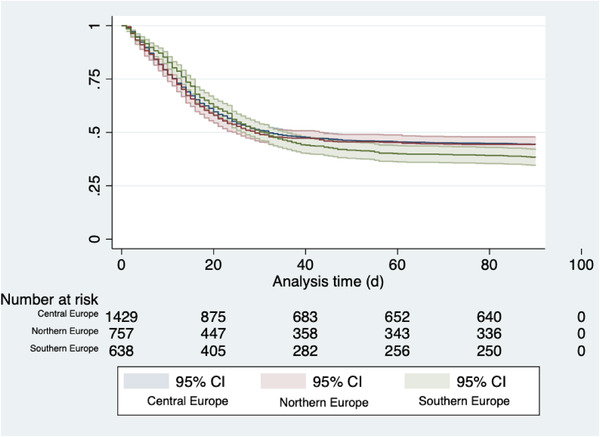
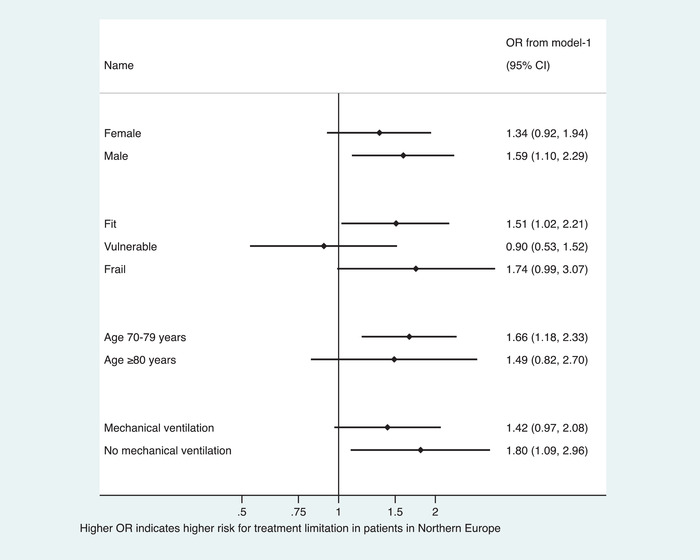
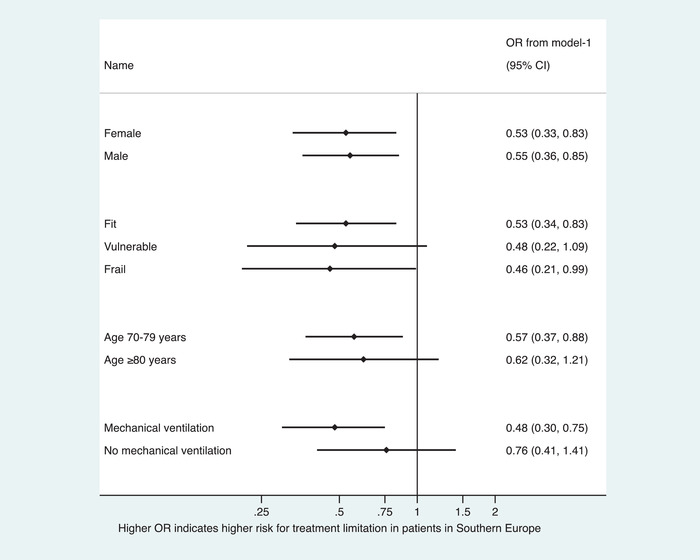
The frequency of the primary endpoint (treatment limitation) was highest in Northern Europe (48%), intermediate in Central Europe (39%) and lowest in Southern Europe (24%). The likelihood for treatment limitations was lower in Southern than in Central Europe (aOR 0.39; 95% confidence interval [CI] 0.21-0.73; p = 0.004), even after multivariable adjustment, whereas no statistically significant differences were observed between Northern and Central Europe (aOR 0.57; 95%CI 0.27-1.22; p = 0.15). After multivariable adjustment, no statistically relevant mortality differences were found between Northern and Central Europe (aOR 1.29; 95%CI 0.80-2.09; p = 0.30) or between Southern and Central Europe (aOR 1.07; 95%CI 0.66-1.73; p = 0.78).
This study shows a north-to-south gradient in rates of treatment limitation in Europe, highlighting the heterogeneity of EoLC practices across countries. However, mortality rates were not affected by these results.
先前的研究报告称,欧洲危重病患者的临终关怀(EoLC)存在区域性差异。
本项针对前瞻性多中心 COVIP 研究的事后分析旨在调查 2019 年冠状病毒病大流行期间重症监护病房老年患者临终关怀实践的变化。
这项研究纳入了 3105 名年龄在 70 岁及以上的危重病患者(中欧:n = 1573;北欧:n = 821;南欧:n = 711)。使用广义估计方程计算调整后的优势比(aOR)以反映人群平均值。数据根据患者特定变量(人口统计学、疾病特异性)和卫生经济数据(国内生产总值、人均卫生支出)进行调整。主要结局是任何治疗限制,90 天死亡率为次要结局。
北欧的主要结局(治疗限制)发生率最高(48%),中欧次之(39%),南欧最低(24%)。与中欧相比,南欧的治疗限制可能性较低(aOR 0.39;95%置信区间 [CI] 0.21-0.73;p = 0.004),即使在多变量调整后也是如此,而北欧和中欧之间没有观察到统计学上的显著差异(aOR 0.57;95%CI 0.27-1.22;p = 0.15)。多变量调整后,北欧和中欧之间的死亡率没有统计学上的显著差异(aOR 1.29;95%CI 0.80-2.09;p = 0.30),南欧和中欧之间也没有统计学上的显著差异(aOR 1.07;95%CI 0.66-1.73;p = 0.78)。
本研究显示,欧洲在治疗限制率方面存在从北到南的梯度,突显了各国临终关怀实践的异质性。然而,这些结果并未影响死亡率。