Department of Anesthesia and Intensive Care, Nord-Trøndelag Hospital Trust, Levanger, Norway
Institute of Circulation and Medical Imaging, Mid-Norway Centre of Sepsis Research, Norwegian University of Science and Technology (NTNU), Trondheim, Norway.
BMJ Open. 2023 Aug 2;13(8):e071846. doi: 10.1136/bmjopen-2023-071846.
To estimate temporal trends in incidence rate (IR) and case fatality during a 14-year period from 2008 to 2021, and to assess possible shifts in these trends during the COVID-19 pandemic.
All Norwegian hospitals 2008-2021.
317 705 patients ≥18 year with a sepsis International Classification of Diseases 10th revision code retrieved from The Norwegian Patient Registry.
Annual age-standardised IRs with 95% CIs. Poisson regression was used to estimate changes in IRs across time, and logistic regression was used to estimate ORs for in-hospital death.
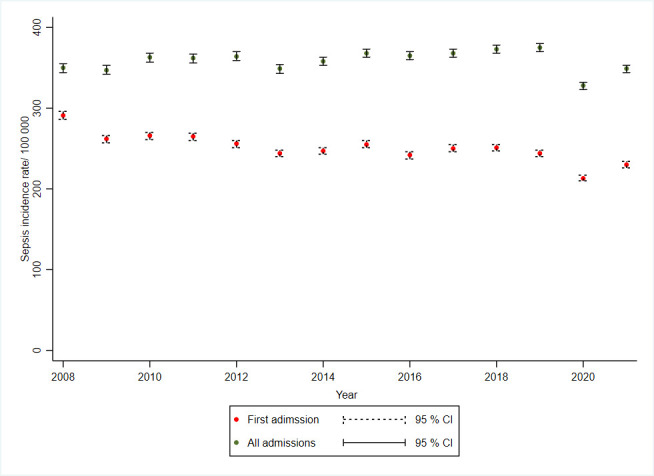
Among 12 619 803 adult hospitalisations, a total of 317 705 (2.5%) hospitalisations in 222 832 (70.0%) unique patients met the sepsis criteria. The overall age-standardised IR of a first sepsis admission was 246/100 000 (95% CI 245 to 247), whereas the age-standardised IR of all sepsis admissions was 352/100 000 (95% CI 351 to 354). In the period 2009-2019, the annual IR for a first sepsis episode was stable (IR ratio (IRR) per year, 0.999; 95% CI 0.994 to 1.004), whereas for recurrent sepsis the IR increased (annual IRR, 1.048; 95% CI 1.037 to 1.059). During the COVID-19 pandemic, the IRR for a first sepsis was 0.877 (95% CI 0.829 to 0.927) in 2020 and 0.929 (95% CI 0.870 to 0.992) in 2021, and for all sepsis it was 0.870 (95% CI 0.810 to 0.935) in 2020 and 0.908 (95% CI 0.840 to 0.980) in 2021, compared with the previous 11-year period. Case fatality among first sepsis admissions declined in the period 2009-2019 (annual OR 0.954 (95% CI 0.950 to 0.958)), whereas case fatality increased during the COVID-19 pandemic in 2020 (OR 1.061 (95% CI 1.001 to 1.124) and in 2021 (OR 1.164 (95% CI 1.098 to 1.233)).
The overall IR of sepsis increased from 2009 to 2019, due to an increasing IR of recurrent sepsis, and indicates that sepsis awareness with updated guidelines and education must continue.
在 2008 年至 2021 年的 14 年期间,估计发病率(IR)和病死率的时间趋势,并评估 COVID-19 大流行期间这些趋势的可能变化。
所有挪威医院 2008-2021。
317705 名年龄≥18 岁的败血症患者,从挪威患者登记处检索到第 10 次修订版国际疾病分类的败血症代码。
年龄标准化的年度发病率(IR)及其 95%置信区间。使用泊松回归估计时间内 IR 的变化,使用逻辑回归估计院内死亡的比值比(OR)。
在 12619803 例成人住院中,共有 317705 例(2.5%)在 222832 例(70.0%)唯一患者中符合败血症标准的住院符合败血症标准。首次败血症入院的总体年龄标准化 IR 为 246/100000(95%CI 245-247),而所有败血症入院的年龄标准化 IR 为 352/100000(95%CI 351-354)。在 2009-2019 年期间,首次败血症发作的年 IR 保持稳定(每年 IR 比(IRR),0.999;95%CI 0.994-1.004),而复发性败血症的 IR 增加(每年 IRR,1.048;95%CI 1.037-1.059)。在 COVID-19 大流行期间,2020 年首次败血症的 IRR 为 0.877(95%CI 0.829-0.927),2021 年为 0.929(95%CI 0.870-0.992),而所有败血症的 IRR 为 2020 年为 0.870(95%CI 0.810-0.935),2021 年为 0.908(95%CI 0.840-0.980)与前 11 年期间相比。2009-2019 年期间,首次败血症入院的病死率下降(每年 OR 0.954(95%CI 0.950-0.958)),而 COVID-19 大流行期间,2020 年(OR 1.061(95%CI 1.001-1.124))和 2021 年(OR 1.164(95%CI 1.098-1.233))的病死率增加。
2009 年至 2019 年期间,败血症的总体 IR 增加,原因是复发性败血症的 IR 增加,这表明必须继续提高败血症意识,并更新指南和教育。