Ning Shen, Jorfi Mehdi, Patel Shaun R, Kim Doo Yeon, Tanzi Rudolph E
Genetics and Aging Research Unit, McCance Center for Brain Health, MassGeneral Institute for Neurodegenerative Disease, Department of Neurology, Massachusetts General Hospital and Harvard Medical School, Boston, MA, United States.
Graduate Program for Neuroscience, Boston University School of Medicine, Boston, MA, United States.
Front Neurosci. 2022 Mar 24;16:854992. doi: 10.3389/fnins.2022.854992. eCollection 2022.
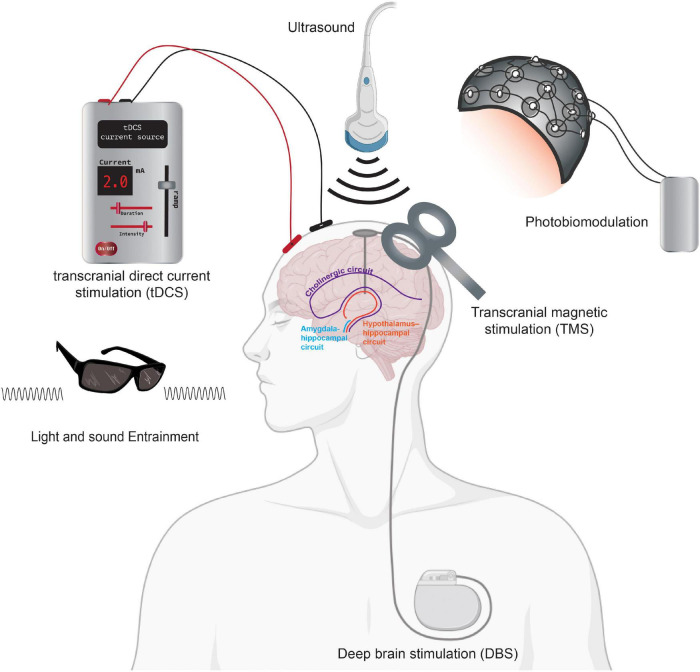
Alzheimer's disease (AD) is the most common cause of dementia in the elderly, clinically defined by progressive cognitive decline and pathologically, by brain atrophy, neuroinflammation, and accumulation of extracellular amyloid plaques and intracellular neurofibrillary tangles. Neurotechnological approaches, including optogenetics and deep brain stimulation, have exploded as new tools for not only the study of the brain but also for application in the treatment of neurological diseases. Here, we review the current state of AD therapeutics and recent advancements in both invasive and non-invasive neurotechnologies that can be used to ameliorate AD pathology, including neurostimulation via optogenetics, photobiomodulation, electrical stimulation, ultrasound stimulation, and magnetic neurostimulation, as well as nanotechnologies employing nanovectors, magnetic nanoparticles, and quantum dots. We also discuss the current challenges in developing these neurotechnological tools and the prospects for implementing them in the treatment of AD and other neurodegenerative diseases.
阿尔茨海默病(AD)是老年人痴呆最常见的病因,临床定义为进行性认知衰退,病理表现为脑萎缩、神经炎症以及细胞外淀粉样斑块和细胞内神经原纤维缠结的积累。神经技术方法,包括光遗传学和深部脑刺激,已成为新的工具,不仅用于大脑研究,还应用于神经系统疾病的治疗。在此,我们综述了AD治疗的现状以及侵入性和非侵入性神经技术的最新进展,这些技术可用于改善AD病理,包括通过光遗传学进行神经刺激、光生物调节、电刺激、超声刺激和磁神经刺激,以及采用纳米载体、磁性纳米颗粒和量子点的纳米技术。我们还讨论了开发这些神经技术工具目前面临的挑战以及将其应用于AD和其他神经退行性疾病治疗的前景。