Siddappaji Kiran Kumar, Gopal Shubha
Department of Studies in Microbiology, University of Mysore, Mysuru, 570006, Karnataka, India.
AIMS Neurosci. 2021 Mar 19;8(3):357-389. doi: 10.3934/Neuroscience.2021020. eCollection 2021.
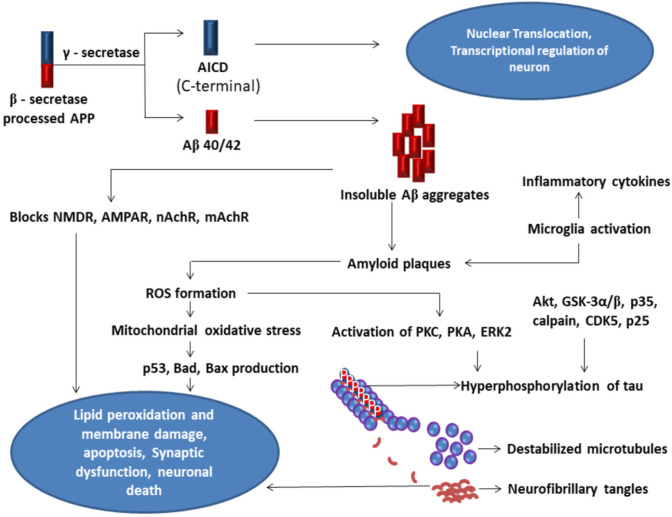
Alzheimer's disease (AD) is one of the most common, severe neurodegenerative brain disorder characterized by the accumulation of amyloid-beta plaques, neurofibrillary tangles in the brain causing neural disintegration, synaptic dysfunction, and neuronal death leading to dementia. Although many US-FDA-approved drugs like Donepezil, Rivastigmine, Galantamine are available in the market, their consumption reduces only the symptoms of the disease but fails in potency to cure the disease. This disease affects many individuals with aging. Combating the disease tends to be very expensive. This review focuses on biochemical mechanisms in the neuron both at normal and AD state with relevance to the tau hypothesis, amyloid hypothesis, the risk factors influencing dementia, oxidative stress, and neuroinflammation altogether integrated with neurodegeneration. A brief survey is carried out on available biomarkers in the diagnosis of the disease, drugs used for the treatment, and the challenges in approaching therapeutic targets in inhibiting the disease pathologies. This review conjointly assesses the demerits with the inefficiency of drugs to reach targets, their side effects, and toxicity. Optimistically, this review directs on the advantageous strategies in using nanotechnology-based drug delivery systems to cross the blood-brain barrier for improving the efficacy of drugs combined with a novel neuronal stem cell therapy approach. Determinately, this review aims at the natural, non-therapeutic healing impact of physical exercise on different model organisms and the effect of safe neuromodulation treatments using repetitive Transcranial Magnetic Stimulation (rTMS), transcranial Electrical Stimulation (tES) in humans to control the disease pathologies prominent in enhancing the synaptic function.
阿尔茨海默病(AD)是最常见、最严重的神经退行性脑疾病之一,其特征是β-淀粉样蛋白斑块的积累、大脑中的神经原纤维缠结,导致神经解体、突触功能障碍和神经元死亡,进而引发痴呆。尽管市场上有许多美国食品药品监督管理局(US-FDA)批准的药物,如多奈哌齐、卡巴拉汀、加兰他敏,但服用这些药物只能减轻疾病症状,无法有效治愈疾病。这种疾病影响着许多老年人。对抗这种疾病的成本往往非常高昂。本综述重点关注正常状态和AD状态下神经元的生化机制,涉及tau假说、淀粉样蛋白假说、影响痴呆的风险因素、氧化应激和神经炎症,并将它们与神经退行性变整合在一起。本文还简要概述了用于该疾病诊断的现有生物标志物、治疗所用药物以及在抑制疾病病理过程中实现治疗靶点所面临的挑战。本综述还共同评估了药物无法有效到达靶点的缺点、它们的副作用和毒性。乐观的是,本综述介绍了基于纳米技术的药物递送系统穿过血脑屏障以提高药物疗效的有利策略,以及结合新型神经元干细胞治疗方法的优势。确切地说,本综述旨在探讨体育锻炼对不同模式生物的自然、非治疗性愈合影响,以及使用重复经颅磁刺激(rTMS)、经颅电刺激(tES)等安全神经调节疗法对人类控制疾病病理过程、增强突触功能的效果。