Pan Kwang Hyun, Kim Jaeyoun, Chung Jong-Won, Kim Keon Ha, Bang Oh Young, Jeon Pyoung, Kim Gyeong-Moon, Seo Woo-Keun
Department of Neurology, Samsung Medical Center, Sungkyunkwan University School of Medicine, Seoul, South Korea.
Department of Neurology, Anam Hospital, Korea University, Seoul, South Korea.
Front Neurol. 2022 Mar 23;13:843871. doi: 10.3389/fneur.2022.843871. eCollection 2022.
This study aimed to investigate clinical outcome predictors of acute stroke patients with large vessel occlusion and active cancer and validate the significance of D-dimer levels for endovascular thrombectomy decisions.
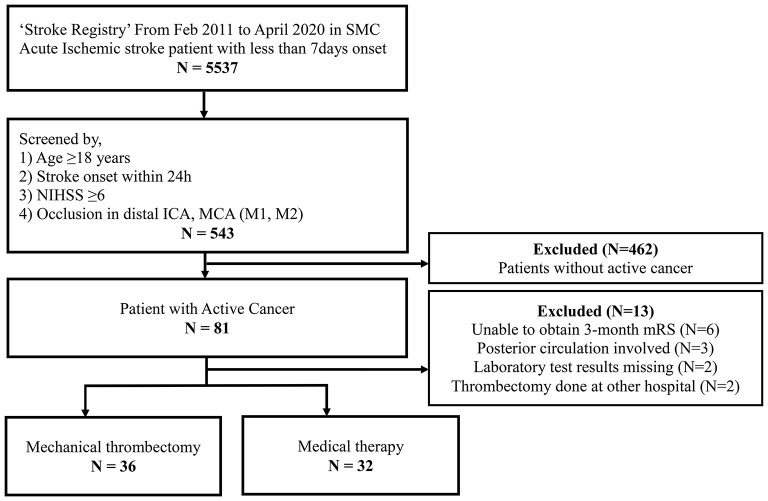
We analyzed a prospectively collected hospital-based stroke registry to determine clinical EVT outcomes of acute stroke patients within 24 h with following criteria: age ≥18 years, NIHSS ≥6, and internal carotid artery or middle cerebral artery lesion. All patients were classified into EVT and non-EVT groups. Patients were divided into two groups by initial D-dimer level. We explored variables potentially associated with successful recanalization as well as 3-month functional outcomes and mortality rates.
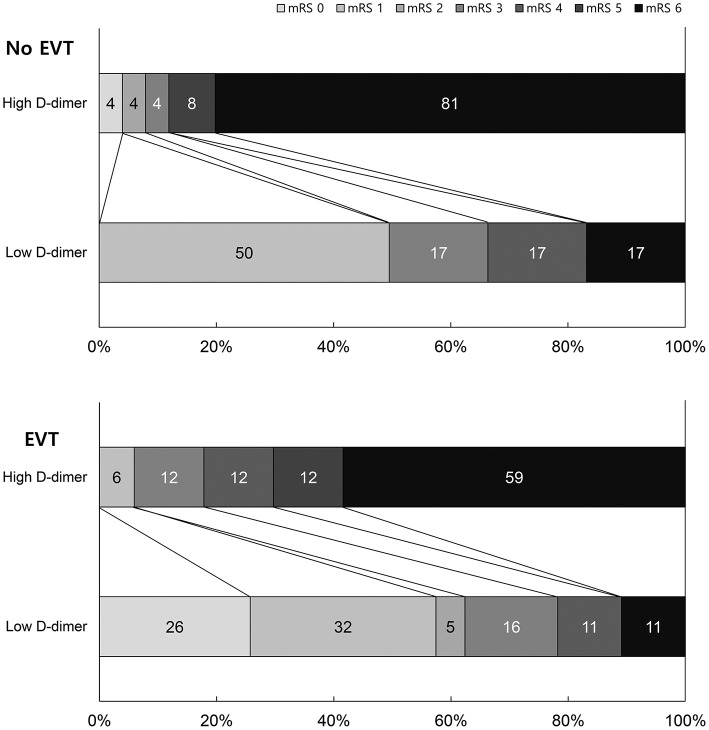
Among 68 patients, 36 were treated with EVT, with successful recanalization in 55.6%. The low D-dimer group showed a higher rate of successful recanalization and favorable outcome than the high D-dimer group. The mortality rate was higher in the high D-dimer group. No EVT and high D-dimer level were independent predictors of mortality, whereas lesion volume and low D-dimer level were independently associated with favorable outcomes.
D-dimer level is a prognostic factor in acute LVO stroke patients with active cancer, and its high value for EVT decisions provisionally supports its testing in this patient population.
本研究旨在调查合并大血管闭塞和活动性癌症的急性卒中患者的临床结局预测因素,并验证D-二聚体水平对血管内血栓切除术决策的意义。
我们分析了前瞻性收集的基于医院的卒中登记数据,以确定符合以下标准的24小时内急性卒中患者的血管内血栓切除术临床结局:年龄≥18岁,美国国立卫生研究院卒中量表(NIHSS)评分≥6,以及颈内动脉或大脑中动脉病变。所有患者分为血管内血栓切除术组和非血管内血栓切除术组。根据初始D-二聚体水平将患者分为两组。我们探讨了可能与成功再通以及3个月功能结局和死亡率相关的变量。
68例患者中,36例行血管内血栓切除术,成功再通率为55.6%。低D-二聚体组的成功再通率和良好结局率高于高D-二聚体组。高D-二聚体组的死亡率更高。未进行血管内血栓切除术和高D-二聚体水平是死亡率的独立预测因素,而病灶体积和低D-二聚体水平与良好结局独立相关。
D-二聚体水平是合并活动性癌症的急性大血管闭塞性卒中患者的预后因素,其在血管内血栓切除术决策中的高价值暂时支持在该患者群体中进行检测。