Department of Microbiology and Immunology, School of Medicine, University of California, Davis, Davis, CA, United States.
Front Immunol. 2022 Mar 24;13:828758. doi: 10.3389/fimmu.2022.828758. eCollection 2022.
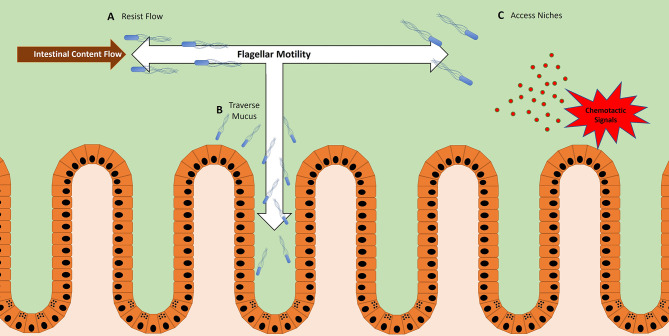
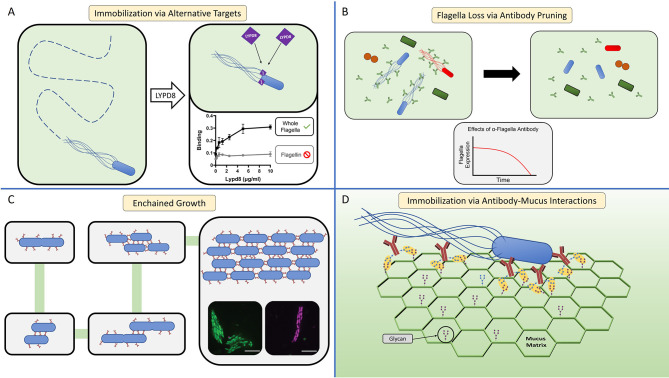
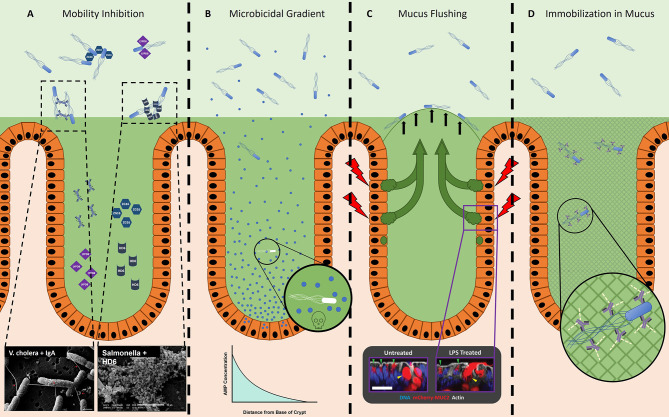
Many bacteria and other microbes achieve locomotion flagella, which are organelles that function as a swimming motor. Depending on the environment, flagellar motility can serve a variety of beneficial functions and confer a fitness advantage. For example, within a mammalian host, flagellar motility can provide bacteria the ability to resist clearance by flow, facilitate access to host epithelial cells, and enable travel to nutrient niches. From the host's perspective, the mobility that flagella impart to bacteria can be associated with harmful activities that can disrupt homeostasis, such as invasion of epithelial cells, translocation across epithelial barriers, and biofilm formation, which ultimately can decrease a host's reproductive fitness from a perspective of natural selection. Thus, over an evolutionary timescale, the host developed a repertoire of innate and adaptive immune countermeasures that target and mitigate this microbial threat. These countermeasures are wide-ranging and include structural components of the mucosa that maintain spatial segregation of bacteria from the epithelium, mechanisms of molecular recognition and inducible responses to flagellin, and secreted effector molecules of the innate and adaptive immune systems that directly inhibit flagellar motility. While much of our understanding of the dynamics of host-microbe interaction regarding flagella is derived from studies of enteric bacterial pathogens where flagella are a recognized virulence factor, newer studies have delved into host interaction with flagellated members of the commensal microbiota during homeostasis. Even though many aspects of flagellar motility may seem innocuous, the host's redundant efforts to stop bacteria in their tracks highlights the importance of this host-microbe interaction.
许多细菌和其他微生物通过鞭毛实现运动,鞭毛是一种作为游泳马达的细胞器。根据环境的不同,鞭毛运动可以发挥多种有益功能,并赋予适应性优势。例如,在哺乳动物宿主中,鞭毛运动使细菌能够抵抗流动清除,有助于接近宿主上皮细胞,并使细菌能够进入营养小生境。从宿主的角度来看,鞭毛赋予细菌的流动性可能与破坏内稳态的有害活动有关,例如上皮细胞的入侵、上皮屏障的易位和生物膜的形成,这最终可以从自然选择的角度降低宿主的生殖适应性。因此,在进化的时间尺度上,宿主发展了一系列先天和适应性免疫对策,以靶向和减轻这种微生物威胁。这些对策范围广泛,包括维持细菌与上皮细胞空间隔离的粘膜结构成分、对鞭毛蛋白的分子识别和诱导反应机制,以及先天和适应性免疫系统的分泌效应分子,这些分子直接抑制鞭毛运动。虽然我们对宿主-微生物相互作用动力学的许多方面的了解都源于对肠道细菌病原体的研究,在这些病原体中,鞭毛是公认的毒力因子,但新的研究深入探讨了在稳态期间宿主与共生微生物群中鞭毛成员的相互作用。尽管鞭毛运动的许多方面看起来似乎无害,但宿主为阻止细菌前进而做出的冗余努力突显了这种宿主-微生物相互作用的重要性。