Department of Dermatology, Sun Yat-sen Memorial Hospital, Sun Yat-sen University, Guangzhou, China.
Front Immunol. 2022 Mar 23;13:817040. doi: 10.3389/fimmu.2022.817040. eCollection 2022.
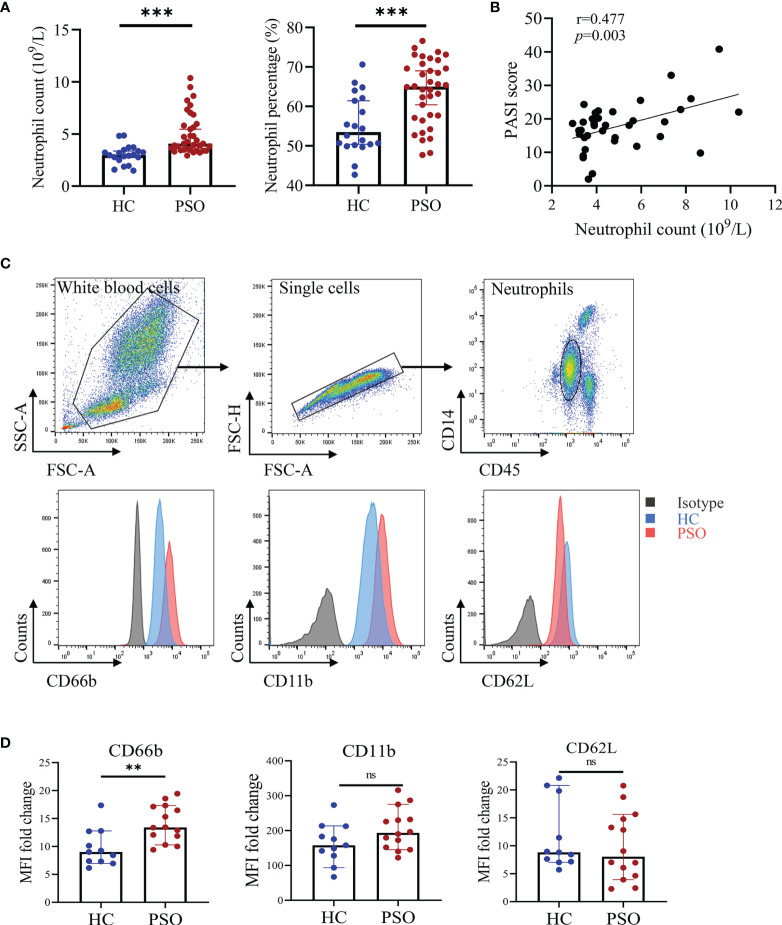
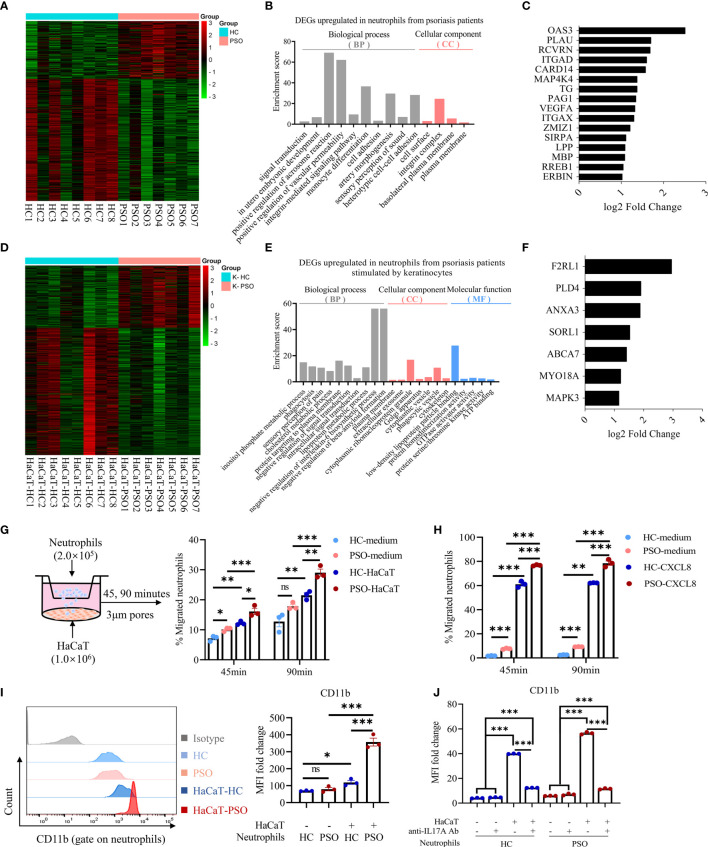
Microabscess of neutrophils in epidermis is one of the histological hallmarks of psoriasis. The axis of neutrophil-keratinocyte has been thought to play a critical role in the pathogenesis of psoriasis. However, the features and mechanism of interaction between the two cell types remain largely unknown. Herein, we found that blood neutrophils were increased in psoriasis patients, positively correlated with disease severity and highly expressed CD66b, but not CD11b and CD62L compared to healthy controls. Keratinocytes expressed high levels of psoriasis-related inflammatory mediators by direct and indirect interaction with neutrophils isolated from psoriasis patients and healthy controls. The capacity of neutrophils in provoking keratinocytes inflammatory response was comparable between the two groups and is dependent on IL-17A produced by itself. Neutrophils isolated from psoriasis patients displayed more transcriptome changes related to integrin and increased migration capacity toward keratinocytes with high CD11b expression on cell surface. Of interest, neutrophils were more susceptible to keratinocyte stimulation than to fibroblasts and human umbilical vein endothelial cells (HUVECs) in terms of CD11b expression and the production of ROS and NETs. In conclusion, neutrophils from psoriasis patients gain a strong capacity of IL-17A production and integrins expression that possibly facilitates their abilities to promote production of psoriasis-related inflammatory mediators and migration, a phenomenon likely induced by their interaction with keratinocytes but not with fibroblasts. These findings provide a proof-of-concept that development of new drugs targeting migration of neutrophils could be a more specific and safe solution to treat psoriasis.
表皮中性粒细胞微脓肿是银屑病的组织学标志之一。中性粒细胞-角质形成细胞轴被认为在银屑病的发病机制中起关键作用。然而,这两种细胞类型之间的相互作用的特征和机制在很大程度上仍然未知。在此,我们发现银屑病患者的血液中性粒细胞增多,与疾病严重程度呈正相关,并且与健康对照组相比,高表达 CD66b,但不表达 CD11b 和 CD62L。角质形成细胞通过与来自银屑病患者和健康对照者的中性粒细胞直接和间接相互作用,表达高水平的与银屑病相关的炎症介质。两组之间中性粒细胞引发角质形成细胞炎症反应的能力相当,并且依赖于其自身产生的 IL-17A。与健康对照组相比,来自银屑病患者的中性粒细胞显示出与整合素相关的更多转录组变化,并且具有更高的迁移能力,而表面表达高 CD11b 的细胞是角质形成细胞。有趣的是,与成纤维细胞和人脐静脉内皮细胞(HUVEC)相比,中性粒细胞在 CD11b 表达和 ROS 和 NETs 的产生方面对角质形成细胞的刺激更敏感。总之,来自银屑病患者的中性粒细胞获得了强大的 IL-17A 产生和整合素表达能力,这可能使其具有促进产生与银屑病相关的炎症介质和迁移的能力,这种现象可能是由其与角质形成细胞而不是成纤维细胞的相互作用引起的。这些发现提供了一个概念验证,即开发针对中性粒细胞迁移的新药可能是一种更特异和安全的治疗银屑病的方法。