Strongylou Dimitra Eleftheria, Flowers Paul, McKenna Ruth, Kincaid Ross Andrew, Clutterbuck Dan, Hammoud Mohamed Ahmed, Heng Julian, Kerr Yvonne, McDaid Lisa, Frankis Jamie Scott
School of Health and Life Sciences, GCU, Glasgow, UK.
Department of Psychology, University of Strathclyde, Glasgow, UK.
Health Psychol Behav Med. 2022 Apr 5;10(1):357-378. doi: 10.1080/21642850.2022.2053687. eCollection 2022.
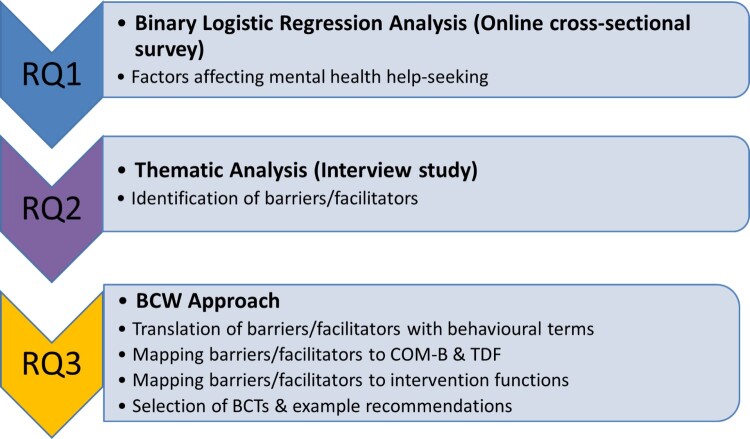
Gay, bisexual and other men who have sex with men (GBMSM) are at far greater risk of experiencing poor mental health (MH) than wider society. This disparity was exacerbated by additional 'unique to sexual minority status' COVID-19 stressors. This sequential, mixed-methods study examined remote MH help-seeking among GBMSM in the U.K. and Ireland during the first COVID-19 lockdown. Quantitative survey data ( = 1368), analysed with logistic regression, suggested GBMSM experiencing moderate-to-severe anxiety and those with a past MH diagnosis were most likely to seek MH support. Thematic analysis of qualitative interview ( = 18) data identified multiple barriers and enablers to GBMSM seeking remote MH help, with the help primarily sought from GBMSM-facing organisations and generic online resources. Finally, the behaviour change wheel was used to generate theoretically informed recommendations to promote MH help-seeking among GBMSM in Scotland. We discuss how applying these recommendations in the short, medium and long term will begin to address GBMSM's MH needs, post COVID-19.
男同性恋者、双性恋者以及其他与男性发生性行为的男性(GBMSM)比更广泛的社会群体面临着更高的心理健康不佳风险。这种差异因新冠疫情带来的额外“性少数群体身份特有的”压力因素而加剧。这项序贯性混合方法研究调查了英国和爱尔兰的GBMSM在首次新冠疫情封锁期间远程寻求心理健康帮助的情况。通过逻辑回归分析的定量调查数据(n = 1368)表明,经历中度至重度焦虑的GBMSM以及曾有心理健康诊断的人最有可能寻求心理健康支持。对定性访谈数据(n = 18)的主题分析确定了GBMSM寻求远程心理健康帮助的多个障碍和促成因素,其寻求帮助的对象主要是面向GBMSM的组织和一般在线资源。最后,运用行为改变轮提出了理论上合理的建议,以促进苏格兰GBMSM寻求心理健康帮助。我们讨论了在短期、中期和长期应用这些建议将如何开始满足GBMSM在新冠疫情后的心理健康需求。