Dey Jhilik, Roberts Akanksha, Mahari Subhasis, Gandhi Sonu, Tripathi Prem Prakash
Cell Biology and Physiology Division, CSIR-Indian Institute of Chemical Biology, Kolkata, India.
Cell Biology and Physiology Division, IICB-Translational Research Unit of Excellence, Kolkata, India.
Front Bioeng Biotechnol. 2022 Mar 24;10:873811. doi: 10.3389/fbioe.2022.873811. eCollection 2022.
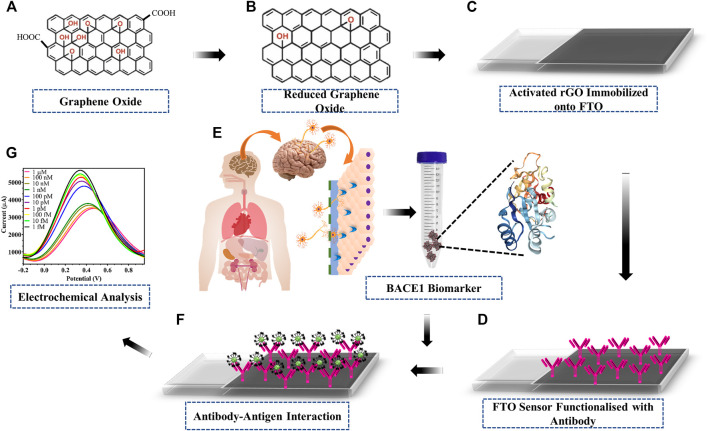
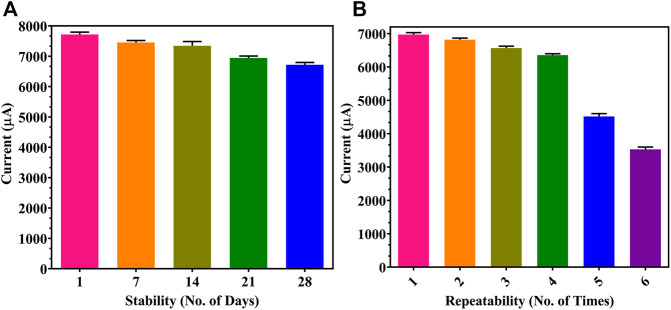
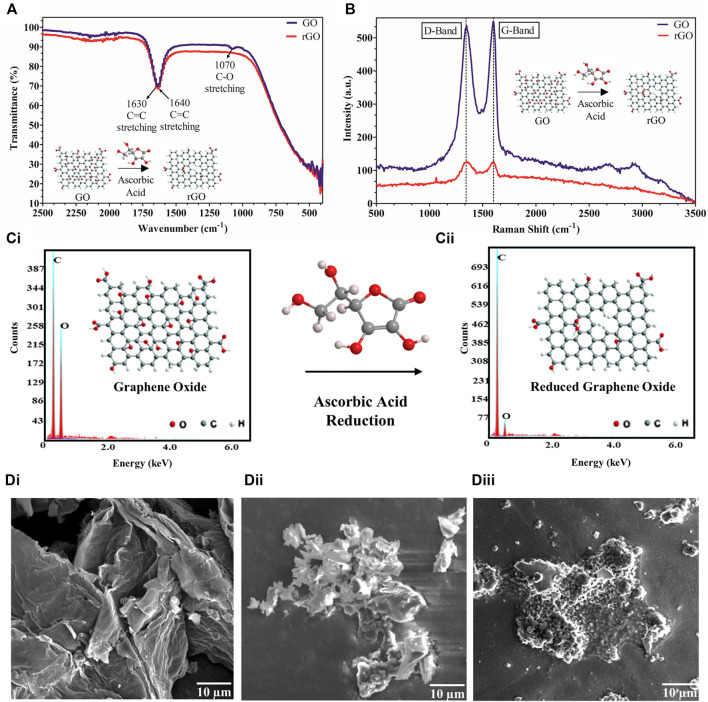
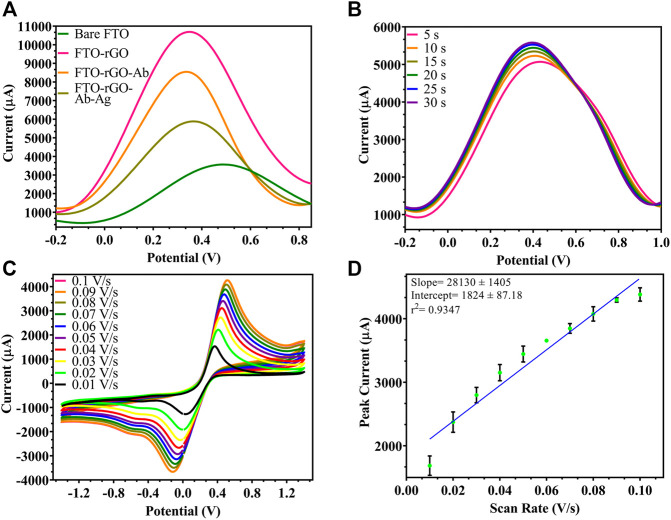
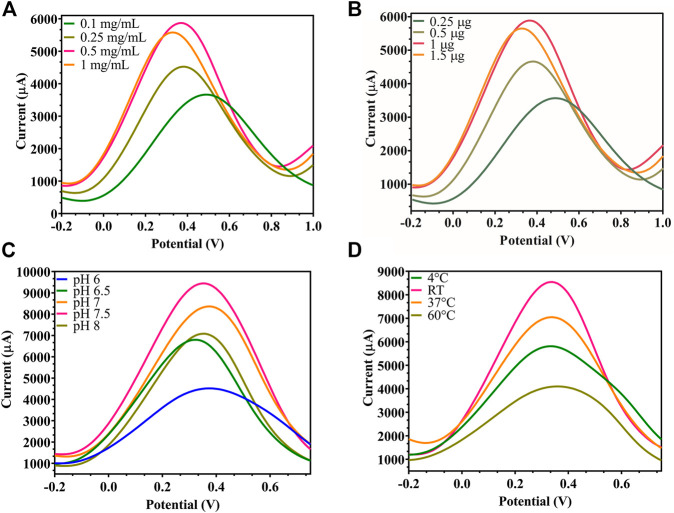
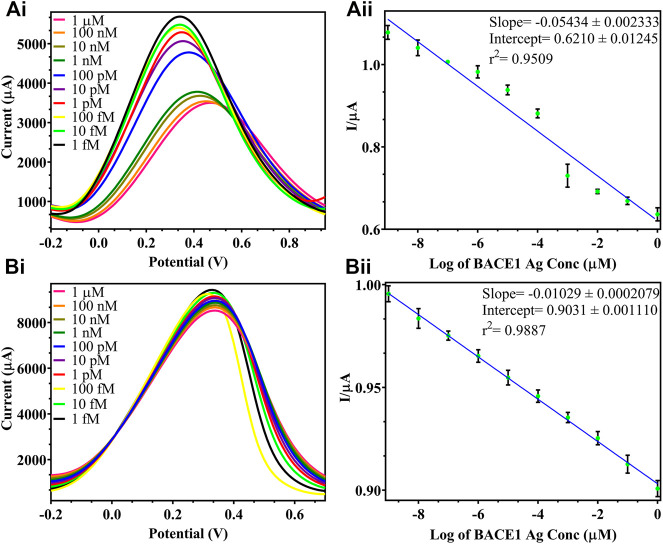
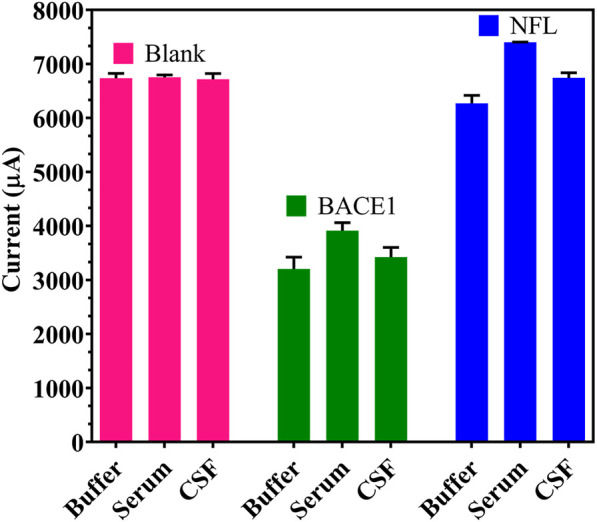
β-Secretase1 (BACE1) catalyzes the rate-limiting step in the generation of amyloid-β peptides, that is, the principal component involved in the pathology of Alzheimer's disease (AD). Recent research studies show correlation between blood and cerebrospinal fluid (CSF) levels of BACE1 with the pathophysiology of AD. In this study, we report one-step synthesized reduced graphene oxide (rGO), activated carbodiimide chemistry, conjugated with BACE1 antibody (Ab), and immobilized on fluorine-doped tin oxide (FTO) electrodes for rapid detection of BACE1 antigen (Ag) for AD diagnosis. The synthesis and fabrication steps were characterized using different types of spectroscopic, X-ray analytic, microscopic, and voltametric techniques. Various parameters including nanomaterial/Ab concentration, response time, pH, temperature, and rate of scan were standardized for maximum current output using the modified electrode. Final validation was performed detection of BACE1 Ag ranging from 1 fM to 1 µM, with a detection limit of 0.64 fM in buffer samples and 1 fM in spiked serum samples, as well as negligible cross-reactivity with neurofilament Ag in buffer, spiked serum, and spiked artificial CSF. The proposed immunosensor gave a quick result in 30 s, and good repeatability and storage stability for a month, making it a promising candidate for sensitive, specific, and early diagnosis of AD. Thus, the fabricated electrochemical biosensor for BACE-1 detection improves detection performance compared to existing sensors as well as reduces detection time and cost, signifying its potential in early diagnosis of AD in clinical samples.
β-分泌酶1(BACE1)催化淀粉样β肽生成过程中的限速步骤,而淀粉样β肽是阿尔茨海默病(AD)病理过程中的主要成分。最近的研究表明,BACE1的血液和脑脊液(CSF)水平与AD的病理生理过程相关。在本研究中,我们报告了一步合成还原氧化石墨烯(rGO),通过活化碳二亚胺化学方法将其与BACE1抗体(Ab)偶联,并固定在氟掺杂氧化锡(FTO)电极上,用于快速检测BACE1抗原(Ag)以诊断AD。使用不同类型的光谱、X射线分析、显微镜和伏安技术对合成和制备步骤进行了表征。使用修饰电极对包括纳米材料/抗体浓度、响应时间、pH值、温度和扫描速率在内的各种参数进行了标准化,以实现最大电流输出。最终验证是通过检测浓度范围为1 fM至1 μM的BACE1 Ag进行的,在缓冲液样品中的检测限为0.64 fM,在加标血清样品中的检测限为1 fM,并且在缓冲液、加标血清和加标人工脑脊液中与神经丝抗原的交叉反应可忽略不计。所提出的免疫传感器在30秒内给出快速结果,并且具有良好的重复性和一个月的储存稳定性,使其成为AD敏感、特异和早期诊断的有希望的候选者。因此,所制备的用于检测BACE-1的电化学生物传感器与现有传感器相比提高了检测性能,同时减少了检测时间和成本,表明其在临床样品中AD早期诊断的潜力。