Zhu Rong-Kun, Shi Jun, Zhou Hong-Jian, Ge Ling, Yin Wen-Hao, Zeng Hui, Wang Xiong-Wei
Department of Neurosurgery, Yangpu Hospital, School of Medicine, Tongji University, Shanghai, 200090, China.
Department of Neurology, Yangpu Hospital of Traditional Chinese Medicine, Shanghai, 200090, China.
Mater Today Bio. 2025 Jul 9;33:102064. doi: 10.1016/j.mtbio.2025.102064. eCollection 2025 Aug.
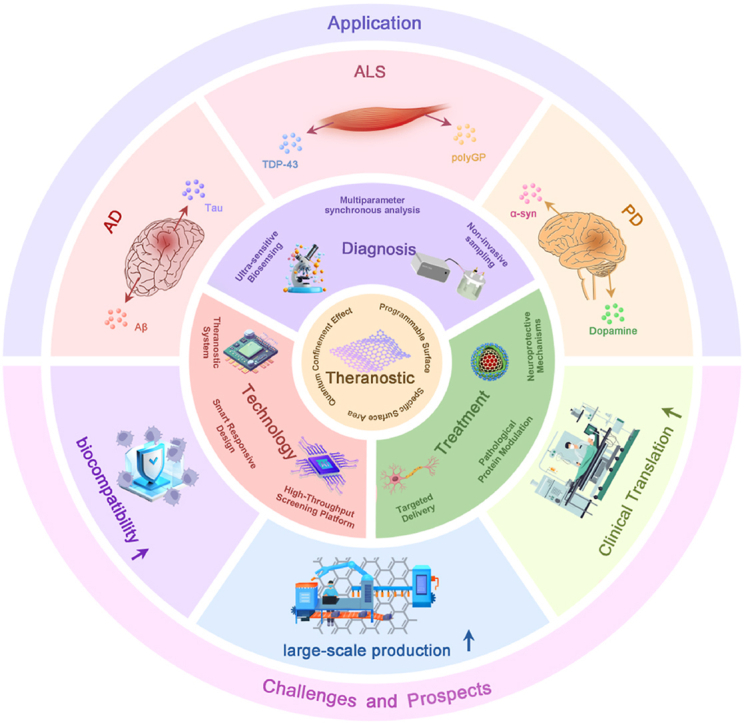
Neurodegenerative diseases (NDDs) have become a major challenge in global public health due to neurotoxicity caused by progressive neuronal degeneration and abnormal protein aggregation, which has attracted widespread attention. Graphene-based nanomaterials provide innovative solutions for the early diagnosis and precise treatment of NDDs by virtue of their ultra-high conductivity, large specific surface area and multifunctional properties. In this paper, we systematically discuss the key applications of these materials in the diagnosis and treatment of NDDs, and deeply analyze the technological breakthroughs and clinical translation challenges. The core of this paper is to illustrate that graphene-based nanomaterials are expected to reshape the paradigm of NDDs diagnosis and treatment through cross-scale technological innovations, promoting the synergistic development of early diagnosis, personalized treatment and real-time monitoring, and providing a transformative strategy for overcoming NDDs.
神经退行性疾病(NDDs)由于进行性神经元变性和异常蛋白质聚集所导致的神经毒性,已成为全球公共卫生领域的一项重大挑战,这一问题已引起广泛关注。基于石墨烯的纳米材料凭借其超高的导电性、大比表面积和多功能特性,为神经退行性疾病的早期诊断和精准治疗提供了创新解决方案。在本文中,我们系统地讨论了这些材料在神经退行性疾病诊断和治疗中的关键应用,并深入分析了技术突破和临床转化挑战。本文的核心在于阐明,基于石墨烯的纳米材料有望通过跨尺度技术创新重塑神经退行性疾病的诊断和治疗模式,推动早期诊断、个性化治疗和实时监测的协同发展,并为攻克神经退行性疾病提供变革性策略。