Kaveladze Benjamin T, Morris Robert R, Dimitrova-Gammeltoft Rosa Victoria, Goldenberg Amit, Gross James J, Antin Judd, Sandgren Melissa, Thomas-Hunt Melissa C
Department of Psychological Science, University of California, Irvine, Irvine, CA, United States.
Airbnb, San Francisco, CA, United States.
Front Digit Health. 2022 Mar 25;4:859849. doi: 10.3389/fdgth.2022.859849. eCollection 2022.
Loneliness, especially when chronic, can substantially reduce one's quality of life. However, positive social experiences might help to break cycles of loneliness by promoting more prosocial cognitions and behaviors. Internet-mediated live video communication platforms (eg Zoom and Twitch) may offer an engaging and accessible medium to deliver such social experiences to people at scale. Despite these platforms' widespread use, there is a lack of research into how their socially interactive elements affect users' feelings of loneliness and connection.
We aimed to experimentally evaluate whether socially interactivity in live video experience improves loneliness-related outcomes.
We recruited participants from an online survey recruitment platform and assigned half to participate in a socially interactive live video experience with 6-12 strangers and the other half to a non-interactive control experience that was designed to be identical in every way but not socially interactive. Participants completed several baseline self-report measures of psychosocial wellbeing, participated in the hour-long video experience (an entertaining astronomy lesson), and then completed some baseline measures again. Four weeks later, we followed up with participants to evaluate their change in trait loneliness since baseline. We Pre-registered our hypotheses and analysis plan and provide our data, analysis code, and study materials online.
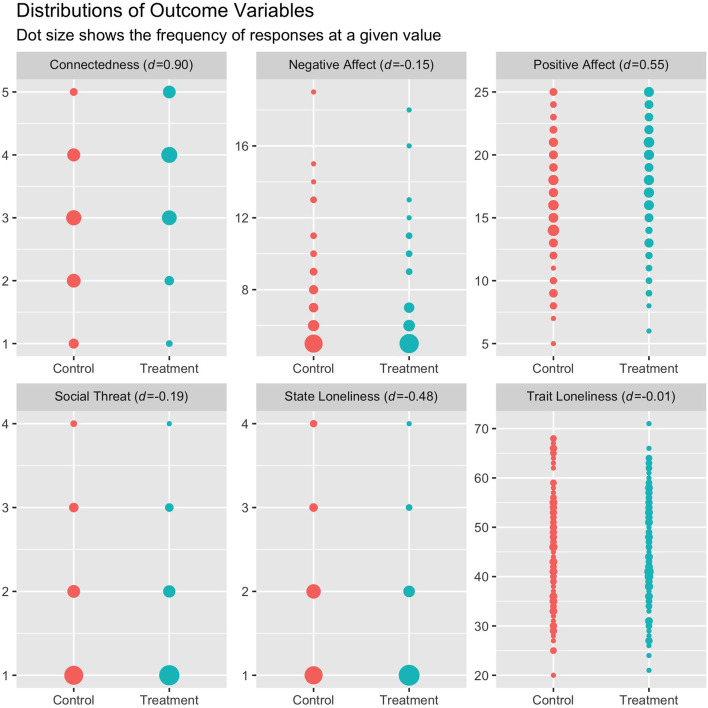
Two hundred and forty-nine participants completed the initial study and met inclusion criteria, 199 of whom also completed the 4-week follow-up. Consistent with our predictions, we found that directly after the more socially interactive experience, participants' feelings of connectedness increased more ( < 0.001), positive affect increased more ( = 0.002), feelings of loneliness decreased more ( < 0.001), social threat decreased more ( = 0.006), and negative affect decreased more ( = 0.003) than they did after the less interactive experience. However, change in trait loneliness between baseline and 4 weeks later did not differ between conditions ( = 0.953).
Including socially interactive components in live video experiences can improve loneliness-related psychosocial outcomes for a short time. Future work should explore leveraging these benefits toward longer-term prosociality. Future work can also identify if the effects we observed generalize across different populations and kinds of online experiences.
孤独,尤其是长期孤独,会显著降低一个人的生活质量。然而,积极的社交体验可能有助于通过促进更多亲社会认知和行为来打破孤独循环。互联网介导的实时视频通信平台(如Zoom和Twitch)可能提供一种引人入胜且易于使用的媒介,将此类社交体验大规模地传递给人们。尽管这些平台被广泛使用,但缺乏关于其社交互动元素如何影响用户孤独感和联系感的研究。
我们旨在通过实验评估实时视频体验中的社交互动性是否能改善与孤独相关的结果。
我们从一个在线调查招募平台招募参与者,将一半参与者分配到与6至12名陌生人进行社交互动的实时视频体验中,另一半分配到非互动对照体验中,该对照体验在各方面都设计得与前者相同,但不具有社交互动性。参与者完成了几项心理社会幸福感的基线自我报告测量,参加了长达一小时的视频体验(一堂有趣的天文学课),然后再次完成一些基线测量。四周后,我们对参与者进行随访,以评估他们自基线以来特质孤独感的变化。我们预先登记了我们的假设和分析计划,并在网上提供了我们的数据、分析代码和研究材料。
249名参与者完成了初始研究并符合纳入标准,其中199人也完成了4周的随访。与我们的预测一致,我们发现,在更具社交互动性的体验之后,参与者的联系感增加得更多(<0.001),积极情绪增加得更多(=0.002),孤独感减少得更多(<0.001),社交威胁减少得更多(=0.006),消极情绪减少得更多(=0.003),比在互动性较低的体验之后变化更大。然而,基线和4周后特质孤独感的变化在不同条件之间没有差异(=0.953)。
在实时视频体验中纳入社交互动成分可以在短时间内改善与孤独相关的心理社会结果。未来的工作应该探索如何利用这些益处促进长期亲社会行为。未来的工作还可以确定我们观察到的效果是否适用于不同人群和各类在线体验。