Speech & Language Therapy, South Tyneside & Sunderland NHS Foundation Trust, Sunderland Royal Hospital, Sunderland, UK.
Otolaryngology, Head and Neck Surgery, Freeman Hospital, Newcastle upon Tyne Hospitals NHS Foundation Trust, Newcastle upon Tyne, UK.
Int J Lang Commun Disord. 2022 Jul;57(4):737-748. doi: 10.1111/1460-6984.12709. Epub 2022 Apr 11.
Total laryngectomy (TL) results in permanent functional changes requiring rapid development of complex new skills. A significant portion of this learning happens in the acute post-surgical stage. There is increasing interest in enhanced recovery after surgery (ERAS) protocols in TL; however, implementation has been difficult. COVID-19 has placed significant pressures on acute services, requiring rapid service changes for TL patients.
To understand the acute patient experience of having a TL both before and during COVID-19.
METHODS & PROCEDURES: Semi-structured interviews using a pre-designed topic guide were conducted with 10 people who had undergone a TL within the last 2 years. Participants were recruited by their speech and language therapists using purposive sampling. Braun and Clarke's iterative approach to data collection and thematic analysis was used to generate key themes from the data.
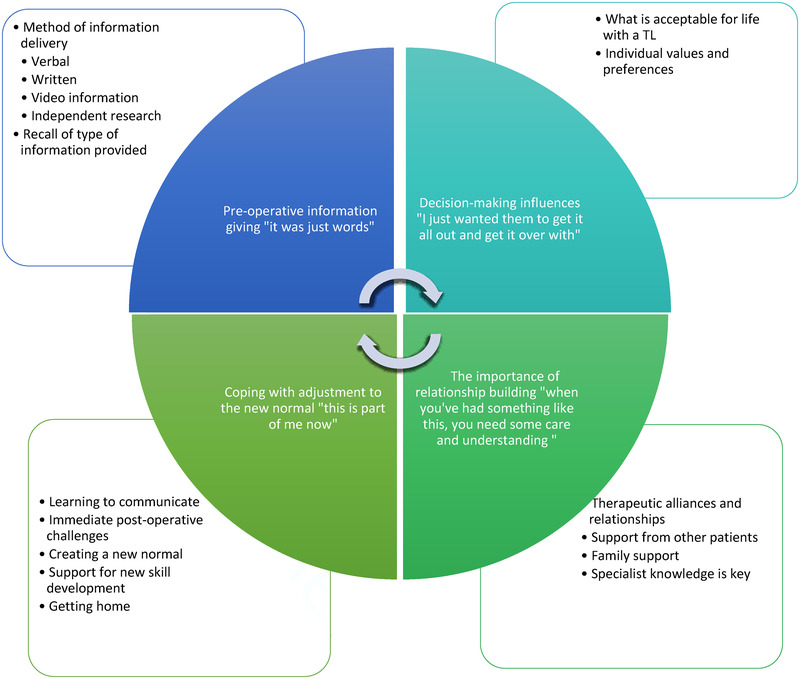
OUTCOMES & RESULTS: Thematic analysis identified four main themes: (1) pre-operative information-giving: 'it was just words'; (2) decision-making influences: 'I just wanted them to get it all out and get it over with'; (3) coping with adjustment to the new normal: 'this is part of me now'; and (4) the importance of relationship-building: 'when you've had something like this, you need some care and understanding'.
CONCLUSIONS & IMPLICATIONS: The need for an individualized approach to TL intervention which incorporates medical and psycho-social approaches from pre-treatment to acute discharge is vital. ERAS models should be reviewed to shift beyond the medical model alone. Rapid service changes due to COVID-19 did not contribute any major changes to the acute patient-reported experience.
What is already known on the subject We know that ERAS protocols have the potential to improve patient outcomes following TL. However, the research does not consider anything other than the early oral feeding debate and it has therefore been difficult to implement ERAS protocols in current service models. COVID19 required head and neck cancer services to make quick changes to surgical pathways, with the potential that some ERAS protocols had been adopted inadvertently. In order to understand the impact of this, we need to understand the patient experience following TL both before and during COVID19. What this paper adds to existing knowledge This paper used qualitative interviews to understand the acute patient experience following TL both during and before COVID19. Findings from these interviews highlighted that people were on the most part, well prepared for the functional changes they would experience after surgery. However, people felt there were gaps in service delivery at the pre-treatment and early discharge home period. Overall, the gaps identified were from a more psycho-social need suggesting that future ERAS models of care should consider both medical and psycho-social principles to enhance patient experience and outcome. What are the potential or actual clinical implications of this work? Pre-treatment services provided to people who have a TL could be reviewed to help maximize long-term adjustment to life. Areas which could be reviewed include the method and mode of information delivery. Further work needs to be done in partnership with community services to improve the immediate discharge home experience.
全喉切除术 (TL) 导致永久性功能改变,需要迅速发展复杂的新技能。这一学习的很大一部分发生在术后急性阶段。术后加速康复 (ERAS) 方案在 TL 中越来越受到关注;然而,实施起来却很困难。新冠疫情给急性服务带来了巨大压力,要求对 TL 患者的服务迅速改变。
了解 TL 患者在新冠疫情前后的急性患者体验。
采用预先设计的主题指南对 10 名最近 2 年内接受 TL 的患者进行半结构式访谈。参与者由言语治疗师通过目的性抽样招募。使用 Braun 和 Clarke 的迭代方法进行数据收集和主题分析,从数据中生成主要主题。
主题分析确定了四个主要主题:(1) 术前信息提供:“只是言语”;(2) 决策影响:“我只是想让他们把所有的东西都拿出来,然后结束”;(3) 适应新的正常生活:“这是我的一部分”;(4) 建立关系的重要性:“当你经历过这样的事情时,你需要一些关心和理解”。
从治疗前到急性出院,需要对 TL 干预采用个体化方法,纳入医疗和心理社会方法至关重要。ERAS 模型应进行审查,以不仅仅局限于医疗模式。由于新冠疫情导致的快速服务变化并没有给急性患者报告的体验带来任何重大变化。
我们知道 ERAS 方案有可能改善 TL 后的患者预后。然而,研究只考虑了早期口服喂养的争论,因此很难在当前的服务模式中实施 ERAS 方案。新冠疫情要求头颈部癌症服务快速改变手术途径,有可能无意中采用了一些 ERAS 方案。为了了解这一点,我们需要了解 TL 患者在新冠疫情前后的急性患者体验。
本文采用定性访谈的方法了解 TL 患者在新冠疫情前后的急性患者体验。这些访谈结果表明,大多数患者对术后将经历的功能变化有较好的准备。然而,人们觉得在治疗前和早期出院回家期间,服务提供存在差距。总的来说,确定的差距是更多的心理社会需求,这表明未来的 ERAS 护理模式应考虑医疗和心理社会原则,以提高患者体验和结果。
这项工作有什么潜在或实际的临床意义?
TL 患者的治疗前服务可以进行审查,以帮助最大程度地长期适应生活。可以审查的领域包括信息传递的方法和模式。需要与社区服务合作,进一步改善出院回家的即时体验。
