• 文献检索
  • 文档翻译
  • 深度研究
  • 学术资讯
  • Suppr Zotero 插件Zotero 插件
  • 邀请有礼
  • 套餐&价格
  • 历史记录
应用&插件
Suppr Zotero 插件Zotero 插件浏览器插件Mac 客户端Windows 客户端微信小程序
定价
高级版会员购买积分包购买API积分包
服务
文献检索文档翻译深度研究API 文档MCP 服务
关于我们
关于 Suppr公司介绍联系我们用户协议隐私条款
关注我们

Suppr 超能文献

核心技术专利:CN118964589B侵权必究
粤ICP备2023148730 号-1Suppr @ 2026

文献检索

告别复杂PubMed语法,用中文像聊天一样搜索,搜遍4000万医学文献。AI智能推荐,让科研检索更轻松。

立即免费搜索

文件翻译

保留排版,准确专业,支持PDF/Word/PPT等文件格式,支持 12+语言互译。

免费翻译文档

深度研究

AI帮你快速写综述,25分钟生成高质量综述,智能提取关键信息,辅助科研写作。

立即免费体验

COVID-19 确诊个体的听力学发现。

Audiological findings in individuals diagnosed with COVID-19.

机构信息

İzmir Tınaztepe University, Faculty of Health Sciences, İzmir, Turkey.

Necmettin Erbakan University, Faculty of Health Sciences, Konya, Turkey.

出版信息

Am J Otolaryngol. 2022 May-Jun;43(3):103428. doi: 10.1016/j.amjoto.2022.103428. Epub 2022 Apr 6.

DOI:10.1016/j.amjoto.2022.103428
PMID:35405495
原文链接:https://pmc.ncbi.nlm.nih.gov/articles/PMC8983074/
Abstract

PURPOSE

It is thought that COVID-19 may cause hearing loss, but its effects on the hearing system are not clear. This study aimed to reveal the effects of COVID-19 on the auditory system by using various audiological measurement methods in individuals diagnosed with COVID-19.

METHODS

Thirty individuals between the ages of 18-45, who were diagnosed with COVID-19 by PCR at least one month ago, and had no pre-COVID-19 hearing loss complaints, constituted the test group. Thirty individuals aged between 18 and 30 years and who had no history of hearing loss constituted the control group. Audiological evaluations of all participants were made with pure-tone audiometry, high-frequency audiometry, transient-evoked otoacoustic emission (TEOAE), distortion product otoacoustic emission (DPOAE), and auditory brainstem response (ABR) measurements.

RESULTS

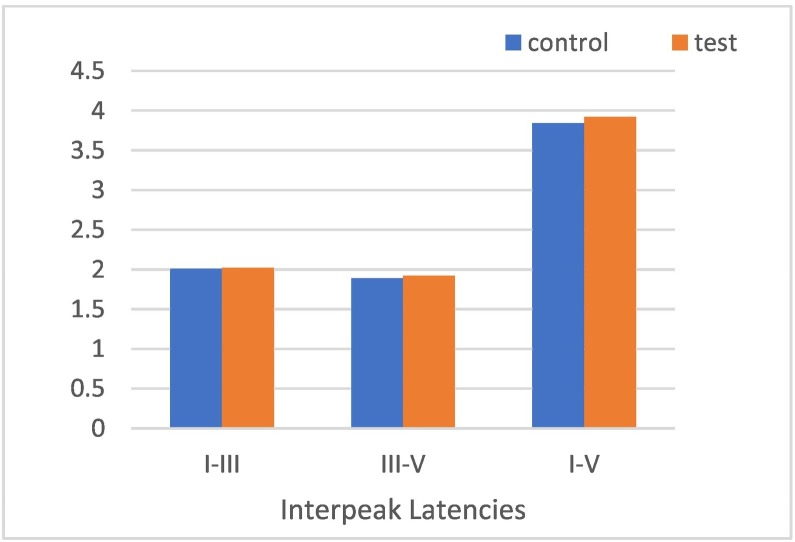
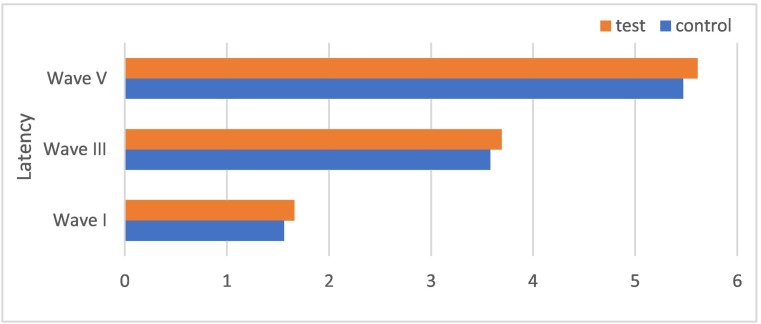
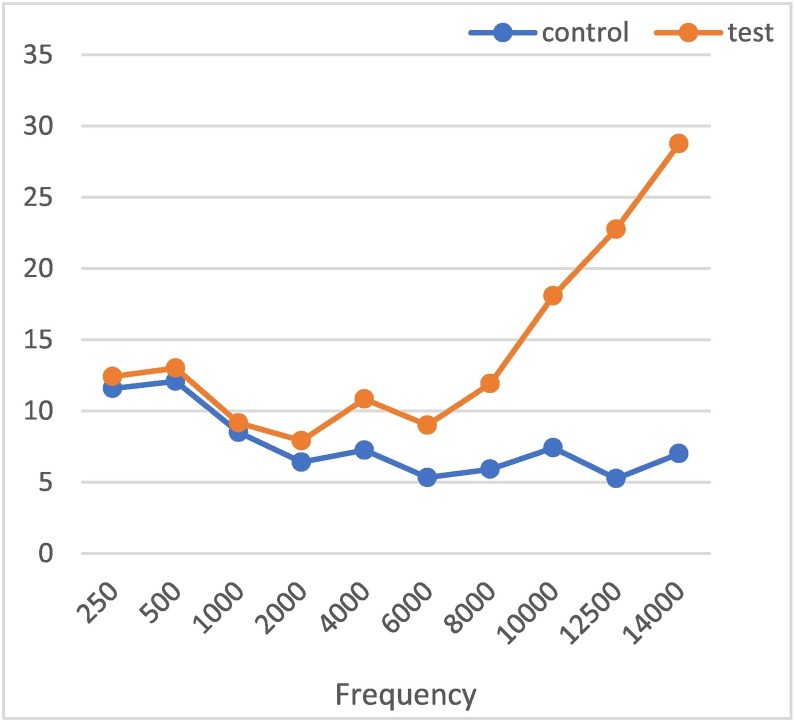
A significant difference was found between the groups at all high frequencies between 4 and 14 kHz (p < 0.05). TEOAE amplitudes at 1500 Hz, 2000 Hz and 4000 Hz frequencies and DPOAE amplitudes at 4003 Hz and higher frequencies were significantly lower in the test group (p < 0.05). While there was a significant difference between the I, III and V absolute latencies between the groups (p < 0.05), there was no significant difference between the I-III, III-V and I-V interpeak latencies (p > 0.05) as a result of the ABR test.

CONCLUSION

This study showed that COVID-19 can cause cochlear damage, especially at high frequencies. More studies are needed to determine the effects of COVID-19 on the auditory system.

摘要

目的

人们认为 COVID-19 可能导致听力损失,但 COVID-19 对听力系统的影响尚不清楚。本研究旨在通过使用各种听力学测量方法,揭示 COVID-19 对已确诊 COVID-19 个体的听觉系统的影响。

方法

本研究纳入了年龄在 18-45 岁之间、至少一个月前通过 PCR 确诊 COVID-19 且无 COVID-19 前听力损失投诉的 30 名个体作为实验组。年龄在 18-30 岁之间且无听力损失史的 30 名个体作为对照组。对所有参与者进行纯音测听、高频测听、瞬态诱发耳声发射(TEOAE)、畸变产物耳声发射(DPOAE)和听性脑干反应(ABR)测量。

结果

两组在 4-14 kHz 的所有高频范围内均存在显著差异(p<0.05)。实验组 1500 Hz、2000 Hz 和 4000 Hz 频率的 TEOAE 振幅和 4003 Hz 及更高频率的 DPOAE 振幅显著降低(p<0.05)。虽然两组的 I、III 和 V 绝对潜伏期之间存在显著差异(p<0.05),但 ABR 测试中 I-III、III-V 和 I-V 峰间潜伏期之间无显著差异(p>0.05)。

结论

本研究表明 COVID-19 可引起耳蜗损伤,尤其是高频听力损失。需要更多的研究来确定 COVID-19 对听觉系统的影响。
https://cdn.ncbi.nlm.nih.gov/pmc/blobs/323d/8983074/069828c25255/gr3_lrg.jpg
https://cdn.ncbi.nlm.nih.gov/pmc/blobs/323d/8983074/a544d39073e2/gr1_lrg.jpg
https://cdn.ncbi.nlm.nih.gov/pmc/blobs/323d/8983074/64b2886f4e61/gr2_lrg.jpg
https://cdn.ncbi.nlm.nih.gov/pmc/blobs/323d/8983074/069828c25255/gr3_lrg.jpg
https://cdn.ncbi.nlm.nih.gov/pmc/blobs/323d/8983074/a544d39073e2/gr1_lrg.jpg
https://cdn.ncbi.nlm.nih.gov/pmc/blobs/323d/8983074/64b2886f4e61/gr2_lrg.jpg
https://cdn.ncbi.nlm.nih.gov/pmc/blobs/323d/8983074/069828c25255/gr3_lrg.jpg

相似文献

1
Audiological findings in individuals diagnosed with COVID-19.COVID-19 确诊个体的听力学发现。
Am J Otolaryngol. 2022 May-Jun;43(3):103428. doi: 10.1016/j.amjoto.2022.103428. Epub 2022 Apr 6.
2
Interpreting auditory brainstem evoked responses and distortion product otoacoustic emissions in diabetic patients with normal hearing.解读正常听力的糖尿病患者的听觉脑干诱发反应和畸变产物耳声发射。
Auris Nasus Larynx. 2021 Apr;48(2):227-234. doi: 10.1016/j.anl.2020.08.022. Epub 2020 Sep 11.
3
Is type 1 diabetes mellitus a cause for subtle hearing loss in pediatric patients?1型糖尿病是小儿患者轻度听力损失的一个原因吗?
Eur Arch Otorhinolaryngol. 2015 Aug;272(8):1867-71. doi: 10.1007/s00405-014-2994-6. Epub 2014 Mar 14.
4
Association of Audiometric Measures with plasma long chain polyunsaturated fatty acids in a high-fish eating population: The Seychelles Child Development Study.在高鱼类摄入人群中,听力测量与血浆长链多不饱和脂肪酸的关系:塞舌尔儿童发展研究。
Neurotoxicology. 2020 Mar;77:137-144. doi: 10.1016/j.neuro.2020.01.005. Epub 2020 Jan 23.
5
[Effect of inner ear hearing loss on delayed otoacoustic emissions (TEOAE) and distortion products (DPOAE)].[内耳听力损失对瞬态耳声发射(TEOAE)和畸变产物耳声发射(DPOAE)的影响]
Laryngorhinootologie. 1996 Dec;75(12):709-18. doi: 10.1055/s-2007-997664.
6
The audiological profile of adults with and without hypertension.患有和未患有高血压的成年人的听力状况
Clinics (Sao Paulo). 2016 Apr;71(4):187-92. doi: 10.6061/clinics/2016(04)02.
7
[Application of objective audiological tests in bilateral tinnitus patients with normal hearing capability].客观听力测试在听力正常的双侧耳鸣患者中的应用
Lin Chuang Er Bi Yan Hou Tou Jing Wai Ke Za Zhi. 2016 Dec;30(23):1846-1849. doi: 10.13201/j.issn.1001-1781.2016.23.003.
8
An investigation of hearing impairment in de-novo Parkinson's disease patients: A preliminary study.新发帕金森病患者听力障碍的调查:一项初步研究。
Parkinsonism Relat Disord. 2015 Aug;21(8):987-91. doi: 10.1016/j.parkreldis.2015.06.007. Epub 2015 Jun 9.
9
Audiological profile of patients with type 2 diabetes mellitus.2 型糖尿病患者的听力学特征。
S Afr J Commun Disord. 2024 Jul 31;71(1):e1-e13. doi: 10.4102/sajcd.v71i1.1035.
10
Determining the cause of hearing loss: differential diagnosis using a comparison of audiometric and otoacoustic emission responses.确定听力损失的原因:通过比较听力测定和耳声发射反应进行鉴别诊断。
Ear Hear. 2006 Oct;27(5):508-25. doi: 10.1097/01.aud.0000233885.02706.ad.

引用本文的文献

1
Altered auditory brainstem responses are post-acute sequela of SARS-CoV-2 (PASC).听觉脑干反应改变是新冠病毒感染后急性后遗症(PASC)。
Sci Rep. 2025 Mar 18;15(1):9387. doi: 10.1038/s41598-025-93664-4.
2
Peripheral and brainstem auditory evaluation in post-COVID-19 individuals.新冠后个体的周围和脑干听觉评估。
Clinics (Sao Paulo). 2024 Aug 3;79:100472. doi: 10.1016/j.clinsp.2024.100472. eCollection 2024.
3
Does coronavirus disease 2019 affect peripheral and central auditory systems? Matched group cross-sectional study and six-month follow up.

本文引用的文献

1
Effects of Covid-19 on the audio-vestibular system.新冠病毒对听觉-前庭系统的影响。
Am J Otolaryngol. 2022 Jan-Feb;43(1):103173. doi: 10.1016/j.amjoto.2021.103173. Epub 2021 Aug 10.
2
The effect of coronavirus disease 2019 on the hearing system.新型冠状病毒肺炎对听觉系统的影响。
J Laryngol Otol. 2021 Sep;135(9):810-814. doi: 10.1017/S0022215121001961. Epub 2021 Aug 4.
3
Hearing Loss, Tinnitus, and Dizziness in COVID-19: A Systematic Review and Meta-Analysis.新型冠状病毒肺炎相关听力损失、耳鸣和头晕:系统评价和荟萃分析。
2019 年冠状病毒病是否影响外周和中枢听觉系统?匹配组横断面研究和 6 个月随访。
J Laryngol Otol. 2024 Jun;138(6):601-607. doi: 10.1017/S0022215124000355. Epub 2024 Mar 8.
4
Auditory and Vestibular Findings in Brazilian Adults Affected by COVID-19: An Exploratory Study.巴西成年人感染 COVID-19 后的听觉和前庭功能研究:一项探索性研究。
Audiol Neurootol. 2023;28(6):466-477. doi: 10.1159/000531207. Epub 2023 Jul 25.
5
Auditory function in symptomatic patients recovered from SARS-CoV-2 and unexposed patients: An analytical cross-sectional study.从新冠病毒感染中康复的有症状患者和未接触过病毒患者的听觉功能:一项分析性横断面研究。
J Otol. 2023 May 19;18(3):118-24. doi: 10.1016/j.joto.2023.05.004.
6
Sensorineural Hearing Loss in Patients with Long-COVID-19: Objective and Behavioral Audiometric Findings.新冠后综合征患者的感音神经性听力损失:客观及行为测听结果
Infect Drug Resist. 2023 Mar 31;16:1931-1939. doi: 10.2147/IDR.S398126. eCollection 2023.
7
Semi-Automated Analysis of Peak Amplitude and Latency for Auditory Brainstem Response Waveforms Using R.使用 R 对半自动化分析听觉脑干反应波形的峰值幅度和潜伏期。
J Vis Exp. 2022 Dec 9(190). doi: 10.3791/64737.
8
Comparative Study of Audiovestibular Symptoms between Early and Late Variants of COVID-19.新型冠状病毒肺炎早期和晚期变体的视听前庭症状比较研究
Audiol Res. 2022 Dec 4;12(6):680-695. doi: 10.3390/audiolres12060065.
9
Audiological profile of adult Long COVID patients.成人长新冠患者的听力学特征。
Am J Otolaryngol. 2022 Sep-Oct;43(5):103579. doi: 10.1016/j.amjoto.2022.103579. Epub 2022 Aug 5.
Can J Neurol Sci. 2022 Mar;49(2):184-195. doi: 10.1017/cjn.2021.63. Epub 2021 Apr 12.
4
Persistent Brainstem Dysfunction in Long-COVID: A Hypothesis.长新冠患者持续性脑干功能障碍:假说。
ACS Chem Neurosci. 2021 Feb 17;12(4):573-580. doi: 10.1021/acschemneuro.0c00793. Epub 2021 Feb 4.
5
Bilateral Sudden Sensorineural Hearing Loss and Intralabyrinthine Hemorrhage in a Patient With COVID-19.新冠病毒感染患者的双侧突发性感觉神经性聋和内耳出血。
Otol Neurotol. 2021 Jan;42(1):e10-e14. doi: 10.1097/MAO.0000000000002860.
6
Coronavirus disease 2019 and sudden sensorineural hearing loss.2019冠状病毒病与突发性感音神经性听力损失
J Laryngol Otol. 2020 Oct 1:1-3. doi: 10.1017/S0022215120002145.
7
Acute Profound Sensorineural Hearing Loss After COVID-19 Pneumonia.新冠病毒肺炎后急性重度感音神经性听力损失
Mayo Clin Proc. 2020 Aug;95(8):1801-1803. doi: 10.1016/j.mayocp.2020.05.034. Epub 2020 Jun 6.
8
COVID-19 May Predispose to Thrombosis by Affecting Both Vascular Endothelium and Platelets.新冠病毒可能通过影响血管内皮和血小板而导致血栓形成。
Clin Appl Thromb Hemost. 2020 Jan-Dec;26:1076029620933945. doi: 10.1177/1076029620933945.
9
Clinical Implications of Chloroquine and Hydroxychloroquine Ototoxicity for COVID-19 Treatment: A Mini-Review.氯喹和羟氯喹耳毒性对 COVID-19 治疗的临床意义:小型综述。
Front Public Health. 2020 May 29;8:252. doi: 10.3389/fpubh.2020.00252. eCollection 2020.
10
Audiological profile of asymptomatic Covid-19 PCR-positive cases.无症状新冠病毒 PCR 阳性病例的听力学特征。
Am J Otolaryngol. 2020 May-Jun;41(3):102483. doi: 10.1016/j.amjoto.2020.102483. Epub 2020 Apr 10.