College of Food and Chemical Engineering, Shaoyang University, Shaoyang 422000, China.
College of Food Science, Shenyang Agricultural University, Shenyang 110000, China.
Ultrason Sonochem. 2022 May;86:106001. doi: 10.1016/j.ultsonch.2022.106001. Epub 2022 Apr 6.
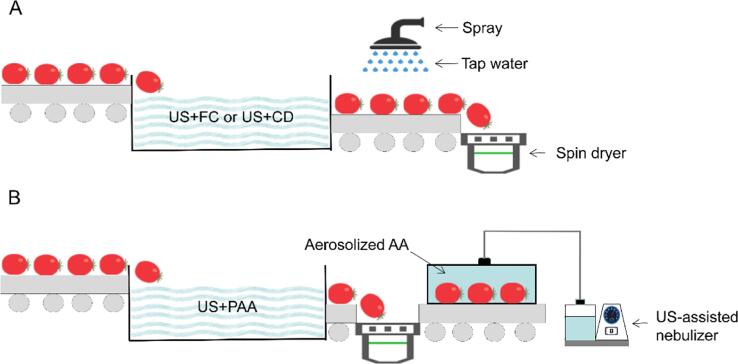
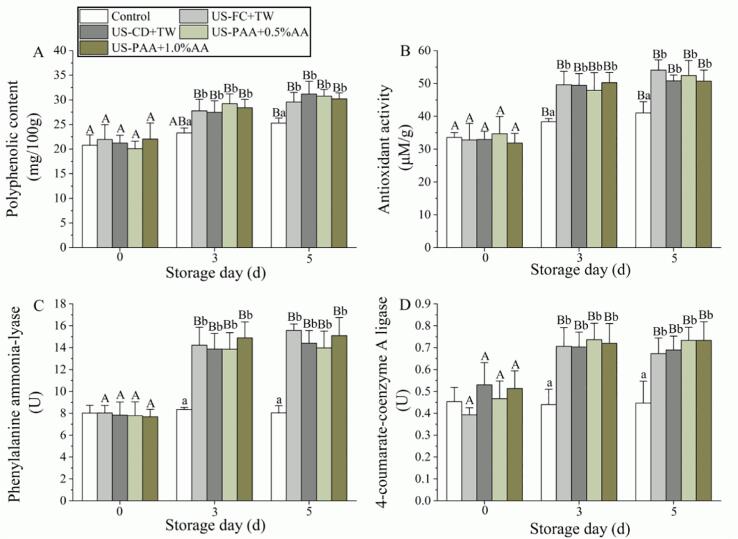
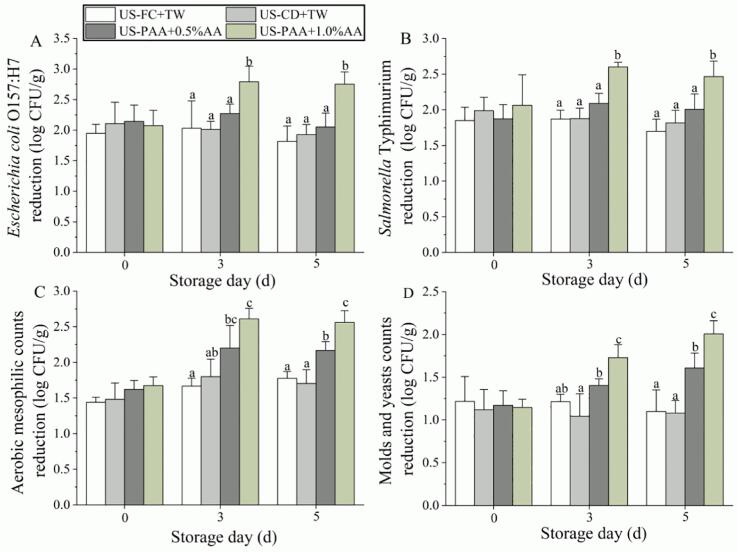
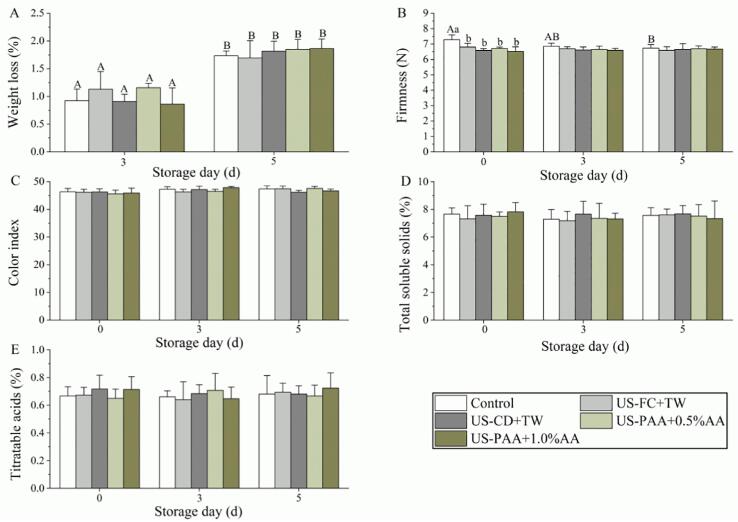
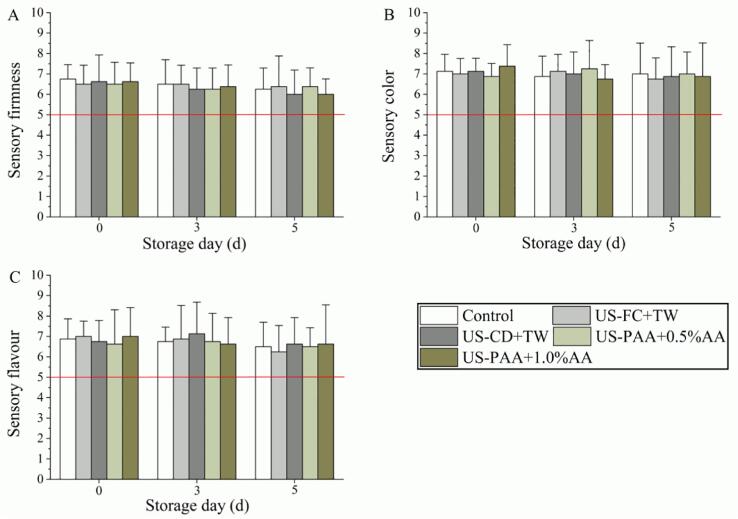
Traditional ultrasound (US)-assisted disinfection is only effective during washing. Coating is an effective method to control microbial growth after washing; however, cross-contamination can occur during immersion in the coating aqueous solution. Tap water (TW) rinsing is generally used to remove sanitizer residues after US-assisted washing; however, the Food and Drug Administration stated that rinsing is unnecessary when the peracetic acid (PAA) concentration does not exceed 80 ppm. In this study, we proposed a novel US-assisted hurdle technology of 80 ppm PAA combined with low-frequency US (25 kHz) during washing, followed by US-assisted aerosolization processing (nonimmersion coating). Ascorbic acid (AA), a safe and low-cost agent, was selected as the aerosolization solution. Cherry tomatoes were selected as the model, and the proposed method was compared with traditional US-assisted disinfection methods (US-10 ppm free chlorine washing + TW rinsing and US-5 ppm chlorine dioxide washing + TW rinsing) to analyze the disinfection efficacy and quality changes. During storage, US-PAA + 1%AA facilitated additional 0.7-0.9, 0.6-0.8, 0.7-1.0, and 0.5-1.0 log CFU/g reductions in the counts of Escherichia coli O157:H7, Salmonella Typhimurium, aerobic mesophilic counts, and molds and yeasts, respectively, as compared with traditional US-assisted methods. Sensory properties, color index, total soluble solids, titratable acidity, and weight loss were not negatively affected by any of the treatments. Firmness was slightly reduced after all treatments; however, the firmness of the samples was maintained during storage, in contrast with the decreased firmness observed in the control. Phenolic content and antioxidant activity significantly increased after all treatments. Further analysis of two key enzymes (phenylalanine ammonia-lyase and 4-coumarate-CoA ligase) involved in phenolic synthesis showed that their levels significantly increased following all treatments, leading to an increase in phenolic content and antioxidant activity. This result also indicated that US-assisted washing could act as an abiotic elicitor to increase nutritional content. Overall, US-PAA + 1%AA treatment served as an effective method for disinfecting produce during washing and for controlling microbial growth after washing without prolonging the processing time, which is an advantage over traditional US-assisted washing.
传统的超声(US)辅助消毒仅在洗涤过程中有效。涂层是一种在洗涤后控制微生物生长的有效方法;然而,在浸入涂层水溶液中时可能会发生交叉污染。自来水(TW)冲洗通常用于在 US 辅助洗涤后去除消毒剂残留;然而,食品和药物管理局表示,当过氧乙酸(PAA)浓度不超过 80 ppm 时,冲洗是不必要的。在这项研究中,我们提出了一种新型的 US 辅助障碍技术,即在洗涤过程中使用 80 ppm PAA 结合低频 US(25 kHz),然后进行 US 辅助雾化处理(非浸入式涂层)。选择抗坏血酸(AA)作为雾化溶液,它是一种安全且低成本的试剂。选择樱桃番茄作为模型,将所提出的方法与传统的 US 辅助消毒方法(US-10 ppm 游离氯洗涤+TW 冲洗和 US-5 ppm 二氧化氯洗涤+TW 冲洗)进行比较,以分析消毒效果和质量变化。在储存过程中,与传统的 US 辅助方法相比,US-PAA+1%AA 分别使大肠杆菌 O157:H7、鼠伤寒沙门氏菌、需氧嗜温菌计数和霉菌和酵母菌的计数减少了 0.7-0.9、0.6-0.8、0.7-1.0 和 0.5-1.0 log CFU/g。感官特性、颜色指数、总可溶性固体、可滴定酸度和失重不受任何处理的负面影响。所有处理后硬度略有降低;然而,与对照相比,样品的硬度在储存过程中得以保持。所有处理后,酚含量和抗氧化活性均显著增加。进一步分析参与酚类合成的两种关键酶(苯丙氨酸解氨酶和 4-香豆酸-CoA 连接酶)的水平表明,所有处理后其水平均显著升高,导致酚含量和抗氧化活性增加。这一结果还表明,US 辅助洗涤可以作为一种非生物诱导剂来提高营养含量。总的来说,US-PAA+1%AA 处理在洗涤过程中对农产品进行消毒,并在洗涤后控制微生物生长,而不延长处理时间,这是优于传统 US 辅助洗涤的优势。