Protić-Sabljić M, Tuteja N, Munson P J, Hauser J, Kraemer K H, Dixon K
Mol Cell Biol. 1986 Oct;6(10):3349-56. doi: 10.1128/mcb.6.10.3349-3356.1986.
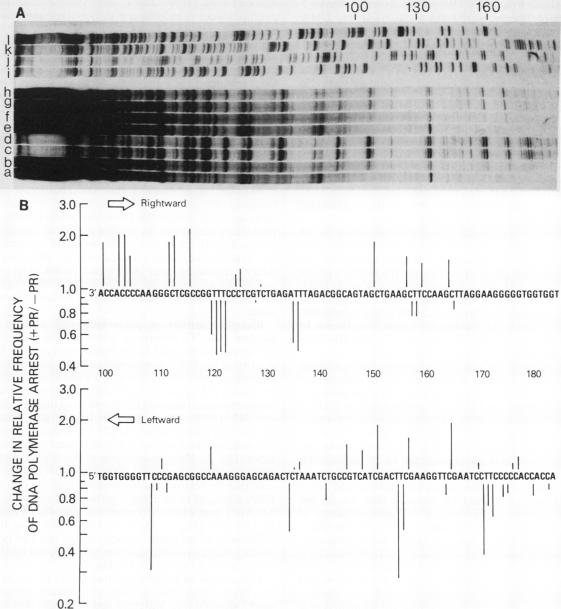
We used a simian virus 40-based shuttle vector plasmid, pZ189, to determine the role of pyrimidine cyclobutane dimers in UV light-induced mutagenesis in monkey cells. The vector DNA was UV irradiated and then introduced into monkey cells by transfection. After replication, vector DNA was recovered from the cells and tested for mutations in its supF suppressor tRNA marker gene by transformation of Escherichia coli carrying a nonsense mutation in the beta-galactosidase gene. When the irradiated vector was treated with E. coli photolyase prior to transfection, pyrimidine cyclobutane dimers were removed selectively. Removal of approximately 90% of the pyrimidine cyclobutane dimers increased the biological activity of the vector by 75% and reduced its mutation frequency by 80%. Sequence analysis of 72 mutants recovered indicated that there were significantly fewer tandem double-base changes and G X C----A X T transitions (particularly at CC sites) after photoreactivation of the DNA. UV-induced photoproducts remained (although at greatly reduced levels) at all pyr-pyr sites after photoreactivation, but there was a relative increase in photoproducts at CC and TC sites and a relative decrease at TT and CT sites, presumably due to a persistence of (6-4) photoproducts at some CC and TC sites. These observations are consistent with the fact that mutations were found after photoreactivation at many sites at which only cyclobutane dimers would be expected to occur. From these results we conclude that UV-induced pyrimidine cyclobutane dimers are mutagenic in DNA replicated in monkey cells.
我们使用了一种基于猿猴病毒40的穿梭载体质粒pZ189,来确定嘧啶环丁烷二聚体在紫外线诱导的猴细胞诱变中的作用。载体DNA经紫外线照射后,通过转染导入猴细胞。复制后,从细胞中回收载体DNA,并通过转化携带β-半乳糖苷酶基因无义突变的大肠杆菌,检测其supF抑制tRNA标记基因中的突变。当照射后的载体在转染前用大肠杆菌光解酶处理时,嘧啶环丁烷二聚体被选择性去除。去除约90%的嘧啶环丁烷二聚体可使载体的生物活性提高75%,并使其突变频率降低80%。对回收的72个突变体进行序列分析表明,DNA光复活后,串联双碱基变化和G X C----A X T转换(特别是在CC位点)明显减少。光复活后,紫外线诱导的光产物在所有嘧啶-嘧啶位点仍然存在(尽管水平大大降低),但CC和TC位点的光产物相对增加,TT和CT位点相对减少,推测是由于一些CC和TC位点存在(6-4)光产物。这些观察结果与以下事实一致:在光复活后,在许多预计只会出现环丁烷二聚体的位点发现了突变。从这些结果我们得出结论,紫外线诱导的嘧啶环丁烷二聚体在猴细胞中复制的DNA中具有诱变作用。