Japan Institute of Sports Sciences, Tokyo 115-0056, Japan.
Japan Society for the Promotion of Science, Tokyo 102-0083, Japan.
Nutrients. 2022 Mar 22;14(7):1320. doi: 10.3390/nu14071320.
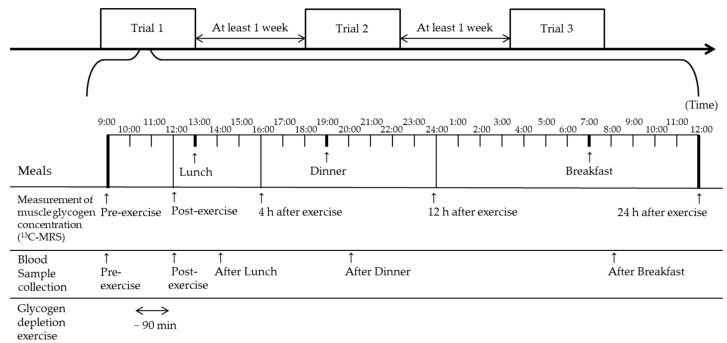
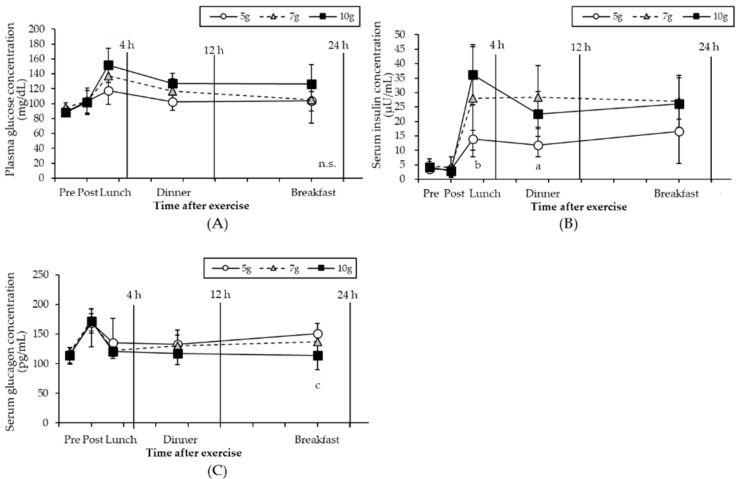
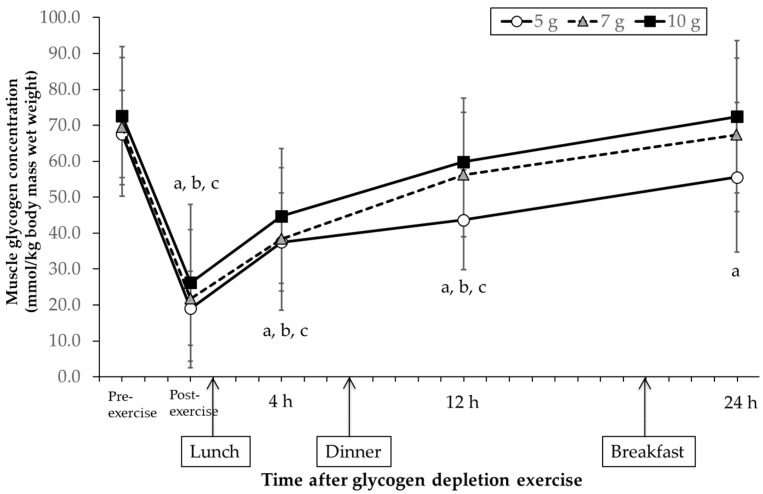
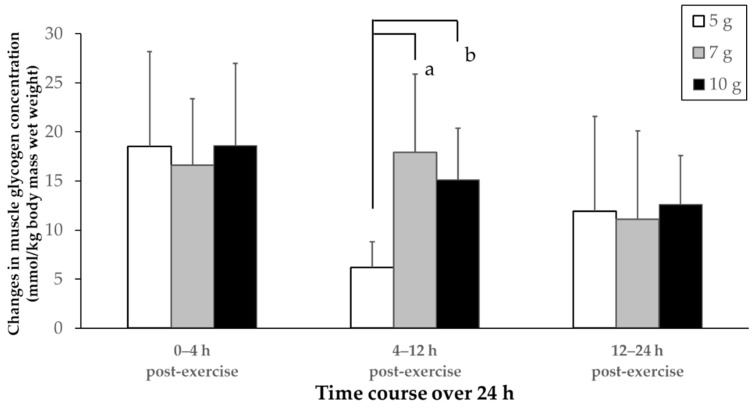
Daily muscle glycogen recovery after training is important for athletes. Few studies have reported a continuous change in muscle glycogen for 24 h. We aimed to investigate the changes in carbohydrate intake amount on muscle glycogen recovery for 24 h after exercise using 13C-magnetic resonance spectroscopy (13C-MRS). In this randomized crossover study, eight male participants underwent prolonged high-intensity exercise, and then consumed one of the three carbohydrate meals (5 g/kg body mass (BM)/d, 7 g/kg BM/d, or 10 g/kg BM/d). Glycogen content of thigh muscle was measured using 13C-MRS before, immediately after, and 4 h, 12 h and 24 h after exercise. Muscle glycogen concentration decreased to 29.9 ± 15.9% by exercise. Muscle glycogen recovery 4−12 h after exercise for the 5 g/kg group was significantly lower compared to those for 7 g/kg and 10 g/kg groups (p < 0.05). Muscle glycogen concentration after 24 h recovered to the pre-exercise levels for 7 g/kg and 10 g/kg groups; however, there was a significant difference for the 5 g/kg group (p < 0.05). These results suggest that carbohydrate intake of 5 g/kg BM/d is insufficient for Japanese athletes to recover muscle glycogen stores 24 h after completing a long-term high-intensity exercise.
运动后每天的肌肉糖原恢复对于运动员来说很重要。很少有研究报道过运动后 24 小时肌肉糖原的连续变化。我们旨在使用 13C-磁共振波谱(13C-MRS)研究运动后 24 小时内碳水化合物摄入量对肌肉糖原恢复的影响。在这项随机交叉研究中,8 名男性参与者进行了长时间的高强度运动,然后分别摄入三种碳水化合物餐中的一种(5 g/kg 体重(BM)/d、7 g/kg BM/d 或 10 g/kg BM/d)。在运动前、运动后即刻以及运动后 4 小时、12 小时和 24 小时使用 13C-MRS 测量大腿肌肉的糖原含量。运动使肌肉糖原浓度下降至 29.9 ± 15.9%。与 7 g/kg 和 10 g/kg 组相比,运动后 4-12 小时 5 g/kg 组的肌肉糖原恢复明显较低(p < 0.05)。7 g/kg 和 10 g/kg 组在 24 小时后肌肉糖原浓度恢复到运动前水平;然而,5 g/kg 组有显著差异(p < 0.05)。这些结果表明,对于日本运动员来说,在完成长期高强度运动后,5 g/kg BM/d 的碳水化合物摄入量不足以恢复肌肉糖原储备 24 小时。