Goff Louise M, Whyte Martin B, Samuel Miriam, Harding Scott V
Division of Diabetes and Nutritional Sciences, King's College London, Franklin-Wilkins Building, Stamford Street, London, SE1 9NH, UK.
Division of Diabetes and Nutritional Sciences, King's College London, Henriette Raphael Building, Room 2.29, Guy's Campus, London, SE1 1UL, UK.
Lipids Health Dis. 2016 Sep 2;15(1):145. doi: 10.1186/s12944-016-0315-3.
Black African (BA) populations are losing the cardio-protective lipid profile they historically exhibited, which may be linked with increasing fructose intakes. The metabolic effects of high fructose diets and how they relate to blood lipids are documented for Caucasians, but have not been described in BA individuals.
The principle objective of this pilot study was to assess the independent impacts of high glucose and fructose feeding in men of BA ancestry compared to men of White European (WE) ancestry on circulating triglyceride (TG) concentrations.
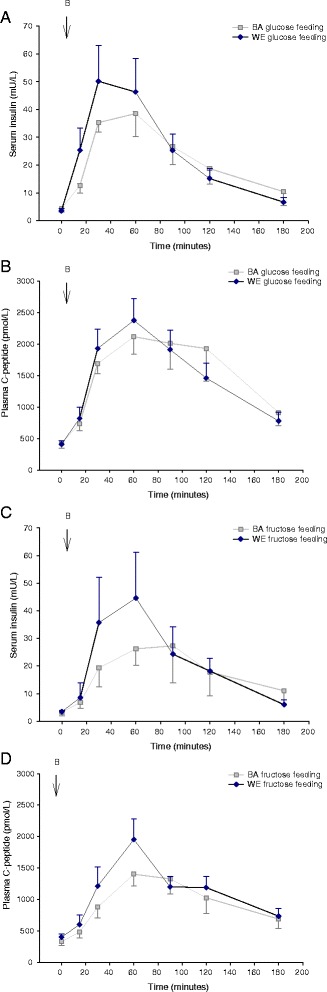
Healthy males, aged 25-60 years, of BA (n = 9) and WE (n = 11) ethnicity were randomly assigned to 2 feeding days in a crossover design, providing mixed nutrient meals with 20 % total daily caloric requirements from either added glucose or fructose. Circulating TG, non-esterified fatty acids (NEFA), glucose, insulin and C-peptide were measured over two 24-h periods.
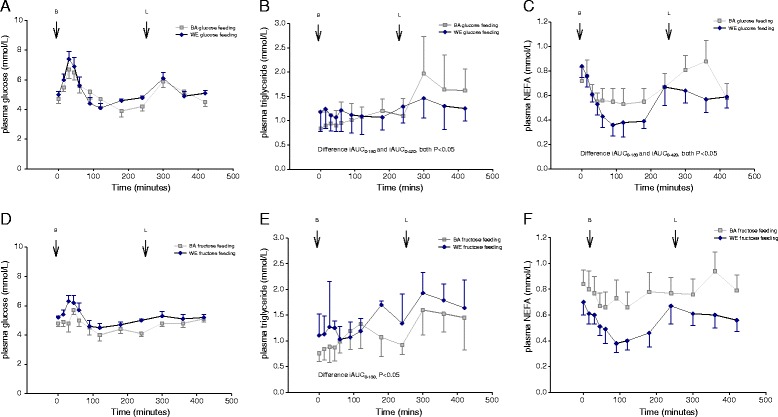
Fasting TGs were lower in BAs than WEs on the fructose feeding day (p < 0.05). There was a trend for fasting TG concentrations 24 h following fructose feeding to increase in both BA (baseline median fasting: 0.80, IQR 0.6-1.1 vs 24-h median post-fructose: 1.09, 0.8-1.4 mmol/L; p = 0.06) and WE (baseline median fasting 1.10, IQR 0.9-1.5 vs 24-h median post-fructose: 1.16, IQR 0.96-1.73 mmol/L; p = 0.06). Analysis within ethnic group demonstrated that in TG iAUC was significantly higher in BA compared to WE on both glucose (35, IQR 11-56 vs -4, IQR -10-1 mmol/L/min; p = 0.004) and fructose (48, IQR 15-68 vs 13, IQR -7-38 mmol/L/min; p = 0.04). Greater suppression of postprandial NEFA was evident in WE than BA after glucose feeding (-73, IQR -81- -52 vs -26, IQR -48- -3 nmol/L/min; p = 0.001) but there was no ethnic difference following fructose feeding.
Understanding the metabolic effects of dietary acculturation and Westernisation that occurs in Black communities is important for developing prevention strategies for chronic disease development. These data show postprandial hypertriglyceridemia following acute feeding of high added fructose and glucose in BA men, compared to WE men, may contribute to metabolic changes observed during dietary acculturation and Westernisation.
The study was retrospectively registered on clinicaltrials.gov: NCT02533817 .
非洲黑人(BA)群体正在失去他们历史上所呈现的心脏保护脂质谱,这可能与果糖摄入量增加有关。高果糖饮食的代谢影响及其与血脂的关系在高加索人群中已有记载,但在BA个体中尚未描述。
本试点研究的主要目的是评估与欧洲白人(WE)血统男性相比,高糖和高果糖饮食对BA血统男性循环甘油三酯(TG)浓度的独立影响。
年龄在25 - 60岁之间的健康BA(n = 9)和WE(n = 11)族裔男性采用交叉设计随机分配到2个喂食日,提供混合营养餐,其中添加葡萄糖或果糖的热量占每日总热量需求的20%。在两个24小时期间测量循环TG、非酯化脂肪酸(NEFA)、葡萄糖、胰岛素和C肽。
在果糖喂食日,BA的空腹TG低于WE(p < 0.05)。果糖喂食后24小时,BA(基线空腹中位数:0.80,IQR 0.6 - 1.1 vs果糖后24小时中位数:1.09,0.8 - 1.4 mmol/L;p = 0.06)和WE(基线空腹中位数1.10,IQR 0.9 - 1.5 vs果糖后24小时中位数:1.16,IQR 0.96 - 1.73 mmol/L;p = 0.06)的空腹TG浓度均有升高趋势。种族组内分析表明,在葡萄糖(35,IQR 11 - 56 vs -4,IQR -10 - 1 mmol/L/min;p = 0.004)和果糖(48,IQR 15 - 68 vs 13,IQR -7 - 38 mmol/L/min;p = 0.04)喂养时,BA的TG iAUC均显著高于WE。葡萄糖喂养后,WE餐后NEFA的抑制作用比BA更明显(-73,IQR -81 - -52 vs -26,IQR -48 - -3 nmol/L/min;p = 0.001),但果糖喂养后无种族差异。
了解黑人社区发生的饮食文化适应和西方化的代谢影响对于制定慢性病发展的预防策略很重要。这些数据表明,与WE男性相比,BA男性急性摄入高添加果糖和葡萄糖后出现餐后高甘油三酯血症,这可能导致饮食文化适应和西方化过程中观察到的代谢变化。
该研究在clinicaltrials.gov上进行了回顾性注册:NCT02533817 。