Department of Cardiology, Shengjing Hospital of China Medical University, Shenyang 110004, China.
School of Public Health, Shanghai Jiao Tong University School of Medicine, Shanghai 200025, China.
Nutrients. 2022 Mar 27;14(7):1394. doi: 10.3390/nu14071394.
Spermidine, a natural polyamine, was found critically involved in cardioprotection and lifespan extension from both animal experiments and human studies.
This study aimed to evaluate the effect of serum spermidine levels on the prognosis in patients with acute myocardial infarction (AMI) and investigate the potential mediation effect of oxidative stress in the above relationship.
We included 377 patients with AMI in a prospective cohort study and measured serum spermidine and oxidative stress indexes (superoxide dismutase enzymes, glutathione peroxidase, and Malondialdehyde) using high-performance liquid chromatography with fluorescence detector and enzyme-linked immunosorbent assay, respectively. The associations of spermidine with AMI outcomes were evaluated using Cox proportional hazards models.
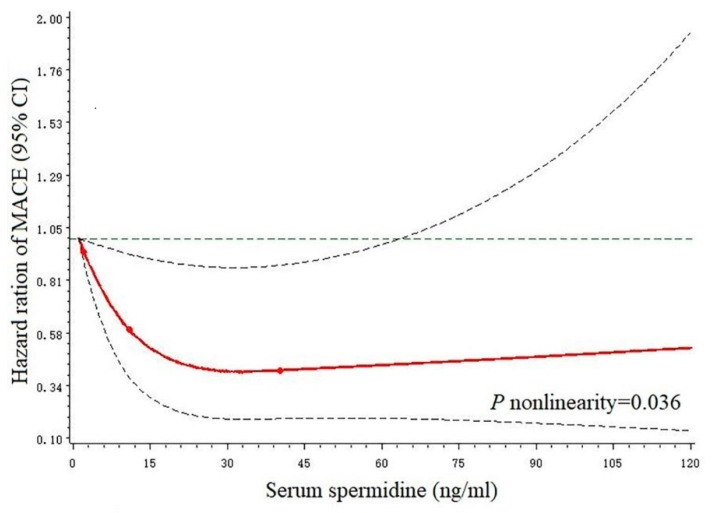
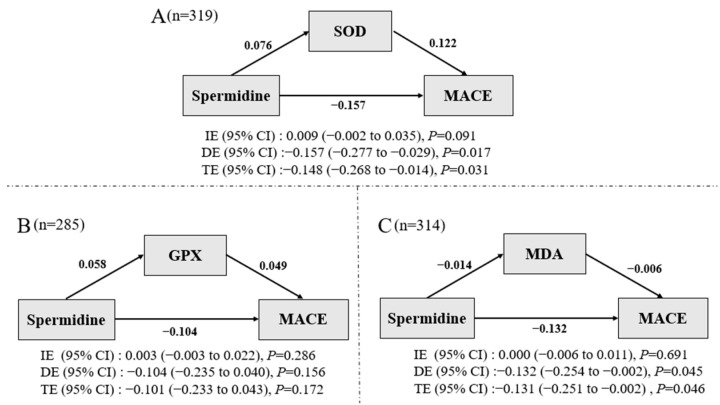
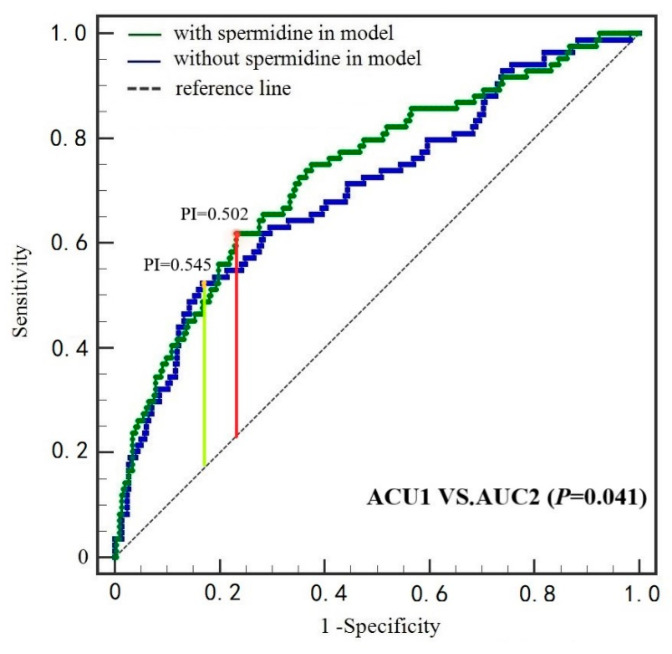
84 (22.3%) major adverse cardiac events (MACE) were documented during a mean follow-up of 12.3 ± 4.2 months. After multivariable adjustment, participants with serum spermidine levels of ≥15.38 ng/mL (T3) and 7.59-5.38 ng/mL (T2) had hazard ratio (HR) for recurrent AMI of 0.450 [95% confidence interval (CI): 0.213-0.984] and 0.441 (95% CI: 0.215-0.907) compared with the ≤7.59 ng/mL (T1), respectively. Participants in T3 and T2 had HR for MACE of 0.566 (95% CI: 0.329-0.947) and 0.516 (95% CI: 0.298-0.893) compared with T1. A faint J-shaped association was observed between serum spermidine levels and the risk of MACE (-nonlinearity = 0.036). Comparisons of areas under receiver operator characteristics curves confirmed that a model including serum spermidine levels had greater predictive power than the one without it (0.733 versus 0.701, = 0.041). A marginal statistically significant mediation effect of superoxide dismutase was shown on the association between spermidine and MACE ( = 0.091).
Serum spermidine was associated with an improved prognosis in individuals with AMI, whereas the underlying mechanism mediated by oxidative stress was not found.
精胺是一种天然多胺,在动物实验和人类研究中均发现其对心脏保护和延长寿命具有重要作用。
本研究旨在评估血清精胺水平对急性心肌梗死(AMI)患者预后的影响,并探讨氧化应激在上述关系中的潜在中介作用。
我们纳入了一项前瞻性队列研究中的 377 名 AMI 患者,使用高效液相色谱荧光检测法和酶联免疫吸附法分别测定血清精胺和氧化应激指标(超氧化物歧化酶、谷胱甘肽过氧化物酶和丙二醛)。使用 Cox 比例风险模型评估精胺与 AMI 结局的相关性。
在平均 12.3±4.2 个月的随访期间,有 84 例(22.3%)发生主要不良心脏事件(MACE)。多变量调整后,血清精胺水平≥15.38ng/mL(T3)和 7.59-5.38ng/mL(T2)的患者,与血清精胺水平≤7.59ng/mL(T1)相比,发生复发性 AMI 的风险比(HR)分别为 0.450(95%可信区间:0.213-0.984)和 0.441(95%可信区间:0.215-0.907)。T3 和 T2 组发生 MACE 的 HR 分别为 0.566(95%可信区间:0.329-0.947)和 0.516(95%可信区间:0.298-0.893),与 T1 组相比。血清精胺水平与 MACE 风险之间存在微弱的 J 型关联(-非线性=0.036)。比较受试者工作特征曲线下的面积证实,包含血清精胺水平的模型比不包含该模型具有更高的预测能力(0.733 比 0.701, = 0.041)。氧化应激介导的作用存在边际统计学显著的中介效应。
血清精胺与 AMI 患者的预后改善相关,而未发现氧化应激介导的潜在机制。