Institute of Intelligent Machines, Hefei Institutes of Physical Science, Chinese Academy of Sciences, Hefei 230031, China.
Science Island Branch of Graduate, University of Science and Technology of China, Hefei 230026, China.
Nutrients. 2022 Apr 4;14(7):1504. doi: 10.3390/nu14071504.
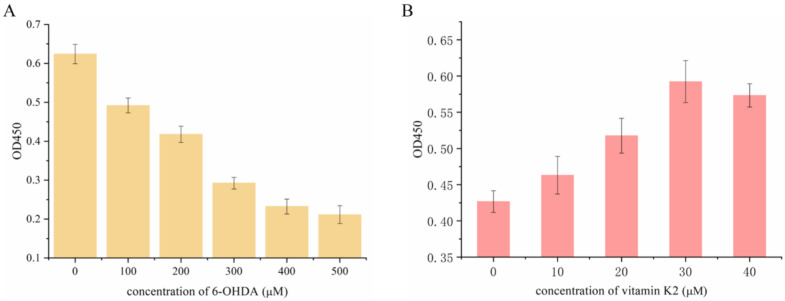
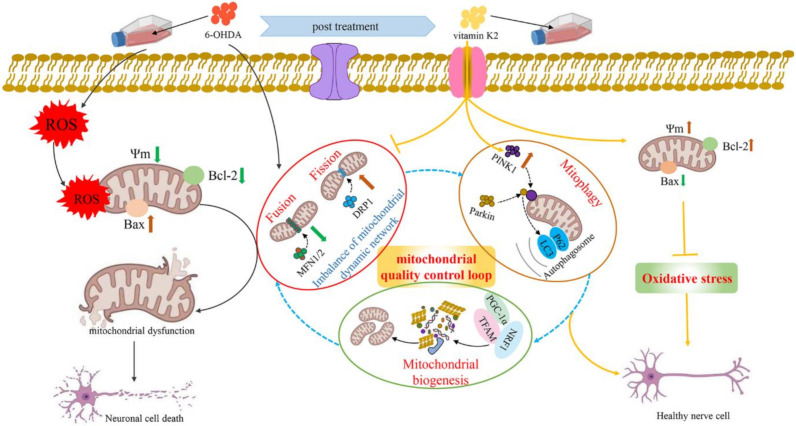
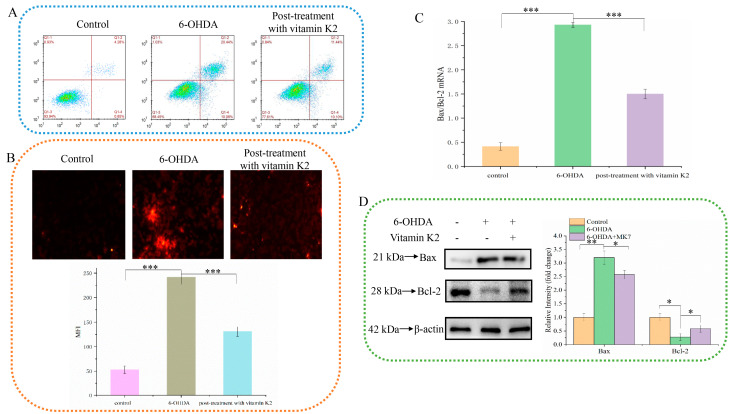
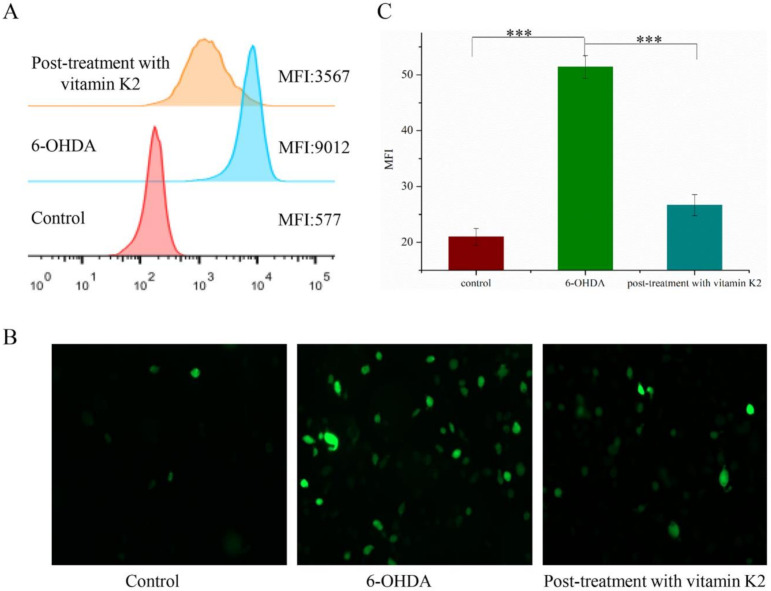
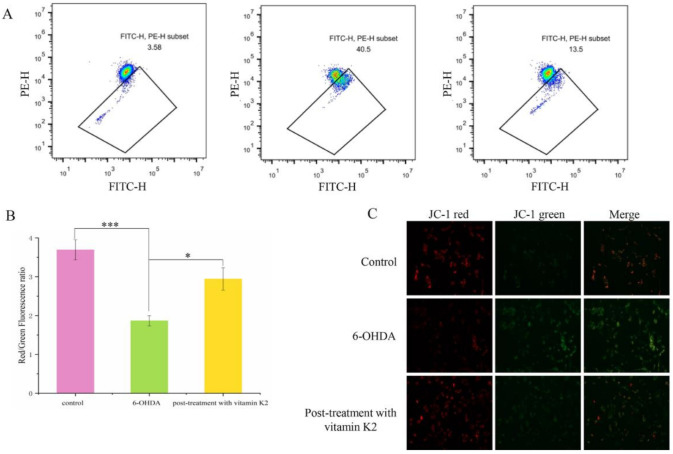
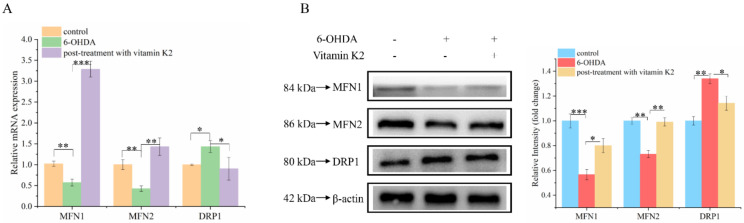
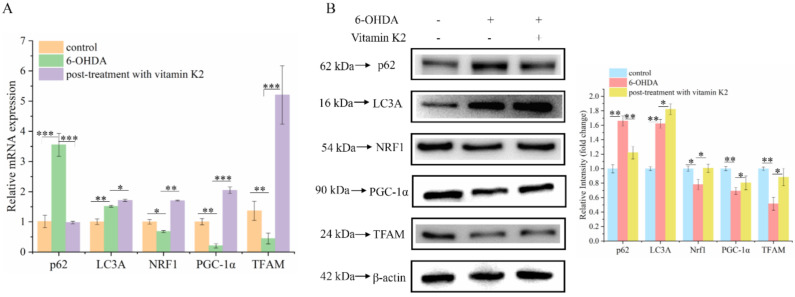
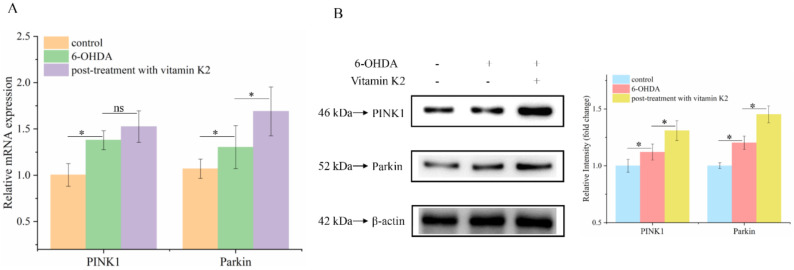
Vitamin K2, a natural fat-soluble vitamin, is a potent neuroprotective molecule, owing to its antioxidant effect, but its mechanism has not been fully elucidated. Therefore, we stimulated SH-SY5Y cells with 6-hydroxydopamine (6-OHDA) in a proper dose-dependent manner, followed by a treatment of vitamin K2. In the presence of 6-OHDA, cell viability was reduced, the mitochondrial membrane potential was decreased, and the accumulation of reactive oxygen species (ROS) was increased. Moreover, the treatment of 6-OHDA promoted mitochondria-mediated apoptosis and abnormal mitochondrial fission and fusion. However, vitamin K2 significantly suppressed 6-OHDA-induced changes. Vitamin K2 played a significant part in apoptosis by upregulating and downregulating Bcl-2 and Bax protein expressions, respectively, which inhibited mitochondrial depolarization, and ROS accumulation to maintain mitochondrial structure and functional stabilities. Additionally, vitamin K2 significantly inhibited the 6-OHDA-induced downregulation of the MFN1/2 level and upregulation of the DRP1 level, respectively, and this enabled cells to maintain the dynamic balance of mitochondrial fusion and fission. Furthermore, vitamin K2 treatments downregulated the expression level of p62 and upregulated the expression level of LC3A in 6-OHDA-treated cells via the PINK1/Parkin signaling pathway, thereby promoting mitophagy. Moreover, it induced mitochondrial biogenesis in 6-OHDA damaged cells by promoting the expression of PGC-1α, NRF1, and TFAM. These indicated that vitamin K2 can release mitochondrial damage, and that this effect is related to the participation of vitamin K2 in the regulation of the mitochondrial quality-control loop, through the maintenance of the mitochondrial quality-control system, and repair mitochondrial dysfunction, thereby alleviating neuronal cell death mediated by mitochondrial damage.
维生素 K2 是一种天然的脂溶性维生素,具有抗氧化作用,是一种有效的神经保护分子,但它的作用机制尚未完全阐明。因此,我们用适当剂量依赖性的 6-羟多巴胺(6-OHDA)刺激 SH-SY5Y 细胞,然后用维生素 K2 处理。在 6-OHDA 存在的情况下,细胞活力降低,线粒体膜电位降低,活性氧(ROS)积累增加。此外,6-OHDA 的处理促进了线粒体介导的细胞凋亡和异常的线粒体分裂和融合。然而,维生素 K2 显著抑制了 6-OHDA 诱导的变化。维生素 K2 通过上调和下调 Bcl-2 和 Bax 蛋白表达,分别在细胞凋亡中发挥重要作用,抑制线粒体去极化和 ROS 积累,以维持线粒体结构和功能的稳定性。此外,维生素 K2 显著抑制了 6-OHDA 诱导的 MFN1/2 水平下调和 DRP1 水平上调,使细胞能够维持线粒体融合和分裂的动态平衡。此外,维生素 K2 通过 PINK1/Parkin 信号通路下调了 6-OHDA 处理细胞中 p62 的表达水平,并上调了 LC3A 的表达水平,从而促进了线粒体自噬。此外,它通过促进 PGC-1α、NRF1 和 TFAM 的表达,诱导 6-OHDA 损伤细胞中线粒体的生物发生。这些表明,维生素 K2 可以释放线粒体损伤,这种作用与维生素 K2 参与调节线粒体质量控制环有关,通过维持线粒体质量控制系统和修复线粒体功能障碍,从而减轻线粒体损伤介导的神经元细胞死亡。