Jain Aditi, McCoy Matthew, Coats Carolyn, Brown Samantha Z, Addya Sankar, Pelz Carl, Sears Rosalie C, Yeo Charles J, Brody Jonathan R
The Jefferson Pancreas, Biliary and Related Cancer Center, Department of Surgery, Thomas Jefferson University, Philadelphia, PA 19107, USA.
Sidney Kimmel Cancer Center, Thomas Jefferson University, Philadelphia, PA 19107, USA.
Cancers (Basel). 2022 Apr 6;14(7):1848. doi: 10.3390/cancers14071848.
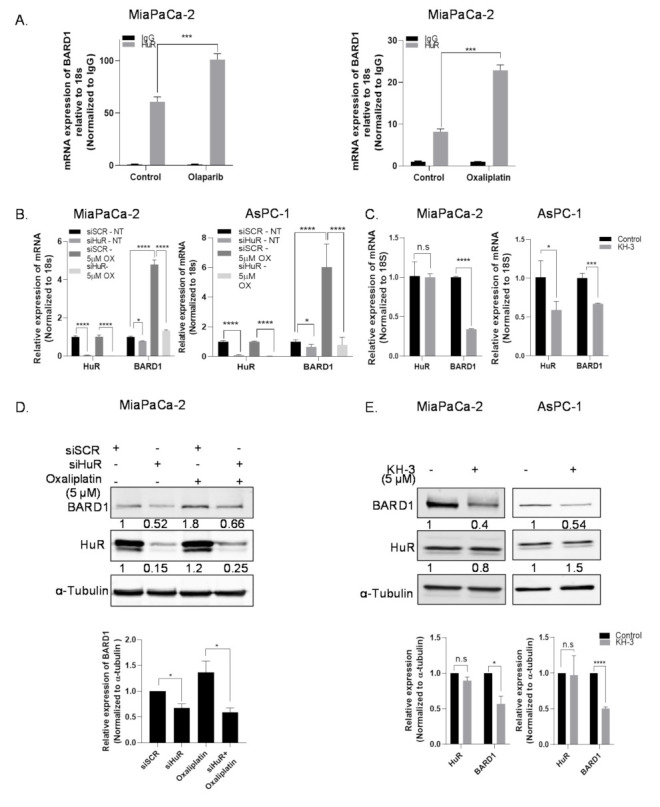
Human Antigen R (HuR/ELAVL1) is known to regulate stability of mRNAs involved in pancreatic ductal adenocarcinoma (PDAC) cell survival. Although several HuR targets are established, it is likely that many remain currently unknown. Here, we identified BARD1 mRNA as a novel target of HuR. Silencing HuR caused a >70% decrease in homologous recombination repair (HRR) efficiency as measured by the double-strand break repair (pDR-GFP reporter) assay. HuR-bound mRNAs extracted from RNP-immunoprecipitation and probed on a microarray, revealed a subset of HRR genes as putative HuR targets, including the BRCA1-Associated-Ring-Domain-1 (BARD1) (p < 0.005). BARD1 genetic alterations are infrequent in PDAC, and its context-dependent upregulation is poorly understood. Genetic silencing (siRNA and CRISPR knock-out) and pharmacological targeting of HuR inhibited both full length (FL) BARD1 and its functional isoforms (α, δ, Φ). Silencing BARD1 sensitized cells to olaparib and oxaliplatin; caused G2-M cell cycle arrest; and increased DNA-damage while decreasing HRR efficiency in cells. Exogenous overexpression of BARD1 in HuR-deficient cells partially rescued the HRR dysfunction, independent of an HuR pro-oncogenic function. Collectively, our findings demonstrate for the first time that BARD1 is a bona fide HuR target, which serves as an important regulatory point of the transient DNA-repair response in PDAC cells.
人抗原R(HuR/ELAVL1)已知可调节参与胰腺导管腺癌(PDAC)细胞存活的mRNA的稳定性。尽管已经确定了几个HuR靶点,但很可能目前仍有许多靶点未知。在这里,我们将BARD1 mRNA鉴定为HuR的一个新靶点。通过双链断裂修复(pDR-GFP报告基因)试验测量,沉默HuR导致同源重组修复(HRR)效率降低>70%。从RNP免疫沉淀中提取并在微阵列上进行检测的与HuR结合的mRNA,揭示了一组HRR基因作为假定的HuR靶点,包括BRCA1相关环结构域1(BARD1)(p<0.005)。BARD1基因改变在PDAC中并不常见,其在不同背景下的上调情况了解甚少。HuR的基因沉默(siRNA和CRISPR敲除)和药物靶向抑制了全长(FL)BARD1及其功能异构体(α、δ、Φ)。沉默BARD1使细胞对奥拉帕利和奥沙利铂敏感;导致G2-M期细胞周期停滞;增加DNA损伤,同时降低细胞中的HRR效率。在HuR缺陷细胞中外源过表达BARD1可部分挽救HRR功能障碍,这与HuR的促癌功能无关。总的来说,我们的研究结果首次证明BARD1是一个真正的HuR靶点,它是PDAC细胞中瞬时DNA修复反应的一个重要调控点。