
基于机器学习和综合生成数据的滚动轴承状态监测。
Condition Monitoring of Ball Bearings Based on Machine Learning with Synthetically Generated Data.
机构信息
Department for Integrated Sensor Systems, University for Continuing Education Krems, 2700 Wiener Neustadt, Austria.
Senzoro GmbH, 1030 Wien, Austria.
出版信息
Sensors (Basel). 2022 Mar 24;22(7):2490. doi: 10.3390/s22072490.
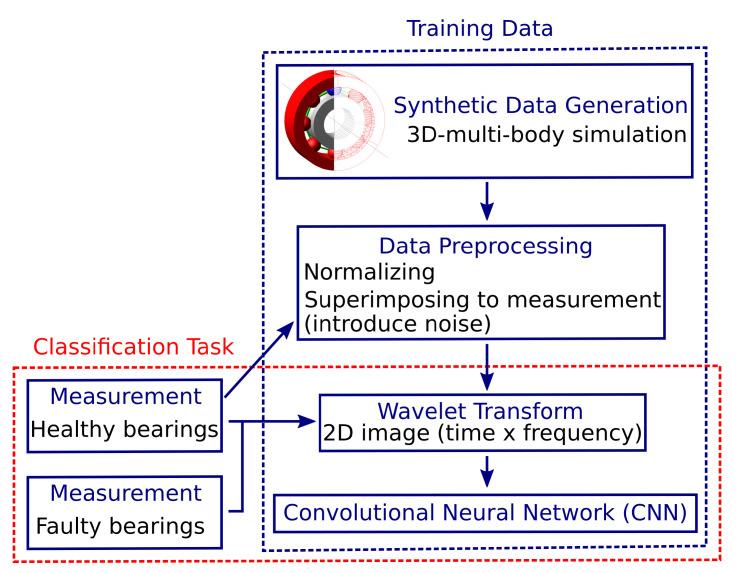
Rolling element bearing faults significantly contribute to overall machine failures, which demand different strategies for condition monitoring and failure detection. Recent advancements in machine learning even further expedite the quest to improve accuracy in fault detection for economic purposes by minimizing scheduled maintenance. Challenging tasks, such as the gathering of high quality data to explicitly train an algorithm, still persist and are limited in terms of the availability of historical data. In addition, failure data from measurements are typically valid only for the particular machinery components and their settings. In this study, 3D multi-body simulations of a roller bearing with different faults have been conducted to create a variety of synthetic training data for a deep learning convolutional neural network (CNN) and, hence, to address these challenges. The vibration data from the simulation are superimposed with noise collected from the measurement of a healthy bearing and are subsequently converted into a 2D image via wavelet transformation before being fed into the CNN for training. Measurements of damaged bearings are used to validate the algorithm's performance.
滚动轴承故障对机器整体故障的影响很大,因此需要采取不同的策略进行状态监测和故障检测。最近在机器学习方面的进展,甚至通过最小化计划维护来提高故障检测的准确性,从而进一步促进了经济上的目标。然而,仍然存在一些具有挑战性的任务,例如收集高质量的数据来明确训练算法,而且在历史数据的可用性方面也存在限制。此外,来自测量的故障数据通常仅适用于特定的机械部件及其设置。在这项研究中,对具有不同故障的滚子轴承进行了 3D 多体仿真,以创建各种用于深度学习卷积神经网络(CNN)的合成训练数据,从而解决这些挑战。模拟产生的振动数据与从健康轴承测量中收集的噪声叠加,然后通过小波变换转换为 2D 图像,再输入 CNN 进行训练。损坏轴承的测量用于验证算法的性能。




 Zotero 插件