State Key Laboratory of Ophthalmology, Zhongshan Ophthalmic Center, Sun Yat-Sen University, Guangdong Provincial Key Laboratory of Ophthalmology and Visual Science, Guangzhou, Guangdong, China.
Opthalmology, Department of Surgery, University of Melbourne, Melbourne, Victoria, Australia.
Br J Ophthalmol. 2023 Aug;107(8):1056-1065. doi: 10.1136/bjophthalmol-2021-320997. Epub 2022 Apr 11.
BACKGROUND/AIMS: Quantity of cataract surgery has long been an important public health indicator to assess health accessibility, however the quality of care has been less investigated. We aimed to summarise the up-to-date evidences to assess the real-world visual outcomes after cataract surgery in different settings.
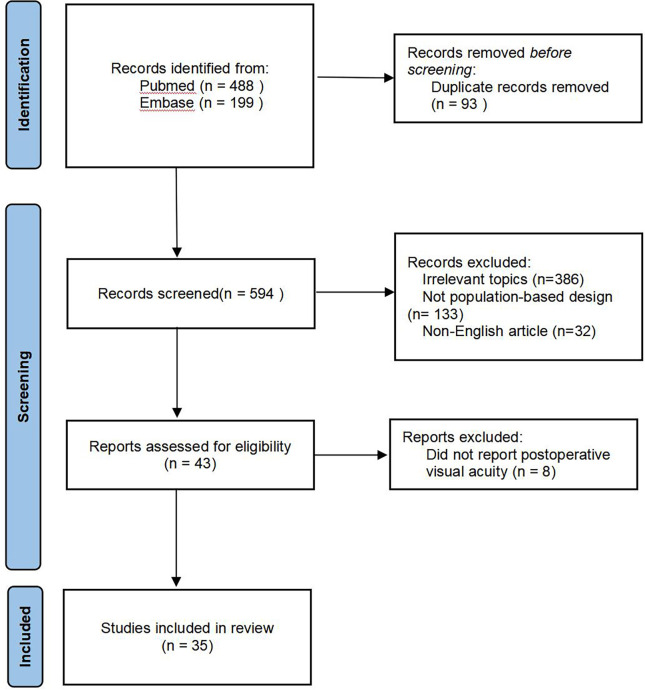
A systematic review was undertaken in October 2021. Population-based cross-sectional and longitudinal studies reporting vision-related outcomes after cataract surgery published from 2006 onward were included. A meta-analysis was not planned.
Twenty-six cross-sectional studies from low-income and middle-income countries (LMICs) and five cross-sectional studies from high-income countries (HICs) were included. The proportions of participants with postoperative presenting visual acuity (VA) ≥0.32 (20/60) were all over 70% in all HICS studies, but mostly below 70% in LMICS studies, ranging from 29.9% to 80.5%. Significant difference in postoperative VA was also observed within countries. The leading causes for postoperative visual impairment (defined mostly as presenting VA <20/60) mainly included refractive error, ocular comorbidities and surgical complications including posterior capsule opacification, except for one study in Nigeria wherein the leading cause was aphakia. Only four population-based cohort studies were included with 5-20 years of follow-up time, generally demonstrating no significant changes in postoperative visual outcomes during the follow-up.
We observed large inequality in the visual outcomes and principal causes of visual impairment after cataract surgery among different countries and regions. Structured quality control and enhancement programmes are needed to improve the outcomes of cataract surgery and reduce inequality.
背景/目的:白内障手术量一直是评估卫生可及性的重要公共卫生指标,但对护理质量的研究较少。我们旨在总结最新证据,评估不同环境下白内障手术后的真实视力结果。
我们于 2021 年 10 月进行了一项系统评价。纳入了 2006 年以来发表的报告白内障手术后与视力相关结果的基于人群的横断面和纵向研究。未计划进行荟萃分析。
纳入了 26 项来自中低收入国家(LMICs)的横断面研究和 5 项来自高收入国家(HICs)的横断面研究。所有 HICS 研究中,术后表现视力(VA)≥0.32(20/60)的参与者比例均超过 70%,但在 LMICS 研究中大多低于 70%,范围为 29.9%至 80.5%。在国内也观察到术后 VA 存在显著差异。术后视力障碍的主要原因(大多定义为表现 VA<20/60)主要包括屈光不正、眼部合并症和手术并发症,包括后囊混浊,但尼日利亚的一项研究除外,主要原因是无晶状体。仅纳入了四项基于人群的队列研究,随访时间为 5-20 年,一般表明在随访期间术后视力结果没有明显变化。
我们观察到不同国家和地区白内障手术后视力结果和视力障碍主要原因存在很大差异。需要实施结构化的质量控制和改进计划,以提高白内障手术的结果并减少不平等。