Criteo AI Lab, Paris, France.
INRIA, Parietal Team, Saclay, France.
Hum Brain Mapp. 2020 Aug 15;41(12):3318-3341. doi: 10.1002/hbm.25019. Epub 2020 Jun 5.
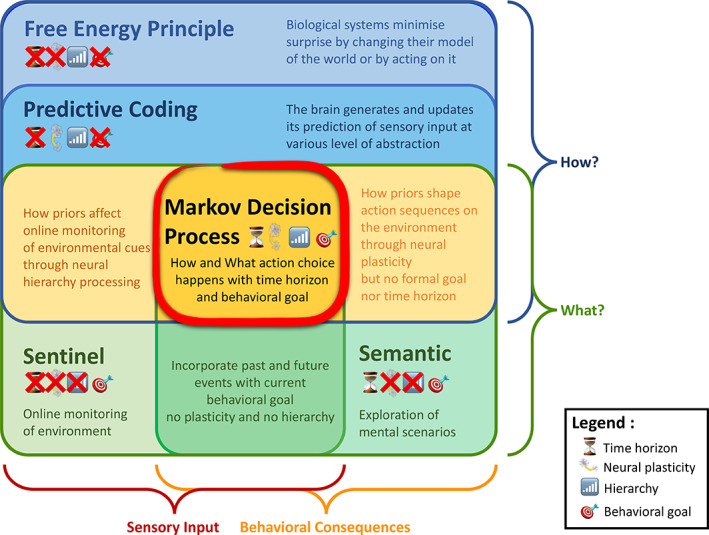
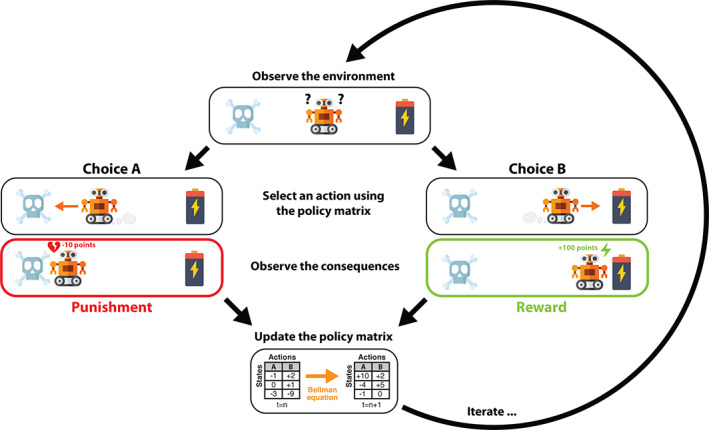
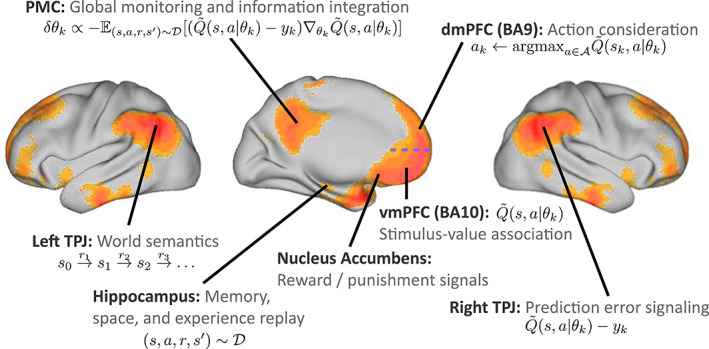
The default mode network (DMN) is believed to subserve the baseline mental activity in humans. Its higher energy consumption compared to other brain networks and its intimate coupling with conscious awareness are both pointing to an unknown overarching function. Many research streams speak in favor of an evolutionarily adaptive role in envisioning experience to anticipate the future. In the present work, we propose a process model that tries to explain how the DMN may implement continuous evaluation and prediction of the environment to guide behavior. The main purpose of DMN activity, we argue, may be described by Markov decision processes that optimize action policies via value estimates through vicarious trial and error. Our formal perspective on DMN function naturally accommodates as special cases previous interpretations based on (a) predictive coding, (b) semantic associations, and (c) a sentinel role. Moreover, this process model for the neural optimization of complex behavior in the DMN offers parsimonious explanations for recent experimental findings in animals and humans.
默认模式网络(DMN)被认为是人类基线心理活动的支撑。与其他大脑网络相比,它消耗的能量更高,与意识的紧密耦合指向一个未知的总体功能。许多研究表明,它在想象经验以预测未来方面具有进化适应性的作用。在目前的工作中,我们提出了一个过程模型,试图解释 DMN 如何实现对环境的连续评估和预测,以指导行为。我们认为,DMN 活动的主要目的可以通过通过代理试错来通过价值估计来优化行动策略的马尔可夫决策过程来描述。我们对 DMN 功能的形式观点自然地包含了基于(a)预测编码、(b)语义关联和(c)哨兵作用的先前解释作为特例。此外,这个 DMN 中复杂行为的神经优化过程模型为动物和人类的最近实验结果提供了简洁的解释。