Institute of Psychology, The John Paul II Catholic University of Lublin, Al. Racławickie 14, 20-950, Lublin, Poland.
Department of Educational and Health Psychology, University of Education Schwäbisch Gmünd, Oberbettringer Strasse 200, 73525, Schwäbisch Gmünd, Germany.
Sci Rep. 2022 Apr 15;12(1):6275. doi: 10.1038/s41598-022-10401-x.
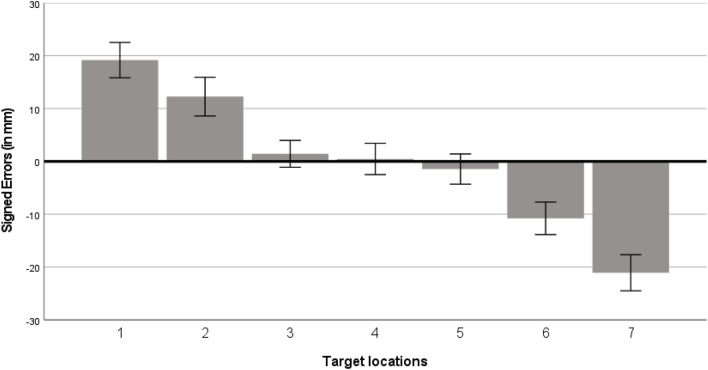
The current study tested strategies of spatial scaling in the haptic domain. Blindfolded adults (N = 31, aged 20-24 years) were presented with an embossed graphic including a target and asked to encode a target location on this map, imagine this map at a given scale, and to localize a target at the same spot on an empty referent space. Maps varied in three different sizes whereas the referent space had a constant size, resulting in three different scaling factors (1:1, 1:2, 1:4). Participants' response times and localization errors were measured. Analyses indicated that both response times and errors increased with higher scaling factors, suggesting the usage of mental transformation stratergies for spatial scaling. Overall, the present study provides a suitable, novel methodology to assess spatial scaling in the haptic domain.
本研究测试了触觉领域中的空间缩放策略。蒙住眼睛的成年人(N=31,年龄 20-24 岁)被呈现一个浮雕图形,其中包括一个目标,并被要求在该地图上编码目标位置,想象该地图在给定的比例下,并在一个空的参照空间中的相同位置定位目标。地图有三种不同的大小,而参照空间的大小保持不变,因此有三种不同的缩放因子(1:1、1:2、1:4)。测量了参与者的反应时间和定位误差。分析表明,反应时间和误差都随着较高的缩放因子而增加,这表明使用了心理转换策略来进行空间缩放。总的来说,本研究提供了一种适用于评估触觉领域中空间缩放的新方法。