Division of Cardiology, Department of Internal Medicine, Seoul St. Mary's Hospital, College of Medicine, The Catholic University of Korea, Seoul, 06591, Republic of Korea.
Catholic Research Institute for Intractable Cardiovascular Disease College of Medicine , The Catholic University of Korea , 06591, Seoul, Republic of Korea.
Cardiovasc Diabetol. 2022 Apr 16;21(1):52. doi: 10.1186/s12933-022-01490-z.
The prevention of subsequent cardiovascular disease (CVD) is an essential part of cancer survivorship care. We conducted the present study to investigate the association between the TyG index (a surrogate marker of insulin resistance) and the risk of cardiovascular disease (CVD) events in cancer survivors.
Adult cancer patients, who underwent routine health examinations during 2009-2010 and were survived for more than 5 years as of January 1, 2011, were followed for hospitalization of CVD (either ischemic heart disease, stroke, or heart failure) until December 2020. Cox model was used to calculate hazard ratios associated with baseline TyG index (log [fasting triglyceride (mg) × fasting glucose (mg)/2]) for the CVD hospitalization.
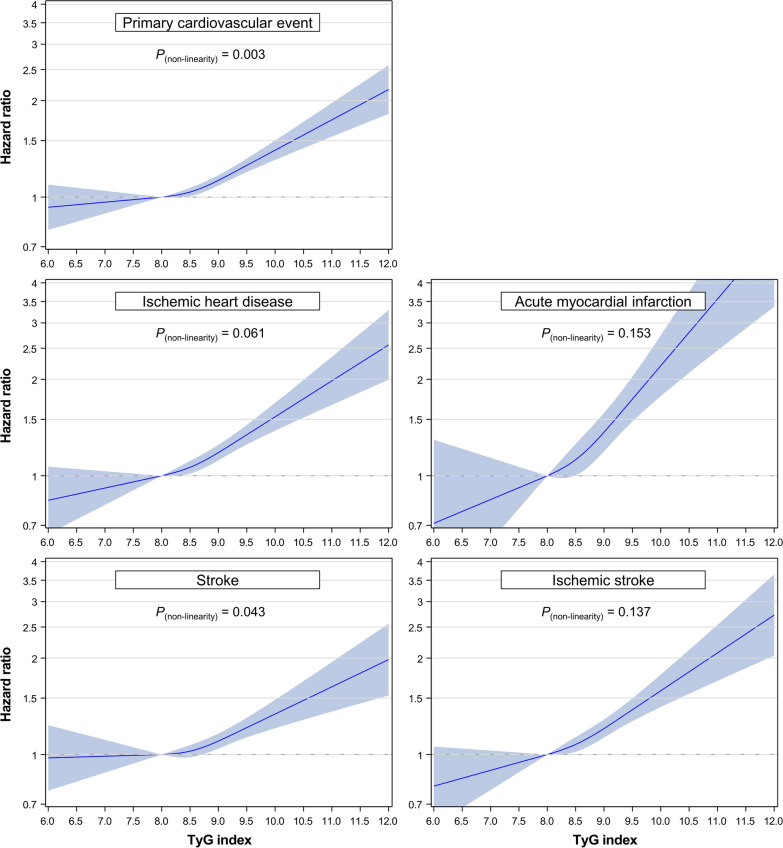
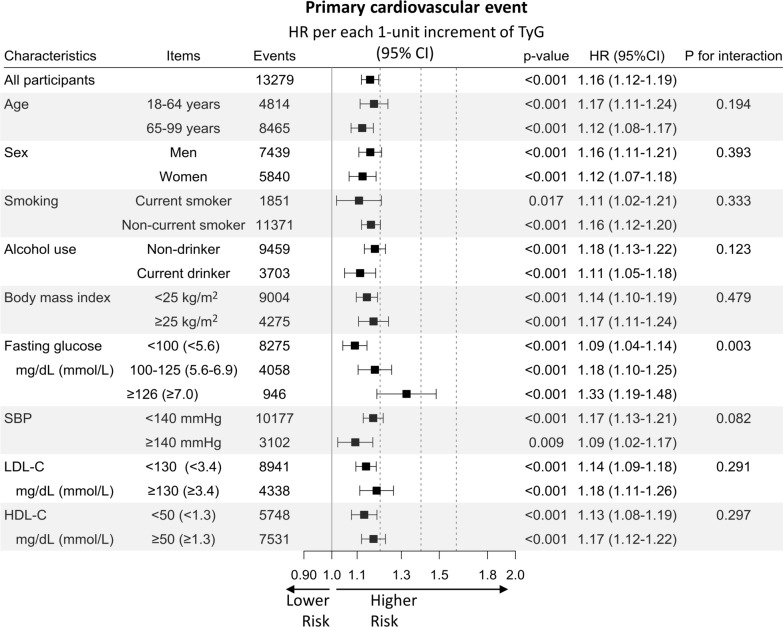
A total of 155,167 cancer survivors (mean age 59.9 ± 12.0 years, female 59.1%) were included in this study. A graded positive association was observed between TyG and CVD hospitalization. An 8% elevated risk for CVD hospitalization was observed for a TyG index of 8-8.4 (aHR 1.08 [95% CI 1.01-1.14]); 10% elevated risk for a TyG index of 8.5-8.9 (aHR 1.10 [95% CI 1.03-1.17]); 23% elevated risk for a TyG index of 9.0-9.4 (aHR 1.23 [95% CI 1.15-1.31]); 34% elevated risk for a TyG index of 9.5-9.9 (aHR 1.34 [95% CI 1.23-1.47]); and 55% elevated risk for a TyG index ≥ 10 compared to the reference group (TyG index < 8). Per 1-unit increase in the TyG index, a 16% increase in CVD hospitalization and a 45% increase in acute myocardial infarction hospitalization were demonstrated. Graded positive associations were evident for atherosclerotic CVD subtypes, such as ischemic heart disease, acute myocardial infarction, and ischemic stroke, but not for hemorrhagic stroke or heart failure.
The TyG index may serve as a simple surrogate marker for the risk stratification of future CVD events, particularly atherosclerotic subtypes, in cancer survivors.
预防后续心血管疾病(CVD)是癌症生存者护理的重要组成部分。我们进行了本项研究,旨在探讨 TyG 指数(胰岛素抵抗的替代标志物)与癌症生存者发生心血管疾病(CVD)事件的风险之间的关联。
在 2009 年至 2010 年期间接受常规健康检查且截至 2011 年 1 月 1 日存活时间超过 5 年的成年癌症患者,将其作为研究对象,随访至 2020 年 12 月,记录 CVD(包括缺血性心脏病、中风或心力衰竭)住院情况。采用 Cox 模型计算 CVD 住院相关的基线 TyG 指数(log [空腹甘油三酯(mg)×空腹血糖(mg)/2])的风险比。
本研究共纳入 155167 例癌症生存者(平均年龄 59.9±12.0 岁,女性占 59.1%)。TyG 与 CVD 住院之间存在分级正相关。TyG 指数为 8-8.4 时,CVD 住院风险增加 8%(风险比 1.08[95%可信区间 1.01-1.14]);TyG 指数为 8.5-8.9 时,CVD 住院风险增加 10%(风险比 1.10[95%可信区间 1.03-1.17]);TyG 指数为 9.0-9.4 时,CVD 住院风险增加 23%(风险比 1.23[95%可信区间 1.15-1.31]);TyG 指数为 9.5-9.9 时,CVD 住院风险增加 34%(风险比 1.34[95%可信区间 1.23-1.47]);TyG 指数≥10 时,CVD 住院风险增加 55%(风险比 1.34[95%可信区间 1.23-1.47]),与参考组(TyG 指数<8)相比。TyG 指数每增加 1 个单位,CVD 住院风险增加 16%,急性心肌梗死住院风险增加 45%。TyG 指数与动脉粥样硬化性 CVD 亚型(如缺血性心脏病、急性心肌梗死和缺血性中风)呈分级正相关,但与出血性中风或心力衰竭无关。
TyG 指数可作为癌症生存者未来 CVD 事件风险分层的简单替代标志物,尤其是动脉粥样硬化性亚型。