Department of Pharmacy, Tongji Hospital, Tongji Medical College, Huazhong University of Science and Technology, Wuhan, China.
Department of Pharmacy, Pengzhou Second People's Hospital, Pengzhou, China.
Front Public Health. 2022 Oct 20;10:996179. doi: 10.3389/fpubh.2022.996179. eCollection 2022.
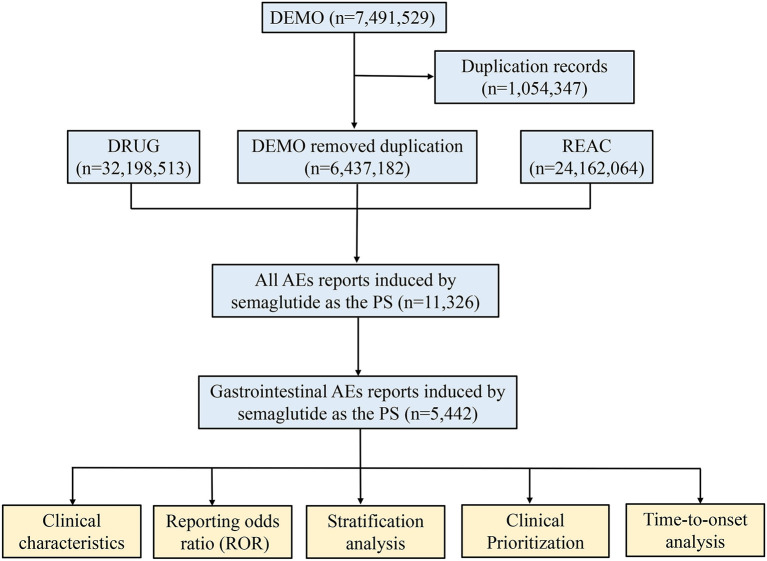
Semaglutide was approved for treatment of type 2 diabetes mellitus (T2DM) and chronic weight management in obesity or overweight adults. However, real-world data regarding its long-term gastrointestinal safety and tolerability in large sample population are incomplete. We evaluated semaglutide-associated gastrointestinal safety signals by data mining of the FDA pharmacovigilance database.
Reporting odds ratio (ROR) was employed to quantify the signals of semaglutide-related gastrointestinal adverse events (AEs) from 2018 to 2022. Serious and non-serious cases were compared by Mann-Whitney test or Chi-squared (χ) test, and signals were prioritized using a rating scale.
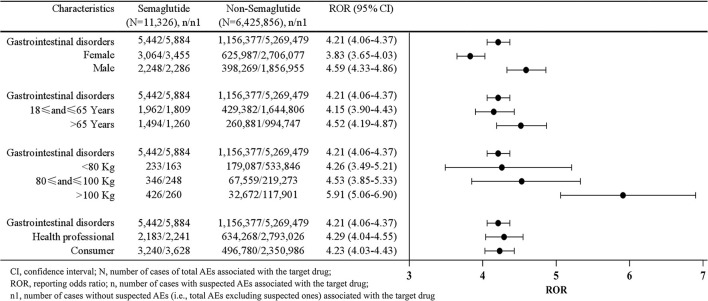
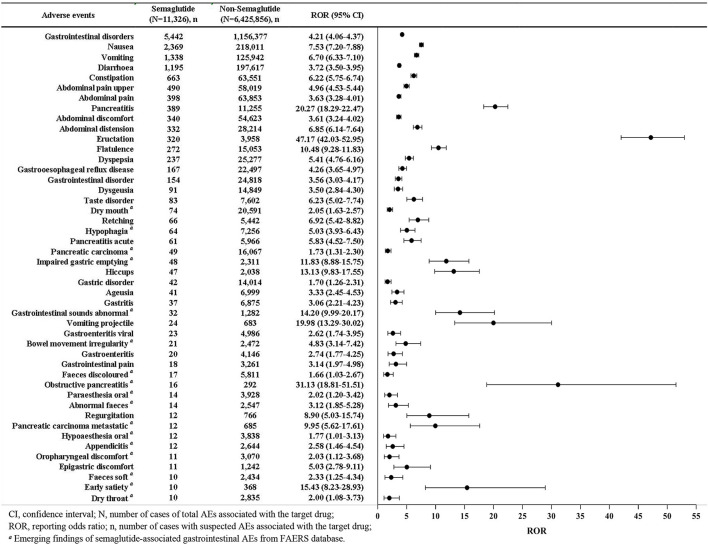
We identified 5,442 cases of semaglutide-associated gastrointestinal AEs, with 45 signals detected, ranging from a ROR of 1.01 (hypoaesthesia oral) to 42.03 (eructation), among which 17 AEs were identified as new and unexpected signals. Patient age ( < 0.001) and body weight ( = 0.006) rather than sex ( = 0.251) might be associated with an increased risk of gastrointestinal AEs severity. Notably, the association between semaglutide and gastrointestinal disorders remained when stratified by age, body weight, sex and reporter type. One strong, 22 moderate and 22 weak clinical priority signals were defined. The median time-to-onset (TTO) for strong clinical priority signal was 23 days, while for moderate and weak, they were 6 and 7 days, respectively. All of the disproportionality signals had early failure type features, suggesting that the risk of gastrointestinal AEs occurrence gradually decreased over time.
Our study provided a deeper and broader understanding of semaglutide's gastrointestinal safety profiles, which would help healthcare professionals to mitigate the risk of gastrointestinal AEs in clinical practice.
司美格鲁肽已被批准用于治疗 2 型糖尿病(T2DM)以及肥胖或超重成人的慢性体重管理。然而,关于其在大样本人群中的长期胃肠道安全性和耐受性的真实世界数据并不完整。我们通过数据挖掘 FDA 药物警戒数据库来评估司美格鲁肽相关的胃肠道安全性信号。
采用报告比值比(ROR)来量化 2018 年至 2022 年司美格鲁肽相关胃肠道不良事件(AE)的信号。采用 Mann-Whitney U 检验或卡方(χ 2 )检验比较严重和非严重病例,使用评级量表对信号进行优先级排序。
我们共发现 5442 例司美格鲁肽相关胃肠道 AE,共检测到 45 个信号,ROR 范围为 1.01(口腔感觉迟钝)至 42.03(呃逆),其中 17 个 AE 被确定为新的和意外信号。患者年龄(<0.001)和体重(=0.006)而非性别(=0.251)可能与胃肠道 AE 严重程度增加相关。值得注意的是,在按年龄、体重、性别和报告者类型分层时,司美格鲁肽与胃肠道疾病之间的相关性仍然存在。定义了 1 个强、22 个中度和 22 个弱的临床优先信号。强临床优先信号的中位 TTO 为 23 天,而中度和弱度信号的 TTO 分别为 6 天和 7 天。所有不成比例的信号均具有早期失效型特征,这表明胃肠道 AE 发生的风险随时间逐渐降低。
本研究提供了对司美格鲁肽胃肠道安全性特征的更深入和更广泛的了解,这将有助于医疗保健专业人员在临床实践中降低胃肠道 AE 的风险。