Domínguez Rubio A Paula, D'Antoni Cecilia L, Piuri Mariana, Pérez Oscar E
Departamento de Química Biológica, Facultad de Ciencias Exactas y Naturales, Universidad de Buenos Aires, Buenos Aires, Argentina.
Instituto de Química Biológica de la Facultad de Ciencias Exactas y Naturales, Universidad de Buenos Aires, Consejo Nacional de Investigaciones Científicas y Técnicas, Buenos Aires, Argentina.
Front Microbiol. 2022 Mar 30;13:864720. doi: 10.3389/fmicb.2022.864720. eCollection 2022.
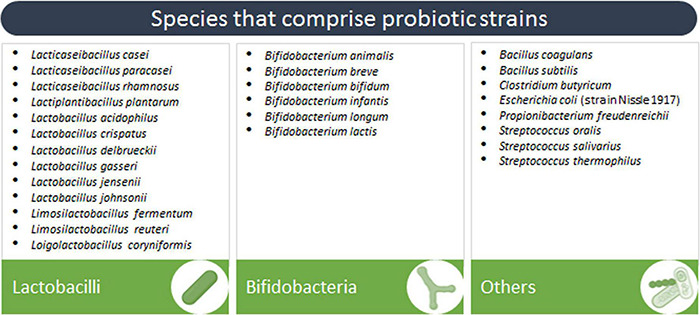
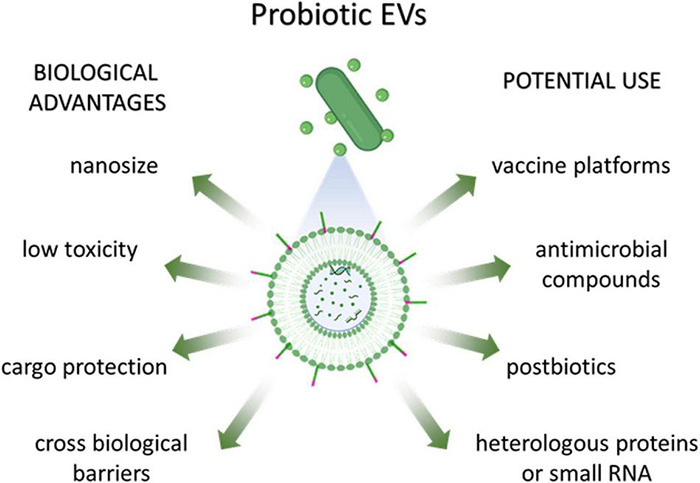
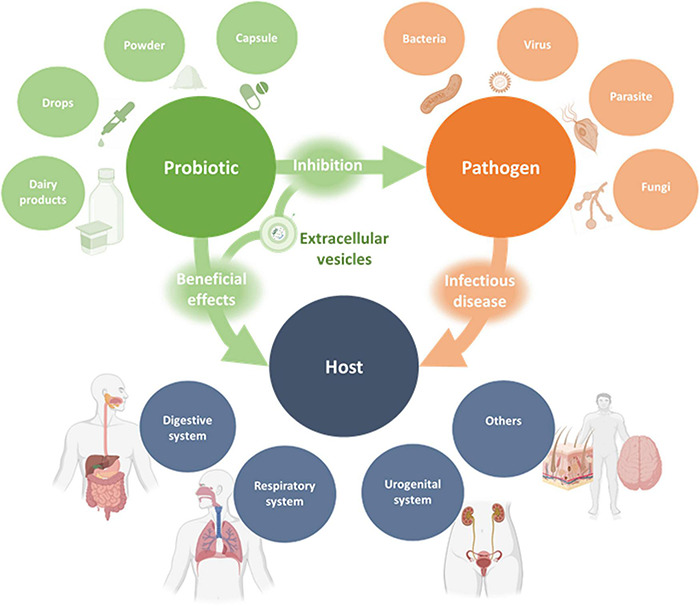
Probiotics have been shown to be effective against infectious diseases in clinical trials, with either intestinal or extraintestinal health benefits. Even though probiotic effects are strain-specific, some "widespread effects" include: pathogen inhibition, enhancement of barrier integrity and regulation of immune responses. The mechanisms involved in the health benefits of probiotics are not completely understood, but these effects can be mediated, at least in part, by probiotic-derived extracellular vesicles (EVs). However, to date, there are no clinical trials examining probiotic-derived EVs health benefits against infectious diseases. There is still a long way to go to bridge the gap between basic research and clinical practice. This review attempts to summarize the current knowledge about EVs released by probiotic bacteria to understand their possible role in the prevention and/or treatment of infectious diseases. A better understanding of the mechanisms whereby EVs package their cargo and the process involved in communication with host cells (inter-kingdom communication), would allow further advances in this field. In addition, we comment on the potential use and missing knowledge of EVs as therapeutic agents (postbiotics) against infectious diseases. Future research on probiotic-derived EVs is needed to open new avenues for the encapsulation of bioactives inside EVs from GRAS (Generally Regarded as Safe) bacteria. This could be a scientific novelty with applications in functional foods and pharmaceutical industries.
益生菌在临床试验中已被证明对传染病有效,对肠道或肠道外健康均有益处。尽管益生菌的作用具有菌株特异性,但一些“广泛作用”包括:抑制病原体、增强屏障完整性和调节免疫反应。益生菌有益健康的机制尚未完全明确,但这些作用至少部分可由益生菌衍生的细胞外囊泡(EVs)介导。然而,迄今为止,尚无临床试验研究益生菌衍生的EVs对传染病的健康益处。要弥合基础研究与临床实践之间的差距仍有很长的路要走。本综述试图总结目前关于益生菌释放的EVs的知识,以了解它们在预防和/或治疗传染病中的可能作用。更好地理解EVs包装其内含物的机制以及与宿主细胞沟通(跨物种沟通)所涉及的过程,将推动该领域取得进一步进展。此外,我们还对EVs作为抗传染病治疗剂(后生元)的潜在用途和知识空白进行了评论。需要对益生菌衍生的EVs进行未来研究,为将生物活性物质封装在来自一般认为安全(GRAS)细菌的EVs内开辟新途径。这可能是一项具有科学创新性的成果,可应用于功能性食品和制药行业。