Wang Lei, Ding Yanling, Bai Yanhui, Shi Jian, Li Jia, Wang Xiuli
Teaching and Research Section of Anesthesiology, Hebei Medical University, Shijiazhuang, China.
Department of Anesthesiology, The Third Hospital of Hebei Medical University, Shijiazhuang, China.
Ann Transl Med. 2022 Mar;10(6):319. doi: 10.21037/atm-22-711.
The lung is one of the most sensitive organs, and is vulnerable to injury caused by limb ischemia-reperfusion (LIR). Dexmedetomidine, an anesthetic adjunct, has been shown to have therapeutic effects on lung injury secondary to LIR. This study aimed to investigate the role of dexmedetomidine in ameliorating LIR-induced lung injury in a mouse model of bilateral hind LIR.
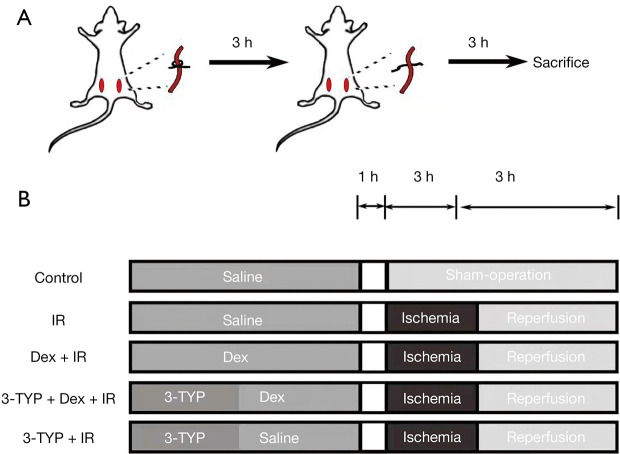
In this study, 75 mice were randomly divided into 5 groups to prepare the LIR model. After the model was established, arterial blood was extracted for blood gas analysis. The pathological changes of lung tissue, lung wet/dry weight ratio, arterial blood gas analysis, detection of myeloperoxidase (MPO) activity, the content of reactive oxygen species (ROS), superoxide dismutase (SOD), glutathione peroxidase (GSH-Px) and malondialdehyde (MDA) in oxidative stress indexes, mitochondrial membrane potential (MMP), adenosine triphosphate (ATP) content and cytochrome c content were measured, and the relative protein expression levels of sirtuin-3 (SIRT3) and apoptosis factor Bcl-2 related X protein (Bax), B-cell Lymphoma 2 (Bcl-2), cleaved caspase 3, and nuclear factor erythroid 2-related factor 2 (Nrf2) and cytoplasmic heme oxygenase-1 (HO-1).
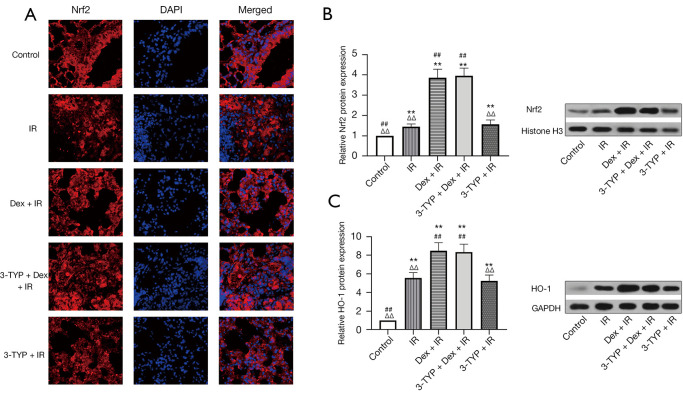
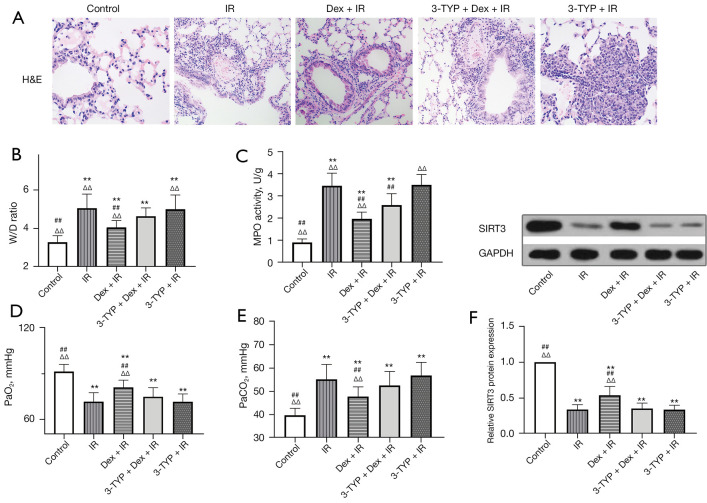
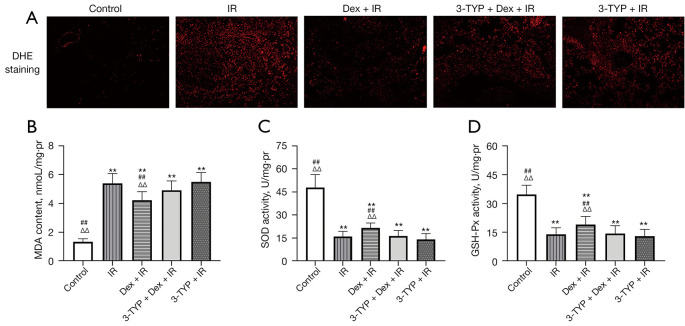
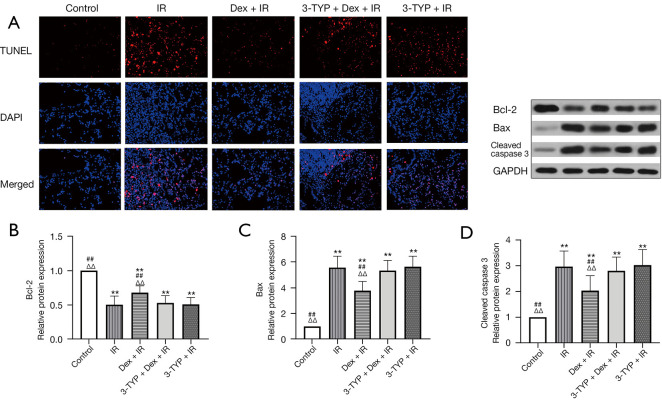
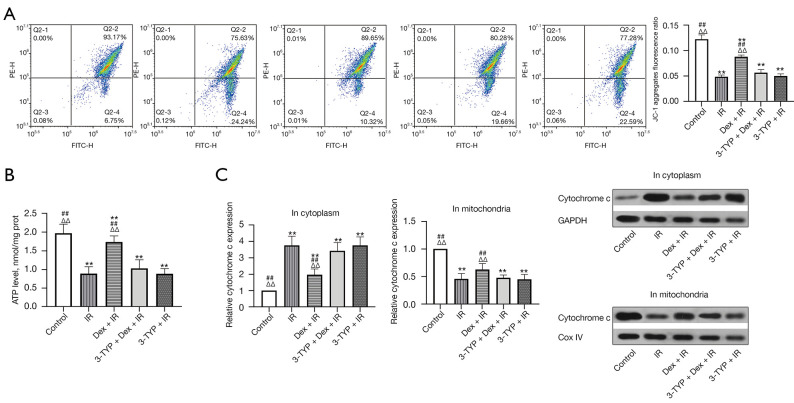
Pretreatment with dexmedetomidine dramatically ameliorated LIR-induced lung injury, the wet/dry weight ratio, the arterial blood gas parameters, and enhanced SIRT3 expression. Moreover, dexmedetomidine significantly inhibits ROS and MDA level and restores antioxidant enzyme activities (SOD, GSH-Px). Of note, dexmedetomidine suppressed LIR-induced lung tissue apoptosis by modulating apoptosis-associated protein such as Bax, Bcl-2, and cleaved caspase 3. Moreover, dexmedetomidine inhibited the LIR-induced decreases in MMP, ATP levels, and the release of cytochrome c of LIR to maintain mitochondrial function. Latest study has shown that activating Nrf2 could promote SIRT3 expression to alleviate IR injury. Intriguingly, dexmedetomidine could facilitate nuclear Nrf2 and cytoplasmic HO-1 expression.
Our findings suggest that dexmedetomidine protects against LIR-induced lung injury by inhibiting the oxidative response, mitochondrial dysfunction and apoptosis. The mechanism appears to be at least partly mediated through the upregulation of SIRT3 expression.
肺是最敏感的器官之一,易受肢体缺血再灌注(LIR)所致损伤。右美托咪定作为一种麻醉辅助药物,已被证明对LIR继发的肺损伤具有治疗作用。本研究旨在探讨右美托咪定在双侧后肢LIR小鼠模型中减轻LIR诱导的肺损伤中的作用。
在本研究中,75只小鼠被随机分为5组以制备LIR模型。模型建立后,采集动脉血进行血气分析。检测肺组织的病理变化、肺湿/干重比、动脉血气分析、髓过氧化物酶(MPO)活性、活性氧(ROS)含量、超氧化物歧化酶(SOD)、谷胱甘肽过氧化物酶(GSH-Px)和丙二醛(MDA)在氧化应激指标中的含量、线粒体膜电位(MMP)、三磷酸腺苷(ATP)含量和细胞色素c含量,并检测沉默调节蛋白3(SIRT3)、凋亡因子Bcl-2相关X蛋白(Bax)、B细胞淋巴瘤2(Bcl-2)、裂解的半胱天冬酶3、核因子红细胞2相关因子2(Nrf2)和细胞质血红素加氧酶-1(HO-1)的相对蛋白表达水平。
右美托咪定预处理显著减轻了LIR诱导的肺损伤、湿/干重比和动脉血气参数,并增强了SIRT3表达。此外,右美托咪定显著抑制ROS和MDA水平,并恢复抗氧化酶活性(SOD、GSH-Px)。值得注意的是,右美托咪定通过调节Bax、Bcl-2和裂解的半胱天冬酶3等凋亡相关蛋白抑制LIR诱导的肺组织凋亡。此外,右美托咪定抑制LIR诱导的MMP、ATP水平降低以及LIR诱导的细胞色素c释放,以维持线粒体功能。最新研究表明,激活Nrf2可促进SIRT3表达以减轻缺血再灌注损伤。有趣的是,右美托咪定可促进细胞核Nrf2和细胞质HO-1表达。
我们的研究结果表明,右美托咪定通过抑制氧化反应、线粒体功能障碍和凋亡来保护免受LIR诱导的肺损伤。其机制似乎至少部分是通过上调SIRT3表达介导的。