Lindsay Julia A B, McGowan Niall M, King Nathan, Rivera Daniel, Li Melanie, Byun Jin, Cunningham Simone, Saunders Kate E A, Duffy Anne
Department of Psychiatry, University of Oxford, UK.
Department of Public Health Sciences, Queen's University, Canada.
BJPsych Open. 2022 Apr 19;8(3):e86. doi: 10.1192/bjo.2022.48.
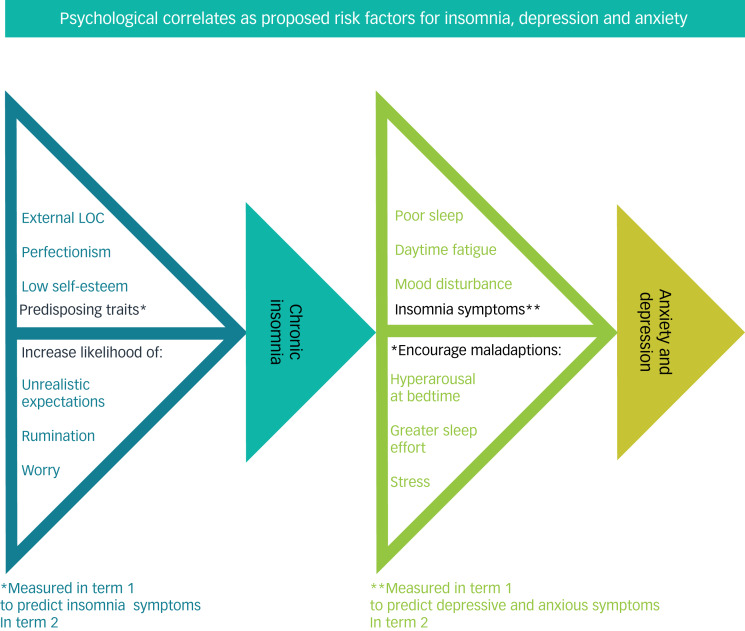
Perfectionism, low self-esteem and external locus of control are psychological constructs linked to insomnia, anxiety and depression. Examining how these constructs impact mental health and serve as risk factors for the development of clinically significant symptoms may help direct psychological support resources and preventative measures for university students.
To longitudinally examine associations between the aforementioned psychological constructs and symptoms of insomnia, anxiety and depression in a large representative sample of first-year university students.
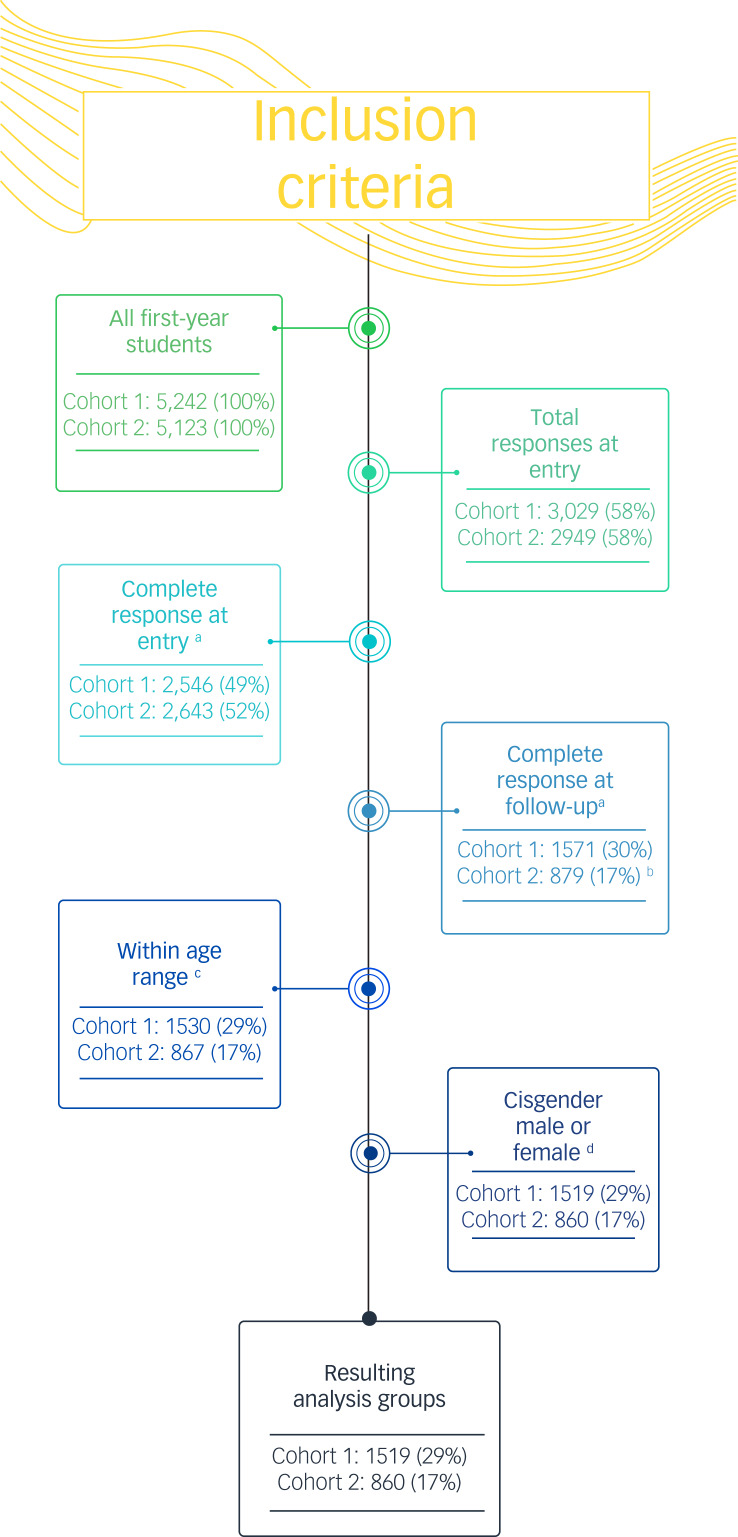
Electronic surveys including validated measures of the predictors and outcomes were emailed to all first-year undergraduate students at entry to a major Canadian university, and followed up on at conclusion of the academic year.
Compared with healthy sleepers, students screening positive for insomnia had lower self-esteem, higher self-evaluative perfectionism and increased external locus of control (all P < 0.001). Self-evaluative perfectionism (standardised β = 0.13, P < 0.01), self-esteem (β = -0.30, P < 0.001) and external locus of control (β = 0.07, P = 0.02) measured at entry were significantly associated with insomnia symptoms at follow-up. Insomnia symptoms at entry were strong predictors of symptoms of depression (β = 0.15, P < 0.001) and anxiety (β = 0.16, P < 0.001) at follow-up, even after controlling for baseline symptoms of those disorders.
Perfectionism, low self-esteem and external locus of control may predispose the development of insomnia symptoms in university students. In turn, insomnia symptoms appear to be robust predictors for depressive and anxiety symptoms. Sleep may be an important prevention target in university students.
完美主义、低自尊和外部控制点是与失眠、焦虑和抑郁相关的心理构念。研究这些构念如何影响心理健康并作为临床上显著症状发展的风险因素,可能有助于指导针对大学生的心理支持资源和预防措施。
纵向研究上述心理构念与一大群具有代表性的大一新生失眠、焦虑和抑郁症状之间的关联。
在加拿大一所主要大学入学时,通过电子邮件向所有大一本科生发送包含预测因素和结果的有效测量指标的电子调查问卷,并在学年结束时进行随访。
与睡眠良好者相比,失眠筛查呈阳性的学生自尊较低、自我评估完美主义较高且外部控制点增加(所有P<0.001)。入学时测量的自我评估完美主义(标准化β=0.13,P<0.01)、自尊(β=-0.30,P<0.001)和外部控制点(β=0.07,P=0.02)与随访时的失眠症状显著相关。即使在控制了这些疾病的基线症状后,入学时的失眠症状仍是随访时抑郁症状(β=0.15,P<0.001)和焦虑症状(β=0.16,P<0.001)的有力预测指标。
完美主义、低自尊和外部控制点可能易使大学生出现失眠症状。反过来,失眠症状似乎是抑郁和焦虑症状的有力预测指标。睡眠可能是大学生的一个重要预防目标。