Comprehensive Clinical Trials Unit, University College London, London, UK.
Institute for Global Health, University College London, London, UK.
BMJ Open. 2022 Apr 19;12(4):e052514. doi: 10.1136/bmjopen-2021-052514.
Nosocomial transmission of SARS-CoV-2 has been a significant cause of mortality in National Health Service (NHS) hospitals during the COVID-19 pandemic. The COG-UK Consortium Hospital-Onset COVID-19 Infections (COG-UK HOCI) study aims to evaluate whether the use of rapid whole-genome sequencing of SARS-CoV-2, supported by a novel probabilistic reporting methodology, can inform infection prevention and control (IPC) practice within NHS hospital settings.
Multicentre, prospective, interventional, superiority study.
14 participating NHS hospitals over winter-spring 2020/2021 in the UK.
Eligible patients must be admitted to hospital with first-confirmed SARS-CoV-2 PCR-positive test result >48 hour from time of admission, where COVID-19 diagnosis not suspected on admission. The projected sample size is 2380 patients.
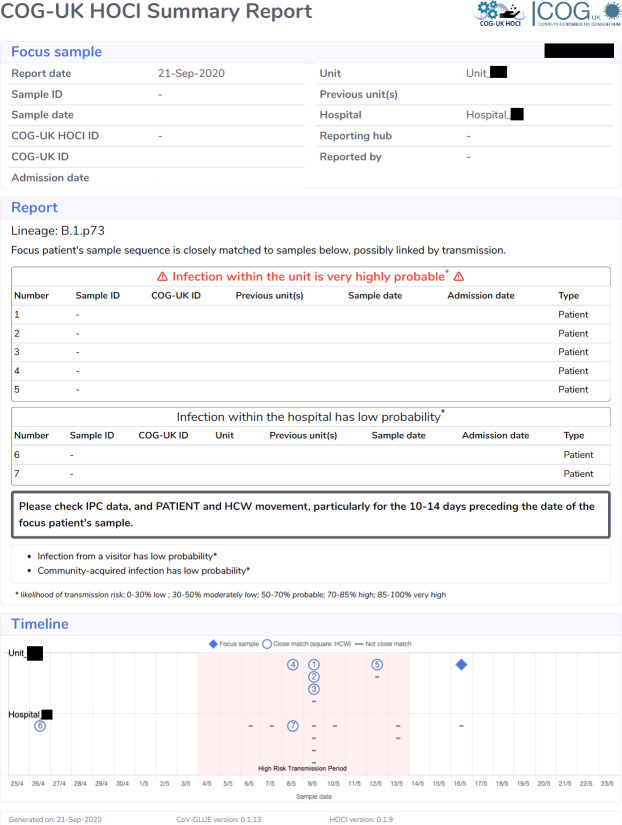
The intervention is the return of a sequence report, within 48 hours in one phase (rapid local lab processing) and within 5-10 days in a second phase (mimicking central lab), comparing the viral genome from an eligible study participant with others within and outside the hospital site.
The primary outcomes are incidence of Public Health England (PHE)/IPC-defined SARS-CoV-2 hospital-acquired infection during the baseline and two interventional phases, and proportion of hospital-onset cases with genomic evidence of transmission linkage following implementation of the intervention where such linkage was not suspected by initial IPC investigation. Secondary outcomes include incidence of hospital outbreaks, with and without sequencing data; actual and desirable changes to IPC actions; periods of healthcare worker (HCW) absence. Health economic analysis will be conducted to determine cost benefit of the intervention. A process evaluation using qualitative interviews with HCWs will be conducted alongside the study.
ISRCTN50212645. Pre-results stage. This manuscript is based on protocol V.6.0. 2 September 2021.
在 COVID-19 大流行期间,医院获得性传播的 SARS-CoV-2 已成为英国国家医疗服务体系(NHS)医院死亡率的重要原因。COG-UK 联盟医院发病 COVID-19 感染(COG-UK HOCI)研究旨在评估使用 SARS-CoV-2 的快速全基因组测序,并辅以新型概率报告方法,是否可以为 NHS 医院环境中的感染预防和控制(IPC)实践提供信息。
多中心、前瞻性、干预性、优效性研究。
2020/2021 年冬季至春季期间,英国的 14 家参与 NHS 医院。
符合条件的患者必须因首次确认为 SARS-CoV-2 PCR 阳性的入院时间超过入院后 48 小时的时间入院,并且入院时未怀疑 COVID-19 诊断。预计样本量为 2380 名患者。
干预措施是在一个阶段(快速本地实验室处理)内 48 小时内返回序列报告,在第二个阶段(模拟中央实验室)内 5-10 天内返回序列报告,将合格研究参与者的病毒基因组与医院内外其他人的基因组进行比较。
主要结局是在基线和两个干预阶段期间,英格兰公共卫生署(PHE)/IPC 定义的 SARS-CoV-2 医院获得性感染的发生率,以及在实施干预措施后,最初的 IPC 调查未怀疑存在传播联系的情况下,有多少医院发病病例具有基因组证据表明存在传播联系。次要结局包括有无测序数据的医院暴发发生率;实际和理想的 IPC 措施变化;医疗保健工作者(HCW)缺勤时间。将进行健康经济分析,以确定干预措施的成本效益。将通过与研究同时进行的 HCW 定性访谈进行过程评估。
ISRCTN50212645。预结果阶段。本文基于 2021 年 9 月 2 日第 6.0 版的方案。