Clinic for Gastroenterology, Hepatology and Infectious Diseases, Medical Faculty of Heinrich Heine University Düsseldorf, University Hospital Düsseldorf, 40225, Düsseldorf, Germany.
Department of Hepatology and Gastroenterology, Charité University Medicine Berlin, Augustenburger Platz 1, 13353, Berlin, Germany.
J Cancer Res Clin Oncol. 2023 Mar;149(3):1285-1293. doi: 10.1007/s00432-022-03998-z. Epub 2022 Apr 19.
There is a growing body of evidence suggesting the decisive involvement of the human microbiome in cancer development. The consumption of antibiotics may fundamentally change the microbiome and thereby create a precancerous environment promoting cancer development and growth. However, clinical data on the association between the consumption of antibiotics and cancer incidence have remained inconclusive. In this study, we quantified the association between the intake of different antibiotics and various cancer entities among outpatients from Germany.
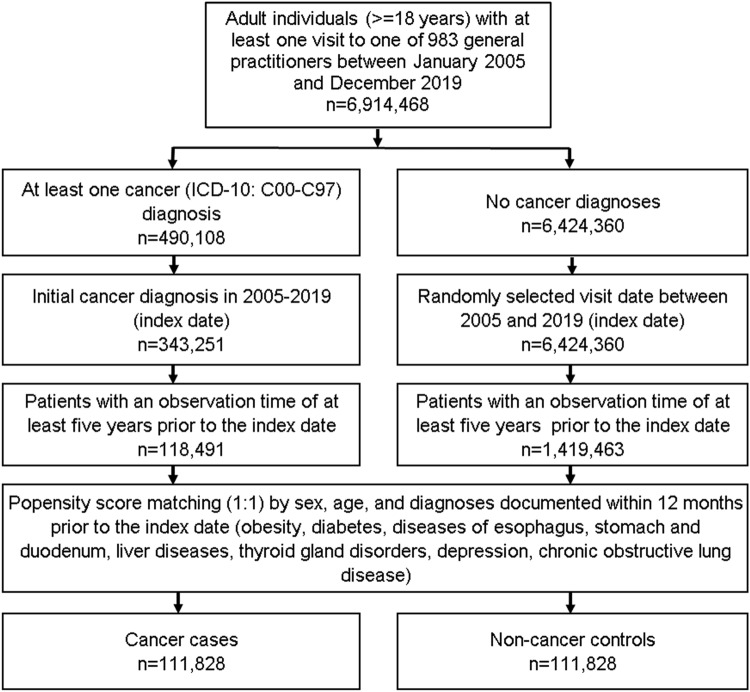
This retrospective case-control study based on the IQVIA Disease Analyzer database included 111,828 cancer patients and 111,828 non-cancer controls who were matched to cancer cases using propensity scores. Patients were categorized as non-users, low-consumption (up to 50th percentile), and high-consumption (above 50 percentile) users of antibiotics overall and for each antibiotic class. Multivariable logistic conditional regression models were used to study the association between antibiotic intake within 5 years prior to the index date (first cancer diagnosis for cases or randomly selected date for controls) and cancer incidence.
The probability of cancer was significantly higher among patients with a history of antibiotic intake than in matched controls. Patients using penicillin or cephalosporins displayed a higher incidence of cancer, while the intake of tetracyclines and macrolides actually reduced the risk of cancer development slightly. A complex picture was observed in our cancer site-stratified analyses. Most notably, the consumption of penicillin was significantly and positively associated with cancer development in the respiratory organs only (low consumption OR: 1.33, 95% CI 1.20-1.47; high consumption OR 1.42, 95% CI 1.22-1.64) and cephalosporin consumption was significantly associated with respiratory organ cancer (low consumption OR: 1.32, 95% CI 1.17-1.48, high consumption OR: 1.47, 95% CI 1.29-1.66), breast cancer (high consumption OR: 1.40, 95% CI 1.25-1.56), and lymphoid and hematopoietic tissue cancer (high consumption OR: 1.50, 95% CI 1.35-1.66).
Our data strongly support the hypothesis that the intake of antibiotics is positively associated with the risk of cancer development.
越来越多的证据表明,人类微生物组在癌症发展中起着决定性作用。抗生素的使用可能会从根本上改变微生物组,从而创造出促进癌症发展和生长的癌前环境。然而,抗生素的使用与癌症发病率之间的临床数据仍不确定。在这项研究中,我们定量分析了德国门诊患者中不同抗生素的摄入与各种癌症实体之间的关联。
本研究基于 IQVIA Disease Analyzer 数据库的回顾性病例对照研究,纳入了 111828 例癌症患者和 111828 例非癌症对照者,通过倾向评分与癌症病例相匹配。患者分为抗生素总体使用和各类抗生素使用的非使用者、低用量(至 50 百分位)和高用量(超过 50 百分位)使用者。多变量逻辑条件回归模型用于研究索引日期(病例的首次癌症诊断或对照者的随机选择日期)前 5 年内抗生素摄入与癌症发病率之间的关系。
有抗生素使用史的患者癌症发生的概率显著高于匹配对照者。使用青霉素或头孢菌素的患者癌症发病率更高,而使用四环素和大环内酯类抗生素实际上略微降低了癌症发展的风险。在我们的癌症部位分层分析中观察到了一个复杂的情况。值得注意的是,仅在呼吸系统中,青霉素的使用与癌症的发展显著正相关(低用量 OR:1.33,95%CI 1.20-1.47;高用量 OR:1.42,95%CI 1.22-1.64),头孢菌素的使用与呼吸系统癌症(低用量 OR:1.32,95%CI 1.17-1.48,高用量 OR:1.47,95%CI 1.29-1.66)、乳腺癌(高用量 OR:1.40,95%CI 1.25-1.56)和淋巴造血组织癌症(高用量 OR:1.50,95%CI 1.35-1.66)显著相关。
我们的数据有力地支持了这样一种假设,即抗生素的摄入与癌症发展的风险呈正相关。