World Mosquito Program Yogyakarta, Centre for Tropical Medicine, Faculty of Medicine, Public Health and Nursing, Universitas Gadjah Mada, Yogyakarta, Indonesia.
World Mosquito Program, Institute of Vector-borne Disease, Monash University, Clayton, Australia.
PLoS Negl Trop Dis. 2022 Apr 20;16(4):e0010284. doi: 10.1371/journal.pntd.0010284. eCollection 2022 Apr.
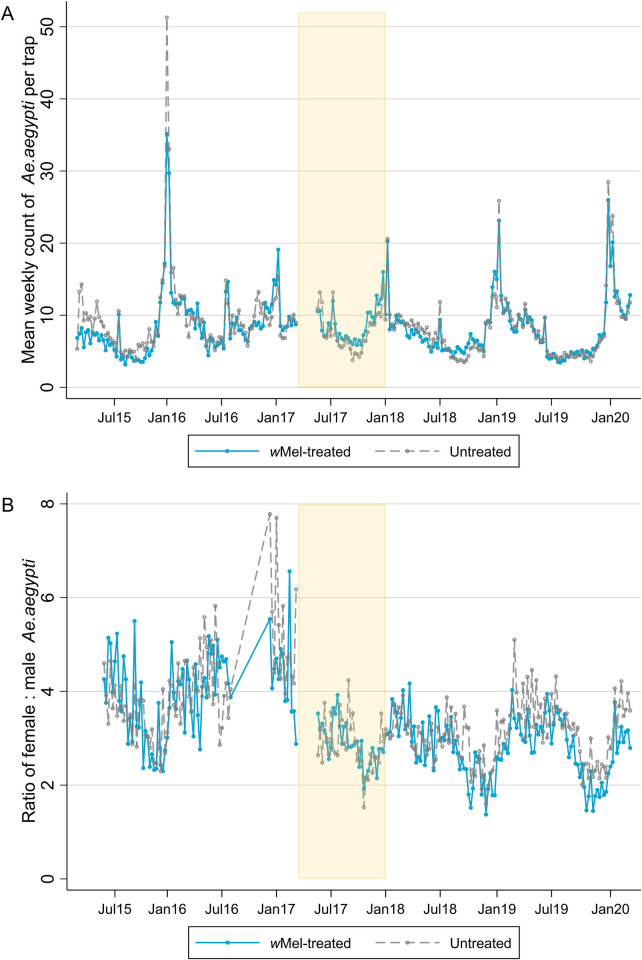
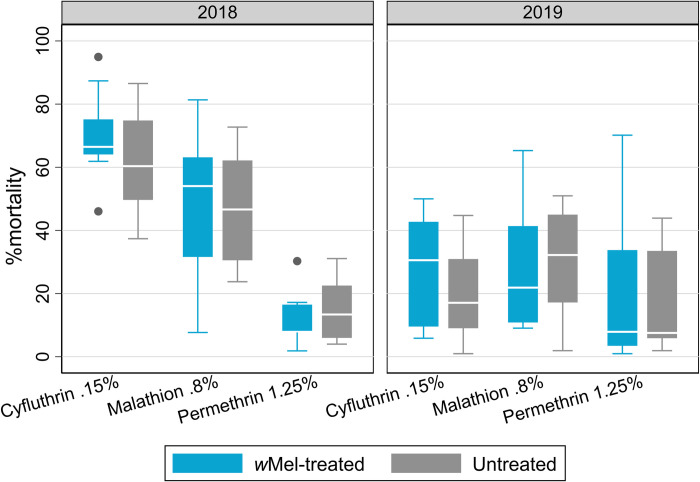
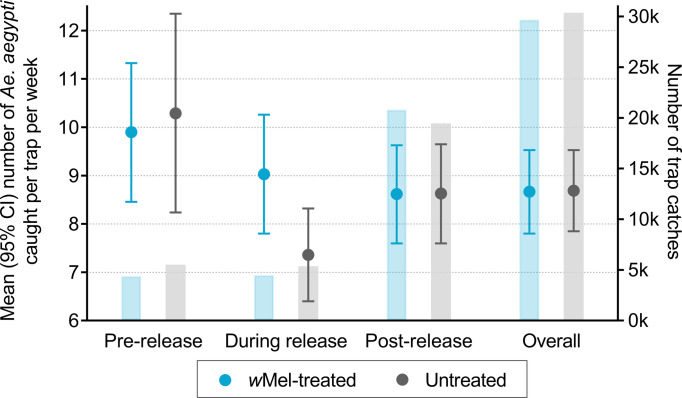
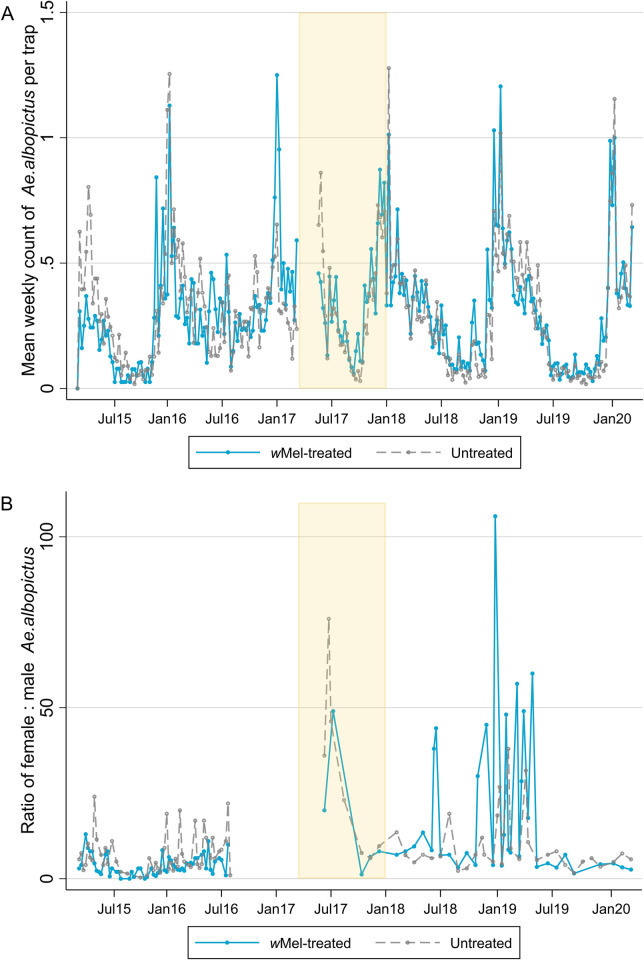
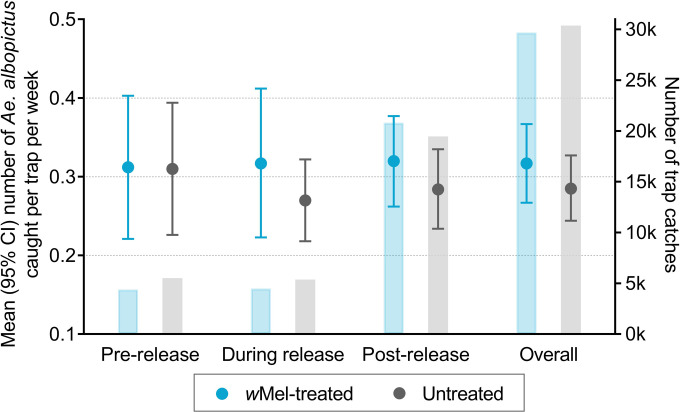
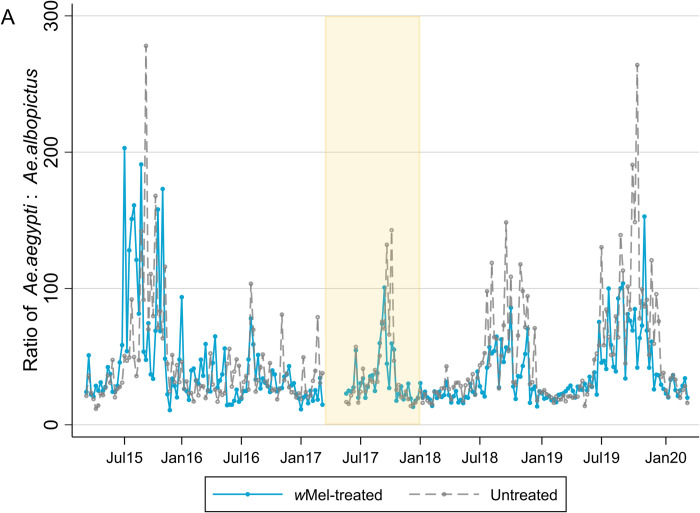
The Applying Wolbachia to Eliminate Dengue (AWED) trial was a parallel cluster randomised trial that demonstrated Wolbachia (wMel) introgression into Ae. aegypti populations reduced dengue incidence. In this predefined substudy, we compared between treatment arms, the relative abundance of Ae. aegypti and Ae. albopictus before, during and after wMel-introgression. Between March 2015 and March 2020, 60,084 BG trap collections yielded 478,254 Ae. aegypti and 17,623 Ae. albopictus. Between treatment arms there was no measurable difference in Ae. aegypti relative abundance before or after wMel-deployments, with a count ratio of 0.96 (95% CI 0.76, 1.21) and 1.00 (95% CI 0.85, 1.17) respectively. More Ae. aegypti were caught per trap per week in the wMel-intervention arm compared to the control arm during wMel deployments (count ratio 1.23 (95% CI 1.03, 1.46)). Between treatment arms there was no measurable difference in the Ae. albopictus population size before, during or after wMel-deployment (overall count ratio 1.10 (95% CI 0.89, 1.35)). We also compared insecticide resistance phenotypes of Ae. aegypti in the first and second years after wMel-deployments. Ae. aegypti field populations from wMel-treated and untreated arms were similarly resistant to malathion (0.8%), permethrin (1.25%) and cyfluthrin (0.15%) in year 1 and year 2 of the trial. In summary, we found no between-arm differences in the relative abundance of Ae. aegypti or Ae. albopictus prior to or after wMel introgression, and no between-arm difference in Ae. aegypti insecticide resistance phenotypes. These data suggest neither Aedes abundance, nor insecticide resistance, confounded the epidemiological outcomes of the AWED trial.
应用沃尔巴克氏体消除登革热(AWED)试验是一项平行的群组随机试验,该试验表明,沃尔巴克氏体(wMel)的引入降低了埃及伊蚊种群的登革热发病率。在这项预先设定的子研究中,我们比较了治疗组之间,在 wMel 引入前后,以及引入期间和之后,埃及伊蚊和白纹伊蚊的相对丰度。在 2015 年 3 月至 2020 年 3 月期间,进行了 60084 次 BG 诱蚊笼采集,共捕获 478254 只埃及伊蚊和 17623 只白纹伊蚊。在 wMel 部署前后,治疗组之间埃及伊蚊的相对丰度没有可测量的差异,计数比分别为 0.96(95%CI 0.76,1.21)和 1.00(95%CI 0.85,1.17)。在 wMel 部署期间,与对照组相比,wMel 干预组每只诱蚊笼每周捕获的埃及伊蚊数量更多(计数比 1.23(95%CI 1.03,1.46))。在 wMel 部署前后,治疗组之间白纹伊蚊的种群数量没有可测量的差异(总体计数比 1.10(95%CI 0.89,1.35))。我们还比较了 wMel 部署前后第一年和第二年埃及伊蚊的杀虫剂抗性表型。在试验的第一年和第二年,来自 wMel 处理和未处理臂的埃及伊蚊田间种群对马拉硫磷(0.8%)、氯菊酯(1.25%)和氯氟氰菊酯(0.15%)的抗性相似。总之,我们没有发现 wMel 引入前后,治疗组之间埃及伊蚊或白纹伊蚊的相对丰度存在差异,也没有发现埃及伊蚊杀虫剂抗性表型存在差异。这些数据表明,在 AWED 试验的流行病学结果中,Aedes 丰度或杀虫剂抗性没有产生混杂作用。