Paulson Winnie, Kodali Naveen Kumar, Balasubramani Karuppusamy, Dixit Rashi, Chellappan Savitha, Behera Sujit Kumar, Balabaskaran Nina Praveen
Department of Epidemiology and Public Health, School of Life Sciences, Central University of Tamil Nadu, Tiruvarur, India.
Department of Geography, School of Earth Sciences, Central University of Tamil Nadu, Tiruvarur, India.
Arch Public Health. 2022 Apr 20;80(1):125. doi: 10.1186/s13690-022-00868-5.
Dengue and chikungunya (CHIKV) are the two major vector-borne diseases of serious public health concern in India. Studies on socioeconomic and housing determinants of dengue and CHIKV at a pan-India level are lacking. Here, we took advantage of the recently carried out Longitudinal Ageing Study in India (LASI) carried out across all the states and Union Territories of India to study the social indicators of dengue and CHIKV in India.
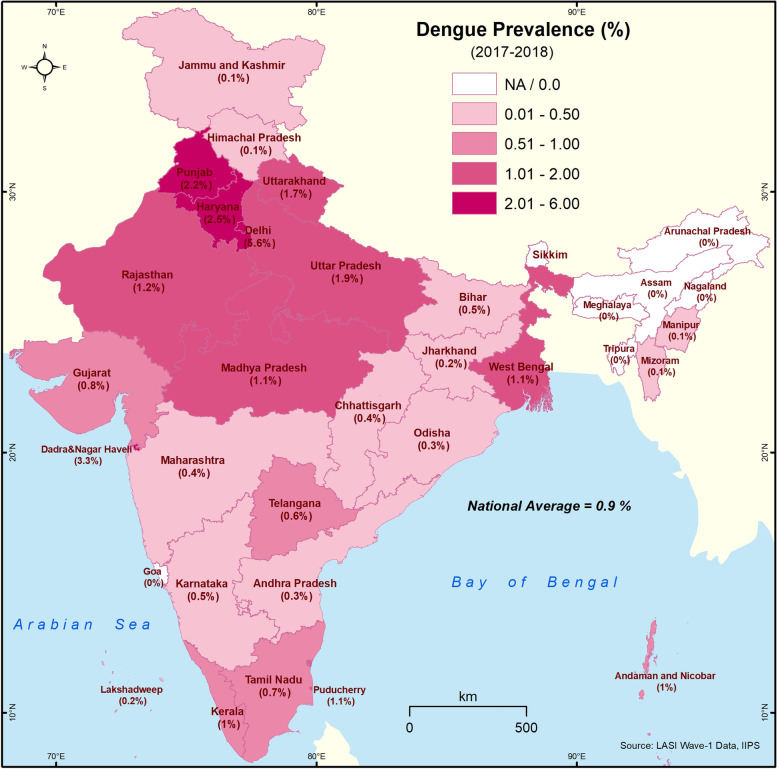
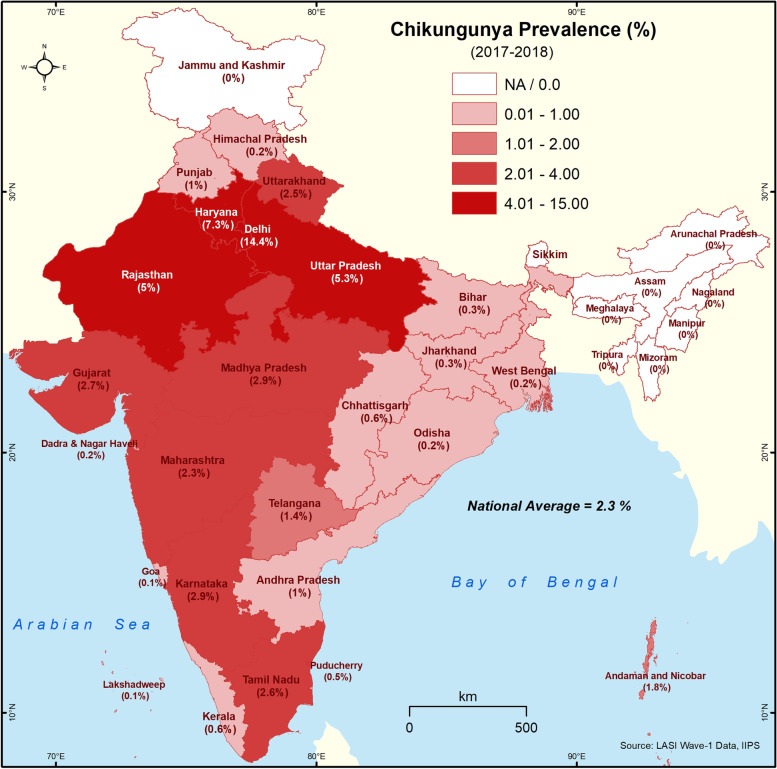
LASI-1 (2017-2018) data on the self-reported period prevalence of dengue and CHIKV from 70,932 respondents aged ≥45 years were used for this analysis. The state-wise distribution of dengue and CHIKV was mapped. Prevalence was estimated for each study variable, and the difference was compared using the χ2 test. The adjusted odds ratios (AOR) of the socioeconomic and housing variables for dengue and CHIKV were estimated using the multiple logistic regression model.
Urban residence is the major socio-economic indicator of dengue and CHIKV (dengue AOR: 1.57, 95% CI: 1.18-2.11; CHIKV AOR: 1.84, 95% CI: 1.36-2.49). The other notable indicator is wealth; rich respondents have higher odds of dengue and CHIKV. Adults older than 54 years and those with high school education and above are associated with a lower likelihood of dengue and CHIKV. In addition, CHIKV is associated with scheduled and forward castes, households with improper toilet facilities, open defecation, and kutcha house type.
Despite the limitation that the data is only from adults ≥ 45, this analysis provides important insights into the socioeconomic and housing variables associated with higher odds of dengue and CHIKV in India. Understanding these determinants may assist in the national planning of prevention and control strategies for dengue and CHIKV.
登革热和基孔肯雅热(CHIKV)是印度严重的两大主要媒介传播的公共卫生问题。目前缺乏在全印度范围内关于登革热和基孔肯雅热的社会经济及住房决定因素的研究。在此,我们利用最近在印度所有邦和联邦属地开展的印度纵向老龄化研究(LASI)来研究印度登革热和基孔肯雅热的社会指标。
本分析使用了来自70932名年龄≥45岁受访者的LASI-1(2017 - 2018年)关于登革热和基孔肯雅热自我报告的时期患病率数据。绘制了登革热和基孔肯雅热的邦级分布图。对每个研究变量的患病率进行了估计,并使用χ2检验比较差异。使用多因素逻辑回归模型估计登革热和基孔肯雅热的社会经济及住房变量的调整优势比(AOR)。
城市居住是登革热和基孔肯雅热的主要社会经济指标(登革热AOR:1.57,95%置信区间:1.18 - 2.11;基孔肯雅热AOR:1.84,95%置信区间:- 1.36 - 2.49)。另一个显著指标是财富;富裕的受访者感染登革热和基孔肯雅热的几率更高。54岁以上成年人以及受过高中及以上教育的人感染登革热和基孔肯雅热的可能性较低。此外,基孔肯雅热与在册种姓和前进种姓、厕所设施不完善的家庭、露天排便以及土坯房类型有关。
尽管数据仅来自45岁及以上成年人存在局限性,但该分析为印度登革热和基孔肯雅热感染几率较高相关的社会经济及住房变量提供了重要见解。了解这些决定因素可能有助于国家制定登革热和基孔肯雅热的预防和控制策略规划。