The First Clinical School, Guangzhou University of Chinese Medicine, Guangzhou, China.
Department of Community Health, Shenzhen Traditional Chinese Medicine Hospital, Shenzhen, China.
Front Endocrinol (Lausanne). 2022 Apr 4;13:855650. doi: 10.3389/fendo.2022.855650. eCollection 2022.
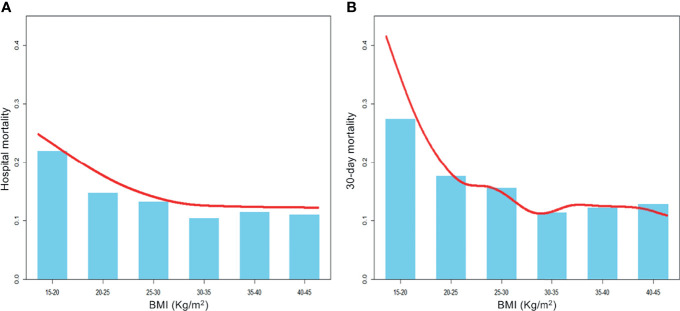
Obesity has long been considered an independent risk factor for cardiovascular diseases (CVD), even in the COVID-19 pandemic. However, recent studies have found that a certain degree of obesity may be beneficial for patients who have already suffered from CVD, which is called the "obesity paradox". Our objective was to investigate whether the obesity paradox existed in coronary care unit (CCU) patients and the relationship between body mass index (BMI) and short- and long-term mortality.
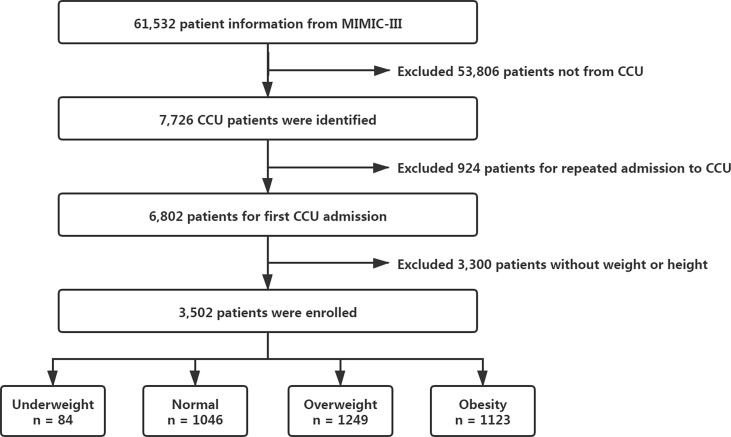
We performed a cohort analysis of 3,502 adult CCU patients from the Medical Information Mart for Intensive Care III (MIMIC-III) database. The patients were divided into four groups according to the WHO BMI categories. Both multivariable logistic regression and Cox regression were used to reveal the relation between BMI and mortality. Subgroup analyses were performed based on Simplified Acute Physiology Score (SAPS) and age.
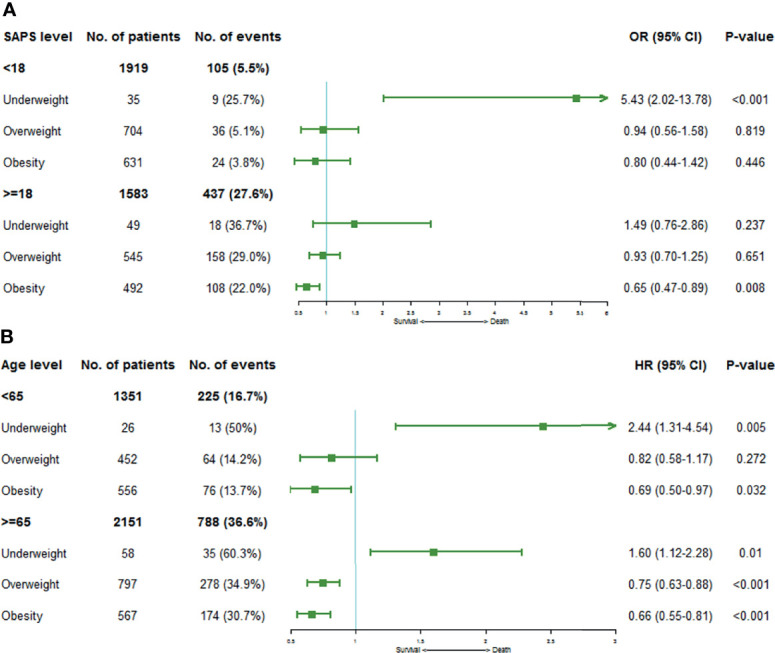
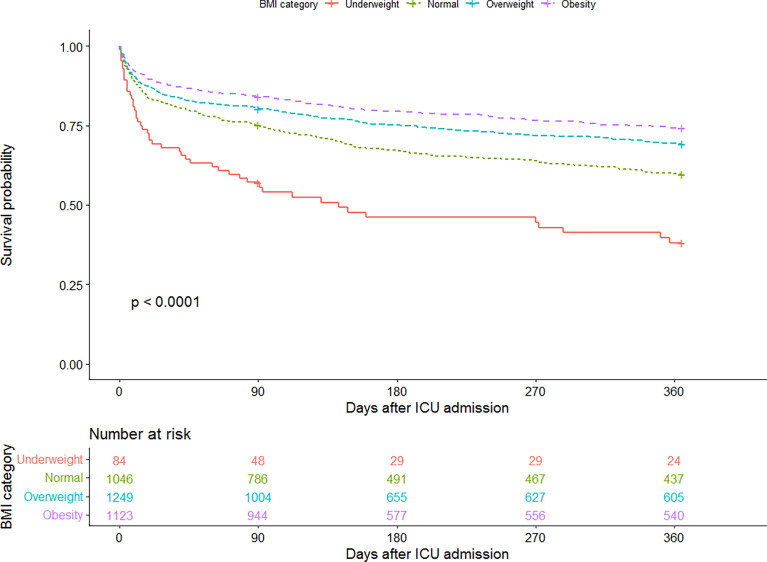
After adjusting for confounders, obese patients had 33% and 30% lower mortality risk at 30-day and 1-year (OR 0.67, 95% CI 0.51 to 0.89; HR 0.70, 95% CI 0.59 to 0.83; respectively) compared with normal-weight patients, while the underweight group were opposite, with 141% and 81% higher in short- and long-term (OR 2.41, 95% CI 1.37 to 4.12; HR 1.81, 95% CI 1.34 to 2.46; respectively). Overweight patients did not have a significant survival advantage at 30-day (OR 0.91, 95% CI 0.70 to 1.17), but did have a 22% lower mortality risk at 1-year (HR 0.78; 95% CI 0.67 to 0.91). The results were consistent after being stratified by SAPS and age.
Our study supports that obesity improved survival at both 30-day and 1-year after CCU admission, and the obesity paradox existed in CCU patients.
肥胖长期以来一直被认为是心血管疾病(CVD)的独立危险因素,即使在 COVID-19 大流行期间也是如此。然而,最近的研究发现,对于已经患有 CVD 的患者,一定程度的肥胖可能是有益的,这被称为“肥胖悖论”。我们的目的是探讨肥胖悖论是否存在于冠心病监护病房(CCU)患者中,以及体重指数(BMI)与短期和长期死亡率之间的关系。
我们对来自医疗信息监护 III (MIMIC-III)数据库的 3502 名成年 CCU 患者进行了队列分析。患者根据世界卫生组织 BMI 类别分为四组。使用多变量逻辑回归和 Cox 回归来揭示 BMI 与死亡率之间的关系。根据简化急性生理学评分(SAPS)和年龄进行亚组分析。
在调整混杂因素后,与正常体重患者相比,肥胖患者在 30 天和 1 年时的死亡率分别降低了 33%和 30%(OR 0.67,95%CI 0.51 至 0.89;HR 0.70,95%CI 0.59 至 0.83),而体重不足组则相反,短期和长期死亡率分别升高了 141%和 81%(OR 2.41,95%CI 1.37 至 4.12;HR 1.81,95%CI 1.34 至 2.46)。超重患者在 30 天内没有显著的生存优势(OR 0.91,95%CI 0.70 至 1.17),但在 1 年内的死亡率降低了 22%(HR 0.78;95%CI 0.67 至 0.91)。在按 SAPS 和年龄分层后,结果仍然一致。
我们的研究支持肥胖在 CCU 入院后 30 天和 1 年均改善了生存率,肥胖悖论存在于 CCU 患者中。