Institute of Health and Science Convergence, Chungbuk National University, Cheongju, South Korea.
Department of Public Health and Preventive Medicine, Chungbuk National University Hospital, Cheongju, South Korea.
Front Public Health. 2022 Apr 4;10:813608. doi: 10.3389/fpubh.2022.813608. eCollection 2022.
Appendicitis is usually diagnosed based on a reliable set of signs and symptoms, and can be effectively treated with surgery, with low morbidity and mortality rates. However, appendicitis is often overlooked in vulnerable populations, including people with disabilities. This study compared 10-year trends of complicated appendicitis between South Koreans with a disability, according to disability severity and type, and those without disabilities.
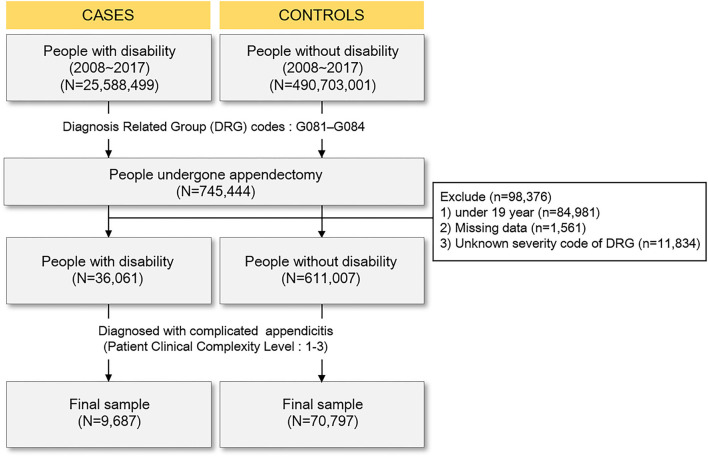
To identify cases of appendicitis, we used the DRG codes in the National Health Information Database of South Korea. Patients with appendicitis were classified in terms of severity based on the DRG codes. Age-standardized incidence rates were calculated for each year during 2008-2017 according to the presence, type, and severity of the disability. Factors associated with complicated appendicitis were examined by multivariate logistic regression using the most recent data (i.e., 2016-2017).
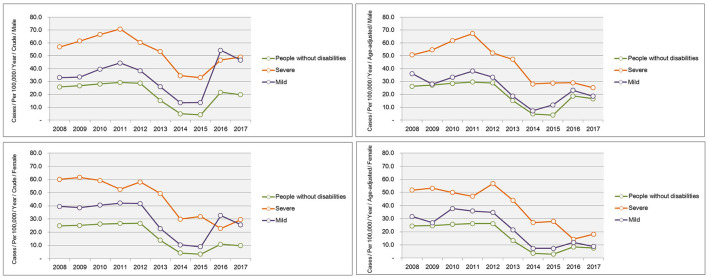
The incidence of complicated appendicitis was higher in people with disabilities, especially those with severe disabilities (26.9 vs. 11.6%). This difference was particularly marked when considering those with a severe disability (aOR = 1.868, 95% CI:1.511-2.309), internal organ problems (aOR = 10.000, 95% CI:5.365-18.638) or a mental disability (aOR = 2.779, 95% CI:1.563-4.939).
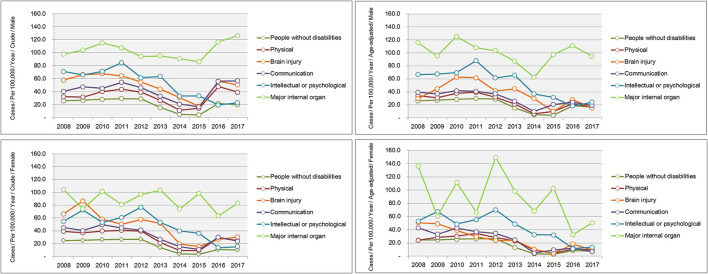
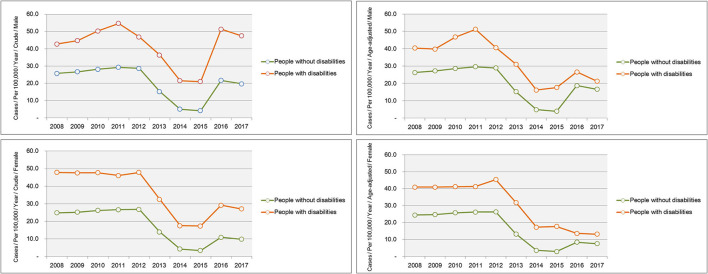
The incidence of complicated appendicitis was higher in people with disability than in those without disability in all years. There was a substantial difference in the incidence of complicated appendicitis between the severe disability and non-disabled groups. Among the various disability types, the incidence of complicated appendicitis was highest for major internal organ problems, followed by intellectual or psychological disabilities. Our findings may be explained by barriers to healthcare access among people with disabilities, particularly those with a severe disability, internal organ problem, or mental disability.
阑尾炎通常根据一组可靠的体征和症状进行诊断,并可以通过手术有效治疗,其发病率和死亡率都较低。然而,在弱势群体中,阑尾炎经常被忽视,包括残疾人。本研究比较了根据残疾严重程度和类型,韩国残疾人和非残疾人中复杂阑尾炎的 10 年趋势。
为了确定阑尾炎病例,我们使用了韩国国家健康信息数据库中的 DRG 代码。根据 DRG 代码,根据严重程度对阑尾炎患者进行分类。根据残疾的存在、类型和严重程度,计算了 2008-2017 年每年的年龄标准化发病率。使用最新数据(即 2016-2017 年),通过多变量逻辑回归检查与复杂阑尾炎相关的因素。
残疾人中复杂阑尾炎的发病率较高,尤其是严重残疾者(26.9% vs. 11.6%)。当考虑严重残疾者(OR = 1.868,95%CI:1.511-2.309)、内部器官问题(OR = 10.000,95%CI:5.365-18.638)或精神残疾(OR = 2.779,95%CI:1.563-4.939)时,这种差异更为明显。
在所有年份中,残疾患者的复杂阑尾炎发病率均高于非残疾患者。严重残疾和非残疾组之间的复杂阑尾炎发病率存在显著差异。在各种残疾类型中,复杂阑尾炎的发病率最高的是主要内部器官问题,其次是智力或心理残疾。我们的发现可以通过残疾人获得医疗保健的障碍来解释,尤其是那些严重残疾、内部器官问题或精神残疾的残疾人。