School of Psychology, Guizhou Normal University, Guiyang, Guizhou, China; Faculty of Psychology, Southwest University, Beibei, Chongqing, China; Center for Rural Children and Adolescents Mental Health Education, Guizhou Normal University, Guiyang, Guizhou, China.
School of Psychology, Guizhou Normal University, Guiyang, Guizhou, China; Center for Rural Children and Adolescents Mental Health Education, Guizhou Normal University, Guiyang, Guizhou, China; College of National Culture and Cognitive Science, Guizhou Minzu University, Guiyang, Guizhou, China.
J Affect Disord. 2022 Jul 1;308:123-129. doi: 10.1016/j.jad.2022.04.074. Epub 2022 Apr 18.
The COVID-19 outbreak has generated many negative psychological outcomes, such as depression, in adolescents. Exploration of protective factors for adolescent mental health is urgently needed, and no research has examined the role of parental involvement.
From March to April 2020, valid data were collected from 1663 Chinese adolescents through online demographic and other questionnaires. Parental involvement at home was assessed by an adapted questionnaire on parental support in learning at home, stress since the COVID-19 outbreak was measured by the Perceived Stress Scale, and three negative psychological outcomes (i.e., depression, anxiety, and posttraumatic stress symptoms (PTSS)) were measured by the Center for Epidemiologic Studies Depression Scale, Zung Self-rating Anxiety Scale, and PTSD Check List-Civilian Version, respectively.
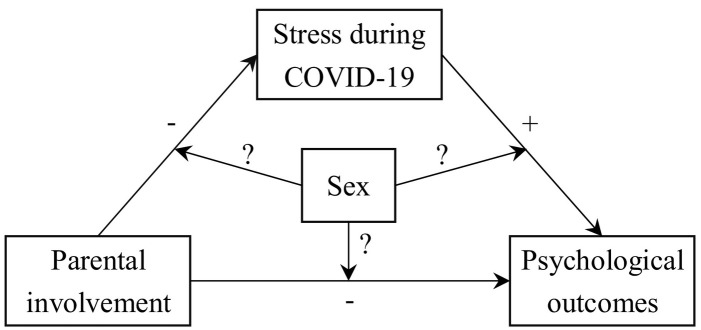
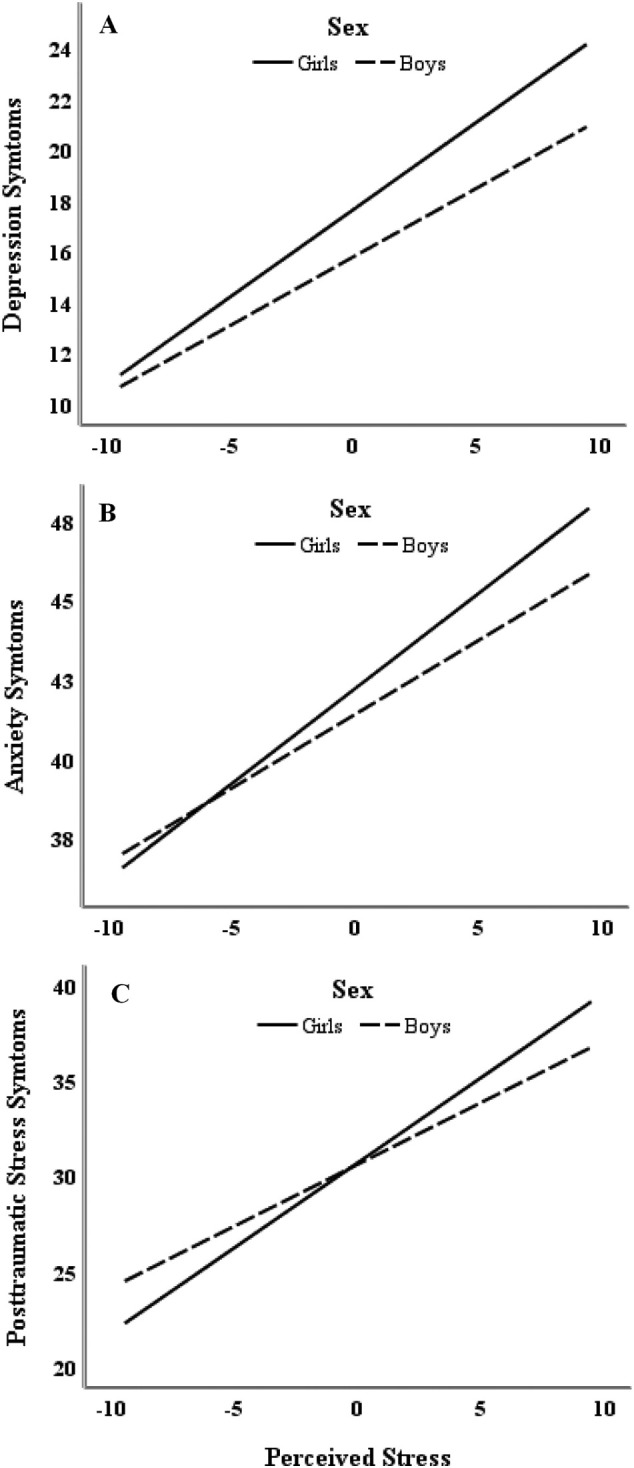
In total, 35.4%, 21% and 25% of adolescents had depression symptoms, anxiety symptoms, and PTSS, respectively. Three moderated mediation models consistently showed the following: a. Parental involvement indirectly reduced the three psychological problems by alleviating perceived stress, and the indirect effects were not moderated by sex. b. There were negative direct effects of parental involvement on the three psychological problems, and the links were not moderated by sex. c. Sex moderated the associations between perceived stress and the three psychological problems.
The cross-sectional design and the sampling of all participants from one junior high school impeded causal inferences and the generalization of our findings, respectively.
We found similar indirect and direct protective roles of parental involvement in boys' and girls' mental health, and girls were more vulnerable to stress.
新冠疫情爆发给青少年带来了许多负面心理后果,如抑郁。探索青少年心理健康的保护因素迫在眉睫,而目前尚无研究探讨父母参与的作用。
2020 年 3 月至 4 月,通过在线人口统计学和其他问卷,从 1663 名中国青少年中收集了有效数据。家庭中父母的参与度通过家庭学习父母支持的改编问卷进行评估,新冠疫情爆发以来的压力通过感知压力量表进行测量,三种负面心理后果(即抑郁、焦虑和创伤后应激症状 (PTSS))分别通过流行病学研究中心抑郁量表、Zung 自评焦虑量表和平民版 PTSD 清单进行测量。
共有 35.4%、21%和 25%的青少年分别有抑郁症状、焦虑症状和 PTSD 症状。三个有调节的中介模型均一致表明:a. 父母参与度通过减轻感知压力间接降低了这三种心理问题,且这种间接效应不受性别调节。b. 父母参与度对这三种心理问题有负向直接效应,且这种联系不受性别调节。c. 性别调节了感知压力与这三种心理问题之间的关联。
横断面设计以及所有参与者均来自一所初中,分别妨碍了因果推断和我们发现的推广。
我们发现父母参与度对男孩和女孩心理健康具有相似的间接和直接保护作用,而女孩更容易受到压力的影响。