Department of Medical Laboratory Technology, Faculty of Applied Medical Sciences, King Abdulaziz University, P.O. Box 80402, Jeddah 21589, Saudi Arabia.
Molecular Diagnostic Laboratory, King Abdulaziz University Hospital, King Abdulaziz University, P.O. Box 80402, Jeddah 21589, Saudi Arabia.
Biosensors (Basel). 2022 Apr 11;12(4):232. doi: 10.3390/bios12040232.
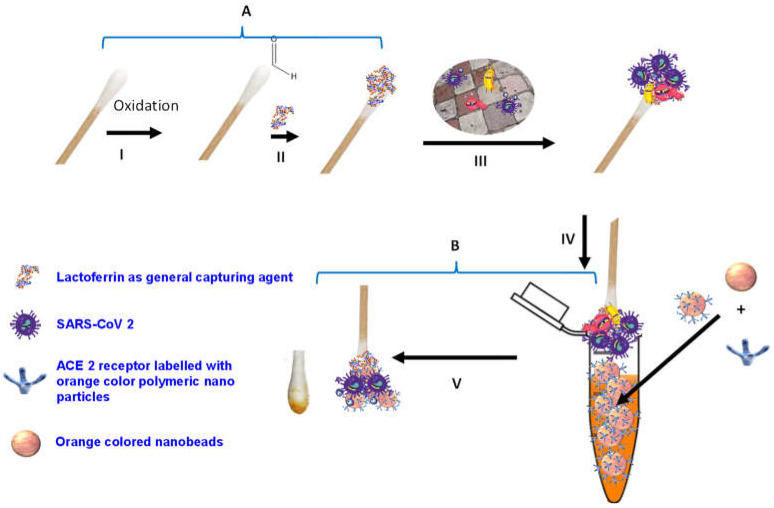
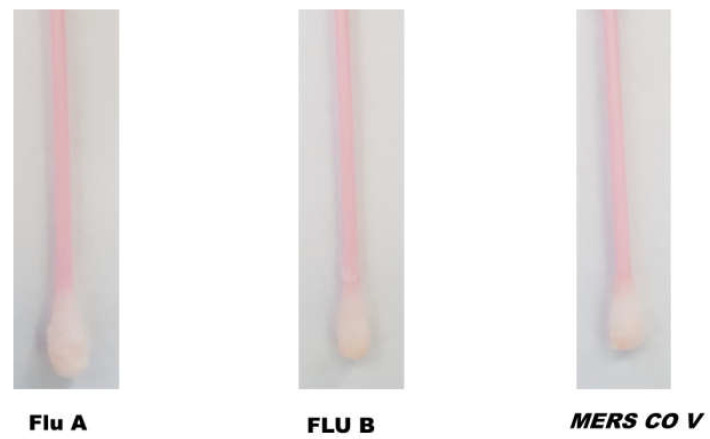
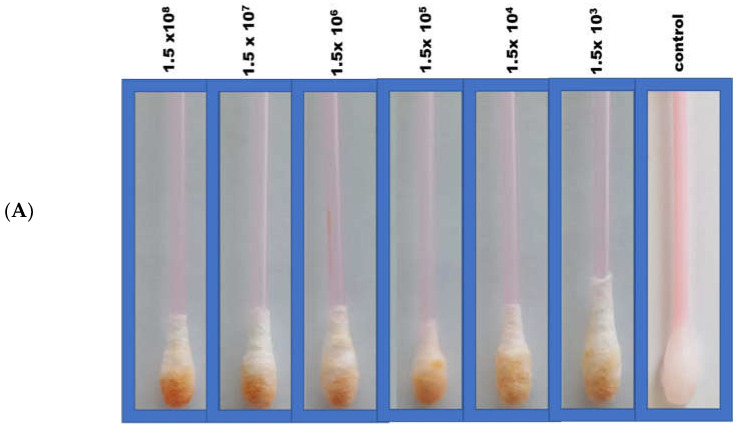
Simple, timely, and precise detection of SARS-CoV-2 in clinical samples and contaminated surfaces aids in lowering attendant morbidity/mortality related to this infectious virus. Currently applied diagnostic techniques depend on a timely laboratory report following PCR testing. However, the application of these tests is associated with inherent shortcomings due to the need for trained personnel, long-time centralized laboratories, and expensive instruments. Therefore, there is an interest in developing biosensing diagnostic frontiers that can help in eliminating these shortcomings with a relatively economical, easy-to-use, well-timed, precise and sensitive technology. This study reports the development of fabricated Q-tips designed to qualitatively and semi-quantitatively detect SARS-CoV-2 in clinical samples and contaminated non-absorbable surfaces. This colorimetric sensor is engineered to sandwich SARS-CoV-2 spike protein between the lactoferrin general capturing agent and the complementary ACE2-labeled receptor. The ACE2 receptor is decorated with an orange-colored polymeric nanoparticle to generate an optical visual signal upon pairing with the SARS-CoV-2 spike protein. This colorimetric change of the Q-tip testing zone from white to orange confirms a positive result. The visual detection limit of the COVID-19 engineered colorimetric Q-tip sensor was 100 pfu/mL within a relatively short turnaround time of 5 min. The linear working range of quantitation was 10-10 pfu/mL. The engineered sensor selectively targeted SARS-CoV-2 spike protein and did not bind to another coronavirus such as MERS-CoV, Flu A, or Flu B present on the contaminated surface. This novel detection tool is relatively cheap to produce and suitable for onsite detection of COVID-19 infection.
简单、及时、准确地检测临床样本和污染表面中的 SARS-CoV-2,有助于降低与这种传染性病毒相关的发病率/死亡率。目前应用的诊断技术依赖于 PCR 检测后的及时实验室报告。然而,由于需要经过培训的人员、长时间的集中式实验室和昂贵的仪器,这些测试的应用存在固有缺陷。因此,人们有兴趣开发生物传感诊断前沿技术,以帮助消除这些缺陷,同时采用相对经济、易于使用、及时、精确和敏感的技术。本研究报告了设计的 Q-tip 的开发,旨在定性和半定量地检测临床样本和污染的不可吸收表面中的 SARS-CoV-2。这种比色传感器设计用于将 SARS-CoV-2 刺突蛋白夹在乳铁蛋白通用捕获剂和互补 ACE2 标记的受体之间。ACE2 受体用橙色聚合物纳米颗粒进行修饰,在与 SARS-CoV-2 刺突蛋白配对时会产生光学视觉信号。Q-tip 测试区从白色变为橙色的比色变化证实了阳性结果。COVID-19 工程比色 Q-tip 传感器的视觉检测限为 100 pfu/mL,在相对较短的 5 分钟周转时间内。定量的线性工作范围为 10-10 pfu/mL。工程传感器选择性地针对 SARS-CoV-2 刺突蛋白,而不会与污染表面上存在的另一种冠状病毒(如 MERS-CoV、Flu A 或 Flu B)结合。这种新型检测工具生产成本相对较低,适合现场检测 COVID-19 感染。