Unni Elizabeth, Bae Sun
Department of Social, Behavioral, and Administrative Sciences, Touro College of Pharmacy, 230 West 125th Street, Room 505, New York, NY 10027, USA.
Eshelman School of Pharmacy, University of North Carolina at Chapel Hill, 301 Pharmacy Lane, Chapel Hill, NC 27599, USA.
Pharmacy (Basel). 2022 Apr 1;10(2):43. doi: 10.3390/pharmacy10020043.
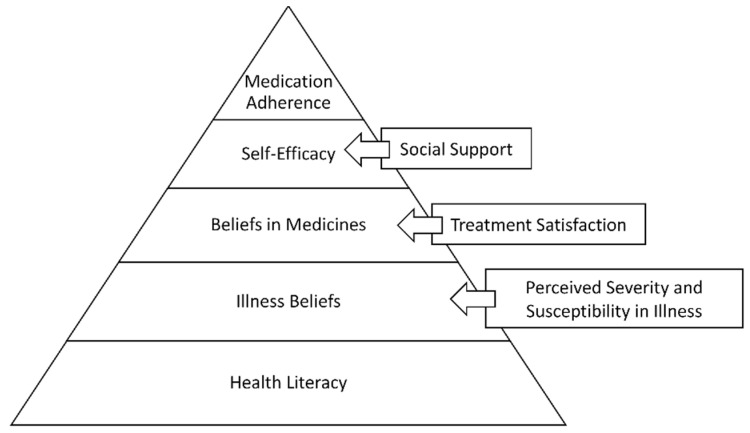
Medication adherence is essential for optimal therapeutic outcomes. However, non-adherence with long-term therapy is at 50%. Several theoretical models have identified several key factors that could explain medication adherence. Though numerous interventions have been developed based on these theoretical models, the success rates with interventions are not the best. This paper proposes a new Hierarchical Model for Medication Adherence. In this model, we propose medication adherence as a five-tier model with medication adherence as the desirable behavior on the top of the pyramid. From the bottom of the hierarchy upwards, the skills/beliefs/behaviors to be achieved are: health literacy, belief in illness (impacted by perceived susceptibility and severity of illness), belief in medicines (impacted by treatment satisfaction), and self-efficacy (impacted by social support). The model further proposes that each individual will achieve or already have these skills/beliefs/behaviors at various levels. Screening patients for these benchmarks will enable providers to decide where to target interventions.
药物依从性对于实现最佳治疗效果至关重要。然而,长期治疗的不依从率达50%。几种理论模型已确定了几个可解释药物依从性的关键因素。尽管基于这些理论模型已开发出多种干预措施,但干预措施的成功率并不理想。本文提出了一种新的药物依从性分层模型。在该模型中,我们将药物依从性提议为一个五层模型,药物依从性是金字塔顶端的理想行为。从层次结构的底部向上,要实现的技能/信念/行为依次为:健康素养、对疾病的信念(受感知到的易感性和疾病严重程度影响)、对药物的信念(受治疗满意度影响)以及自我效能感(受社会支持影响)。该模型进一步提出,每个人在不同层面上会实现或已经具备这些技能/信念/行为。对患者进行这些基准筛查将使医疗服务提供者能够决定干预的目标方向。