• 文献检索
  • 文档翻译
  • 深度研究
  • 学术资讯
  • Suppr Zotero 插件Zotero 插件
  • 邀请有礼
  • 套餐&价格
  • 历史记录
应用&插件
Suppr Zotero 插件Zotero 插件浏览器插件Mac 客户端Windows 客户端微信小程序
定价
高级版会员购买积分包购买API积分包
服务
文献检索文档翻译深度研究API 文档MCP 服务
关于我们
关于 Suppr公司介绍联系我们用户协议隐私条款
关注我们

Suppr 超能文献

核心技术专利:CN118964589B侵权必究
粤ICP备2023148730 号-1Suppr @ 2026

文献检索

告别复杂PubMed语法,用中文像聊天一样搜索,搜遍4000万医学文献。AI智能推荐,让科研检索更轻松。

立即免费搜索

文件翻译

保留排版,准确专业,支持PDF/Word/PPT等文件格式,支持 12+语言互译。

免费翻译文档

深度研究

AI帮你快速写综述,25分钟生成高质量综述,智能提取关键信息,辅助科研写作。

立即免费体验

经气管滴注后大鼠肺部的双层碳纳米管的毒性和致癌性评估:一项为期两年的研究。

Assessment of the toxicity and carcinogenicity of double-walled carbon nanotubes in the rat lung after intratracheal instillation: a two-year study.

机构信息

Nanotoxicology Lab Project, Nagoya City University, 3-1 Tanabe-Dohri, Mizuho-ku, Nagoya, 467-8603, Japan.

Department of Experimental Pathology and Tumor Biology, Graduate School of Medical Sciences, Nagoya City University, Nagoya, Japan.

出版信息

Part Fibre Toxicol. 2022 Apr 22;19(1):30. doi: 10.1186/s12989-022-00469-8.

DOI:10.1186/s12989-022-00469-8
PMID:35449069
原文链接:https://pmc.ncbi.nlm.nih.gov/articles/PMC9026941/
Abstract

BACKGROUND

Considering the expanding industrial applications of carbon nanotubes (CNTs), safety assessment of these materials is far less than needed. Very few long-term in vivo studies have been carried out. This is the first 2-year in vivo study to assess the effects of double walled carbon nanotubes (DWCNTs) in the lung and pleura of rats after pulmonary exposure.

METHODS

Rats were divided into six groups: untreated, Vehicle, 3 DWCNT groups (0.12 mg/rat, 0.25 mg/rat and 0.5 mg/rat), and MWCNT-7 (0.5 mg/rat). The test materials were administrated by intratracheal-intrapulmonary spraying (TIPS) every other day for 15 days. Rats were observed without further treatment until sacrifice.

RESULTS

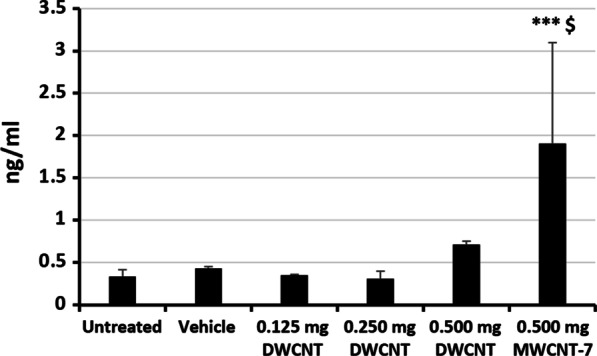
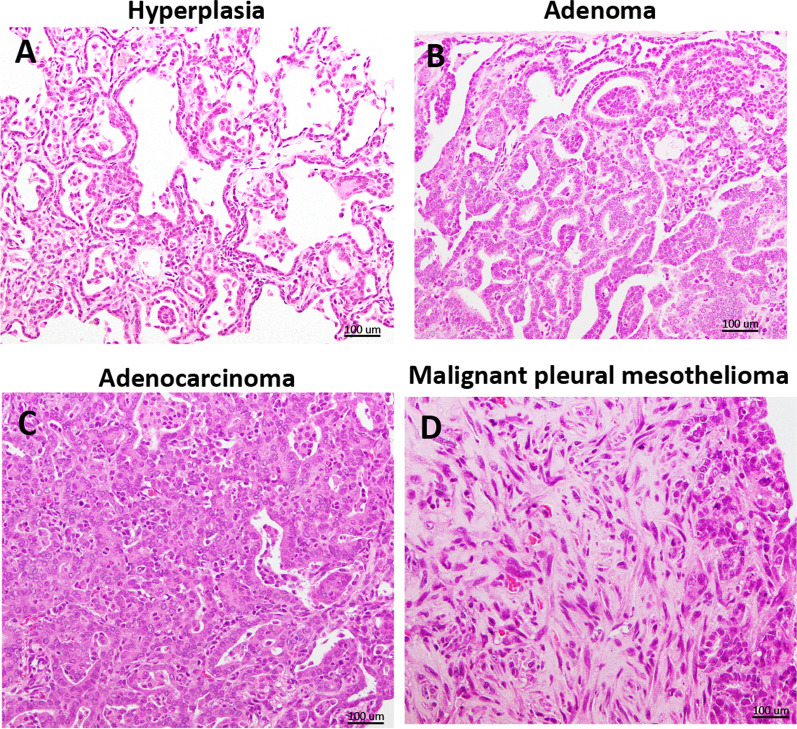
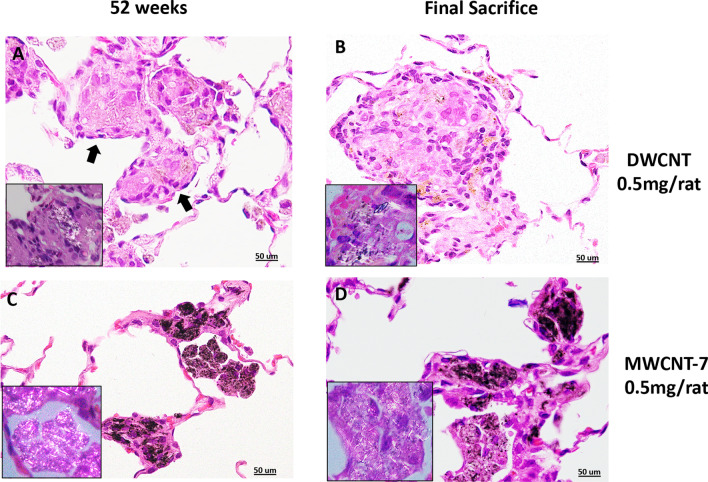
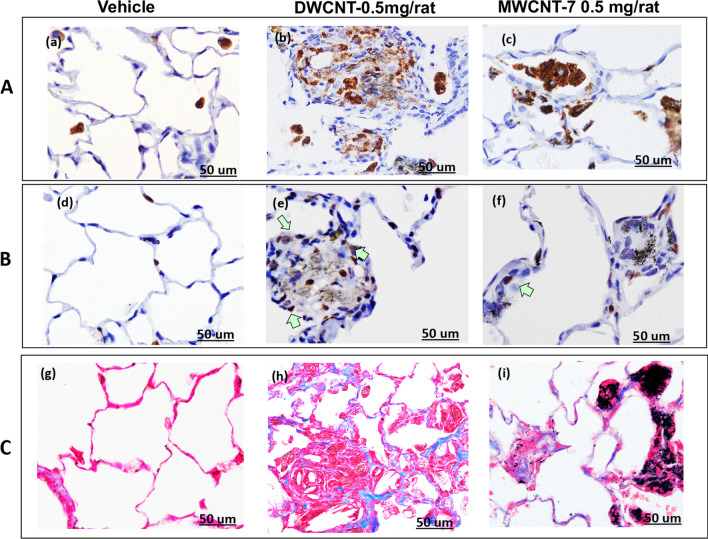
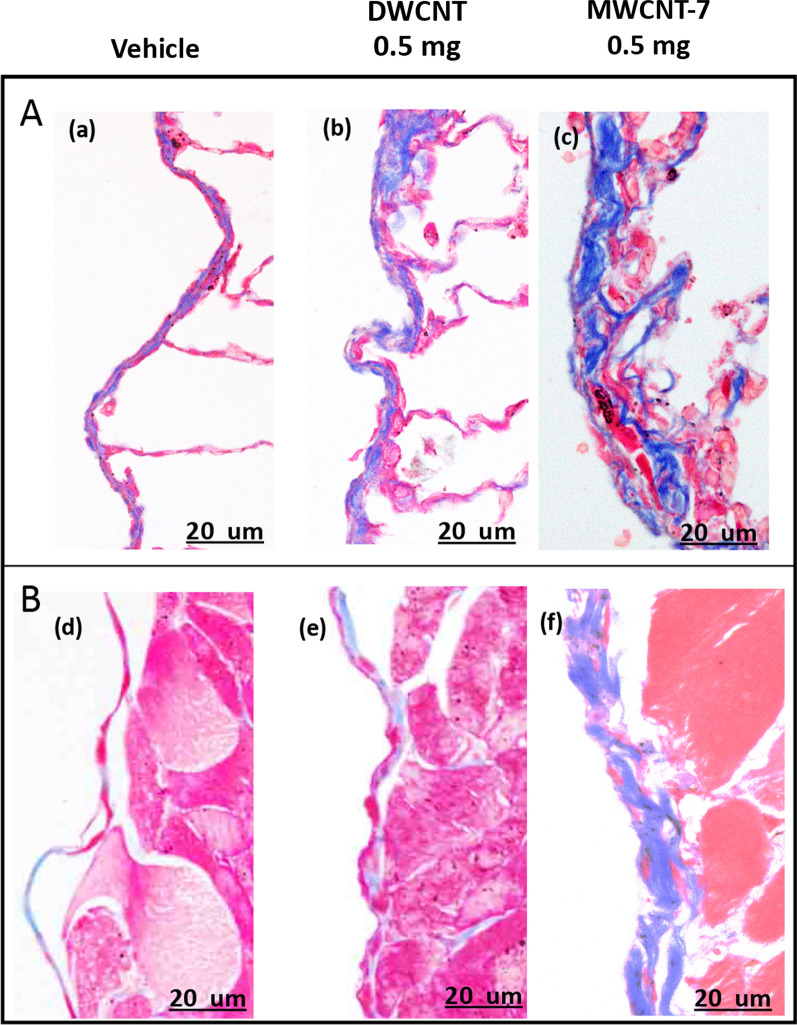
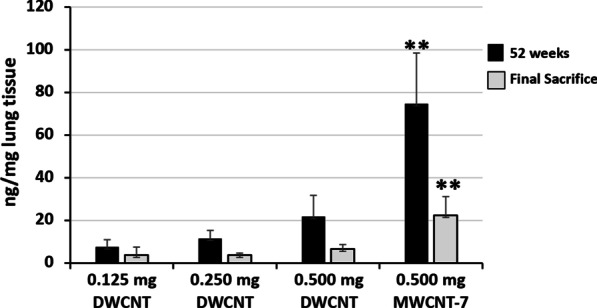
DWCNT were biopersistent in the rat lung and induced marked pulmonary inflammation with a significant increase in macrophage count and levels of the chemotactic cytokines CCL2 and CCL3. In addition, the 0.5 mg DWCNT treated rats had significantly higher pulmonary collagen deposition compared to the vehicle controls. The development of carcinomas in the lungs of rats treated with 0.5 mg DWCNT (4/24) was not quite statistically higher (p = 0.0502) than the vehicle control group (0/25), however, the overall incidence of lung tumor development, bronchiolo-alveolar adenoma and bronchiolo-alveolar carcinoma combined, in the lungs of rats treated with 0.5 mg DWCNT (7/24) was statistically higher (p < 0.05) than the vehicle control group (1/25). Notably, two of the rats treated with DWCNT, one in the 0.25 mg group and one in the 0.5 mg group, developed pleural mesotheliomas. However, both of these lesions developed in the visceral pleura, and unlike the rats administered MWCNT-7, rats administered DWCNT did not have elevated levels of HMGB1 in their pleural lavage fluids. This indicates that the mechanism by which the mesotheliomas that developed in the DWCNT treated rats is not relevant to humans.

CONCLUSIONS

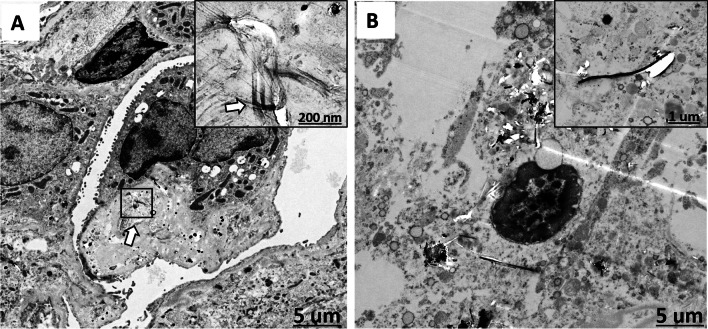
Our results demonstrate that the DWCNT fibers we tested are biopersistent in the rat lung and induce chronic inflammation. Rats treated with 0.5 mg DWCNT developed pleural fibrosis and lung tumors. These findings demonstrate that the possibility that at least some types of DWCNTs are fibrogenic and tumorigenic cannot be ignored.

摘要

背景

考虑到碳纳米管(CNTs)在工业应用中的不断扩大,对这些材料的安全评估远远不够。很少有长期的体内研究。这是首次对肺部暴露后大鼠双层碳纳米管(DWCNTs)在肺和胸膜中的影响进行为期 2 年的体内研究。

方法

将大鼠分为六组:未处理组、对照组、3 个 DWCNT 组(0.12mg/rat、0.25mg/rat 和 0.5mg/rat)和 MWCNT-7 组(0.5mg/rat)。通过气管内肺喷雾(TIPS)每隔一天给药 15 天。大鼠在没有进一步治疗的情况下观察到处死。

结果

DWCNT 在大鼠肺部具有生物持久性,并引起明显的肺部炎症,巨噬细胞计数和趋化因子 CCL2 和 CCL3 的水平显著增加。此外,与对照组相比,0.5mg DWCNT 处理的大鼠肺胶原沉积明显升高。与对照组(0/25)相比,0.5mg DWCNT 处理的大鼠肺部(4/24)癌的发展并不统计学上更高(p=0.0502),但 0.5mg DWCNT 处理的大鼠肺部肿瘤发展、细支气管肺泡腺瘤和细支气管肺泡癌的总发生率(7/24)统计学上高于对照组(1/25)。值得注意的是,0.25mg 组和 0.5mg 组的 2 只 DWCNT 处理的大鼠发生了胸膜间皮瘤。然而,这两种病变均发生在脏层胸膜上,与给予 MWCNT-7 的大鼠不同,给予 DWCNT 的大鼠胸膜灌洗液中 HMGB1 水平没有升高。这表明在 DWCNT 处理的大鼠中发展的间皮瘤的机制与人类无关。

结论

我们的结果表明,我们测试的 DWCNT 纤维在大鼠肺部具有生物持久性,并引起慢性炎症。用 0.5mg DWCNT 处理的大鼠发生胸膜纤维化和肺肿瘤。这些发现表明,至少某些类型的 DWCNTs 具有纤维发生和肿瘤发生的可能性不容忽视。
https://cdn.ncbi.nlm.nih.gov/pmc/blobs/dc5b/9026941/efba7f76b3fe/12989_2022_469_Fig10_HTML.jpg
https://cdn.ncbi.nlm.nih.gov/pmc/blobs/dc5b/9026941/b82c8b950dcd/12989_2022_469_Fig1_HTML.jpg
https://cdn.ncbi.nlm.nih.gov/pmc/blobs/dc5b/9026941/82ddcc5e9f14/12989_2022_469_Fig2_HTML.jpg
https://cdn.ncbi.nlm.nih.gov/pmc/blobs/dc5b/9026941/41890af05c2f/12989_2022_469_Fig3_HTML.jpg
https://cdn.ncbi.nlm.nih.gov/pmc/blobs/dc5b/9026941/fbc9d406ec1e/12989_2022_469_Fig4_HTML.jpg
https://cdn.ncbi.nlm.nih.gov/pmc/blobs/dc5b/9026941/cda63db16800/12989_2022_469_Fig5_HTML.jpg
https://cdn.ncbi.nlm.nih.gov/pmc/blobs/dc5b/9026941/fd6058cfbb24/12989_2022_469_Fig6_HTML.jpg
https://cdn.ncbi.nlm.nih.gov/pmc/blobs/dc5b/9026941/21ec782fdf4b/12989_2022_469_Fig7_HTML.jpg
https://cdn.ncbi.nlm.nih.gov/pmc/blobs/dc5b/9026941/d44f37bc2d76/12989_2022_469_Fig8_HTML.jpg
https://cdn.ncbi.nlm.nih.gov/pmc/blobs/dc5b/9026941/1600da5868dd/12989_2022_469_Fig9_HTML.jpg
https://cdn.ncbi.nlm.nih.gov/pmc/blobs/dc5b/9026941/efba7f76b3fe/12989_2022_469_Fig10_HTML.jpg
https://cdn.ncbi.nlm.nih.gov/pmc/blobs/dc5b/9026941/b82c8b950dcd/12989_2022_469_Fig1_HTML.jpg
https://cdn.ncbi.nlm.nih.gov/pmc/blobs/dc5b/9026941/82ddcc5e9f14/12989_2022_469_Fig2_HTML.jpg
https://cdn.ncbi.nlm.nih.gov/pmc/blobs/dc5b/9026941/41890af05c2f/12989_2022_469_Fig3_HTML.jpg
https://cdn.ncbi.nlm.nih.gov/pmc/blobs/dc5b/9026941/fbc9d406ec1e/12989_2022_469_Fig4_HTML.jpg
https://cdn.ncbi.nlm.nih.gov/pmc/blobs/dc5b/9026941/cda63db16800/12989_2022_469_Fig5_HTML.jpg
https://cdn.ncbi.nlm.nih.gov/pmc/blobs/dc5b/9026941/fd6058cfbb24/12989_2022_469_Fig6_HTML.jpg
https://cdn.ncbi.nlm.nih.gov/pmc/blobs/dc5b/9026941/21ec782fdf4b/12989_2022_469_Fig7_HTML.jpg
https://cdn.ncbi.nlm.nih.gov/pmc/blobs/dc5b/9026941/d44f37bc2d76/12989_2022_469_Fig8_HTML.jpg
https://cdn.ncbi.nlm.nih.gov/pmc/blobs/dc5b/9026941/1600da5868dd/12989_2022_469_Fig9_HTML.jpg
https://cdn.ncbi.nlm.nih.gov/pmc/blobs/dc5b/9026941/efba7f76b3fe/12989_2022_469_Fig10_HTML.jpg

相似文献

1
Assessment of the toxicity and carcinogenicity of double-walled carbon nanotubes in the rat lung after intratracheal instillation: a two-year study.经气管滴注后大鼠肺部的双层碳纳米管的毒性和致癌性评估:一项为期两年的研究。
Part Fibre Toxicol. 2022 Apr 22;19(1):30. doi: 10.1186/s12989-022-00469-8.
2
Comparative pulmonary toxicity of a DWCNT and MWCNT-7 in rats.大鼠体内 DWCNT 和 MWCNT-7 的比较肺毒性。
Arch Toxicol. 2019 Jan;93(1):49-59. doi: 10.1007/s00204-018-2336-3. Epub 2018 Oct 19.
3
Comparative carcinogenicity study of a thick, straight-type and a thin, tangled-type multi-walled carbon nanotube administered by intra-tracheal instillation in the rat.经气管内滴注给予大鼠的厚直型和细缠结型多壁碳纳米管的比较致癌性研究。
Part Fibre Toxicol. 2020 Oct 15;17(1):48. doi: 10.1186/s12989-020-00382-y.
4
Carcinogenic effect of potassium octatitanate (POT) fibers in the lung and pleura of male Fischer 344 rats after intrapulmonary administration.八钛酸钾(POT)纤维经气管内染尘对雄性 F344 大鼠肺和胸膜的致癌作用。
Part Fibre Toxicol. 2019 Sep 2;16(1):34. doi: 10.1186/s12989-019-0316-2.
5
Two-year intermittent exposure of a multiwalled carbon nanotube by intratracheal instillation induces lung tumors and pleural mesotheliomas in F344 rats.经气管滴注方式给予 F344 大鼠为期两年的多壁碳纳米管间歇性暴露,可诱导其肺部产生肿瘤和胸膜间皮瘤。
Part Fibre Toxicol. 2022 May 19;19(1):38. doi: 10.1186/s12989-022-00478-7.
6
MWCNT-7 administered to the lung by intratracheal instillation induces development of pleural mesothelioma in F344 rats.经气管内滴注给予肺部的 MWCNT-7 可诱导 F344 大鼠发生胸膜间皮瘤。
Cancer Sci. 2019 Aug;110(8):2485-2492. doi: 10.1111/cas.14121. Epub 2019 Jul 25.
7
Multiwalled carbon nanotubes intratracheally instilled into the rat lung induce development of pleural malignant mesothelioma and lung tumors.经气管内注入大鼠肺部的多壁碳纳米管可诱发胸膜恶性间皮瘤和肺部肿瘤的发生。
Cancer Sci. 2016 Jul;107(7):924-35. doi: 10.1111/cas.12954. Epub 2016 Jun 23.
8
Promotion of lung adenocarcinoma following inhalation exposure to multi-walled carbon nanotubes.吸入多壁碳纳米管后促进肺腺癌发生
Part Fibre Toxicol. 2014 Jan 9;11:3. doi: 10.1186/1743-8977-11-3.
9
Investigation of the pulmonary bioactivity of double-walled carbon nanotubes.研究双壁碳纳米管的肺部生物活性。
J Toxicol Environ Health A. 2013;76(15):922-36. doi: 10.1080/15287394.2013.825571.
10
Pulmonary and pleural inflammation after intratracheal instillation of short single-walled and multi-walled carbon nanotubes.气管内滴注短单壁和多壁碳纳米管后肺部和胸膜炎症
Toxicol Lett. 2016 Aug 22;257:23-37. doi: 10.1016/j.toxlet.2016.05.025. Epub 2016 May 31.

引用本文的文献

1
Comparison of Lung Inflammatory and Transcriptional Responses in Mice and Rats Following Pulmonary Exposure to a Fiber Paradigm-Compatible and Non-Compatible MWCNT.肺部暴露于纤维模式兼容和不兼容的多壁碳纳米管后小鼠和大鼠肺部炎症及转录反应的比较
Nanomaterials (Basel). 2025 Sep 4;15(17):1364. doi: 10.3390/nano15171364.
2
Nanoparticles for Cancer Immunotherapy: Innovations and Challenges.用于癌症免疫治疗的纳米颗粒:创新与挑战
Pharmaceuticals (Basel). 2025 Jul 22;18(8):1086. doi: 10.3390/ph18081086.
3
Dynamic QSAR modeling for predicting in vivo genotoxicity and inflammation induced by nanoparticles and advanced materials: a time-dose-property/response approach.

本文引用的文献

1
Spontaneous Primary Pleural Mesothelioma in Fischer 344 (F344) and Other Rat Strains: A Retrospective Review.自发性原发性胸膜间皮瘤在 Fischer 344(F344)和其他大鼠品系中的表现:一项回顾性研究。
Toxicol Pathol. 2022 Feb;50(2):167-175. doi: 10.1177/01926233211053631. Epub 2021 Nov 2.
2
Occupational Exposure to Carbon Nanotubes and Carbon Nanofibres: More Than a Cobweb.职业性接触碳纳米管和碳纳米纤维:不止是蛛丝马迹。
Nanomaterials (Basel). 2021 Mar 16;11(3):745. doi: 10.3390/nano11030745.
3
Assessment of the Carcinogenicity of Carbon Nanotubes in the Respiratory System.
用于预测纳米颗粒和先进材料诱导的体内遗传毒性和炎症的动态定量构效关系建模:一种时间-剂量-性质/反应方法。
J Nanobiotechnology. 2025 Jun 6;23(1):420. doi: 10.1186/s12951-025-03510-y.
4
Critical values for dimensional parameters of mesotheliomagenic mineral fibers: evidence from the dimensions and rigidity of MWCNT.间皮瘤致癌矿物纤维尺寸参数的临界值:来自多壁碳纳米管尺寸和刚性的证据。
Front Toxicol. 2025 Apr 22;7:1568513. doi: 10.3389/ftox.2025.1568513. eCollection 2025.
5
Safety of Mechanically Fibrillated Cellulose Nanofibers (CNFs) by Inhalation Exposure Based on TG412.基于TG412通过吸入暴露评估机械原纤化纤维素纳米纤维(CNFs)的安全性。
Nanomaterials (Basel). 2025 Jan 28;15(3):214. doi: 10.3390/nano15030214.
6
A Review of the Carcinogenic Potential of Thick Rigid and Thin Flexible Multi-Walled Carbon Nanotubes in the Lung.厚壁刚性和薄壁柔性多壁碳纳米管在肺部致癌潜力的综述
Nanomaterials (Basel). 2025 Jan 22;15(3):168. doi: 10.3390/nano15030168.
7
Fullerene and fullerene whisker are not carcinogenic to the lungs and pleura in rat long-term study after 2-week intra-tracheal intrapulmonary administration.富勒烯和富勒烯晶须经气管内支气管内 2 周给药的大鼠长期研究,肺部和胸膜无致癌性。
Arch Toxicol. 2024 Dec;98(12):4143-4158. doi: 10.1007/s00204-024-03863-7. Epub 2024 Sep 13.
8
Time-Course of Transcriptomic Change in the Lungs of F344 Rats Repeatedly Exposed to a Multiwalled Carbon Nanotube in a 2-Year Test.在一项为期两年的试验中,F344大鼠肺部反复暴露于多壁碳纳米管后转录组变化的时间进程。
Nanomaterials (Basel). 2023 Jul 19;13(14):2105. doi: 10.3390/nano13142105.
9
Single-Walled vs. Multi-Walled Carbon Nanotubes: Influence of Physico-Chemical Properties on Toxicogenomics Responses in Mouse Lungs.单壁碳纳米管与多壁碳纳米管:物理化学性质对小鼠肺部毒理基因组学反应的影响
Nanomaterials (Basel). 2023 Mar 15;13(6):1059. doi: 10.3390/nano13061059.
10
Carbon Nanotubes as Carriers in Drug Delivery for Non-Small Cell Lung Cancer, Mechanistic Analysis of Their Carcinogenic Potential, Safety Profiling and Identification of Biomarkers.碳纳米管作为非小细胞肺癌药物递送载体:致癌潜力的机制分析、安全性评估和生物标志物鉴定。
Int J Nanomedicine. 2022 Dec 8;17:6157-6180. doi: 10.2147/IJN.S384592. eCollection 2022.
碳纳米管在呼吸系统中的致癌性评估。
Cancers (Basel). 2021 Mar 15;13(6):1318. doi: 10.3390/cancers13061318.
4
Comparative carcinogenicity study of a thick, straight-type and a thin, tangled-type multi-walled carbon nanotube administered by intra-tracheal instillation in the rat.经气管内滴注给予大鼠的厚直型和细缠结型多壁碳纳米管的比较致癌性研究。
Part Fibre Toxicol. 2020 Oct 15;17(1):48. doi: 10.1186/s12989-020-00382-y.
5
Asbestos induces mesothelial cell transformation via HMGB1-driven autophagy.石棉通过 HMGB1 驱动的自噬诱导间皮细胞转化。
Proc Natl Acad Sci U S A. 2020 Oct 13;117(41):25543-25552. doi: 10.1073/pnas.2007622117. Epub 2020 Sep 30.
6
SIN List criticism based on misunderstandings.避免基于误解的批评。
Nat Nanotechnol. 2020 Jun;15(6):418. doi: 10.1038/s41565-020-0692-7.
7
Microenvironmental Alterations in Carbon Nanotube-Induced Lung Inflammation and Fibrosis.碳纳米管诱导的肺部炎症和纤维化中的微环境改变
Front Cell Dev Biol. 2020 Feb 28;8:126. doi: 10.3389/fcell.2020.00126. eCollection 2020.
8
Banning carbon nanotubes would be scientifically unjustified and damaging to innovation.禁止碳纳米管在科学上是不合理的,并且会损害创新。
Nat Nanotechnol. 2020 Mar;15(3):164-166. doi: 10.1038/s41565-020-0656-y.
9
Expert workshop on the hazards and risks of poorly soluble low toxicity particles.专家研讨会:低毒性难溶性颗粒的危害与风险
Inhal Toxicol. 2020 Feb;32(2):53-62. doi: 10.1080/08958378.2020.1735581. Epub 2020 Mar 9.
10
Grouping all carbon nanotubes into a single substance category is scientifically unjustified.将所有碳纳米管归为单一物质类别在科学上是不合理的。
Nat Nanotechnol. 2020 Mar;15(3):164. doi: 10.1038/s41565-020-0654-0.